Northwestern Medicine Healthcare AI Forum -- November 21, 2025
Keywords
Summary
147 words
Critical Evaluation
Value of the Information & Strength of the Argument
The presentation provides valuable insights into the application of genomic language models for enhancer prediction, a challenging problem in genomics. The argumentation is solid, with a clear logical flow from biological background to methodological details and validation. The speaker supports her claims with quantitative results (accuracy, MCC, validation percentages) and comparisons to existing methods. She also acknowledges limitations, such as the difficulty in distinguishing enhancers from other open chromatin regions, which adds credibility. The work is novel in its use of DNABERT for enhancer prediction and its integration with variant effect prediction.
Scientific Rigor, Source Quality, Title Accuracy
The presentation demonstrates scientific rigor through the use of established datasets (ENCODE, VISTA, etc.) and external validation. The speaker cites several published studies (e.g., Wang et al. 2023, Nature Communications 2024) and mentions her own model (DeepVur) under review. The title accurately reflects the content. The talk is well-structured and the methodology is transparent. However, as a single presentation, it lacks peer review, and some predictions (e.g., 1.82 million enhancers) may be overestimates. The speaker does not discuss potential biases in the training data or the generalizability of the model to other species.
200 words
Title / Content Match
The title accurately reflects the content, which focuses on genomic language modeling for enhancer prediction and allele-specific activity.
Quality & Reliability
8/10
The presentation is a detailed account of original research, with clear methodology, validation against external databases, and references to published studies. The speaker is a PhD student supervised by a known researcher, and the work is grounded in established resources like ENCODE. However, the talk is a single presentation without peer review visible in the video, and some claims (e.g., 1.82 million enhancers) are based on model predictions that may have limitations.
Key Moments
Markers derived by PSI from the transcript: the creator did not define chapters.
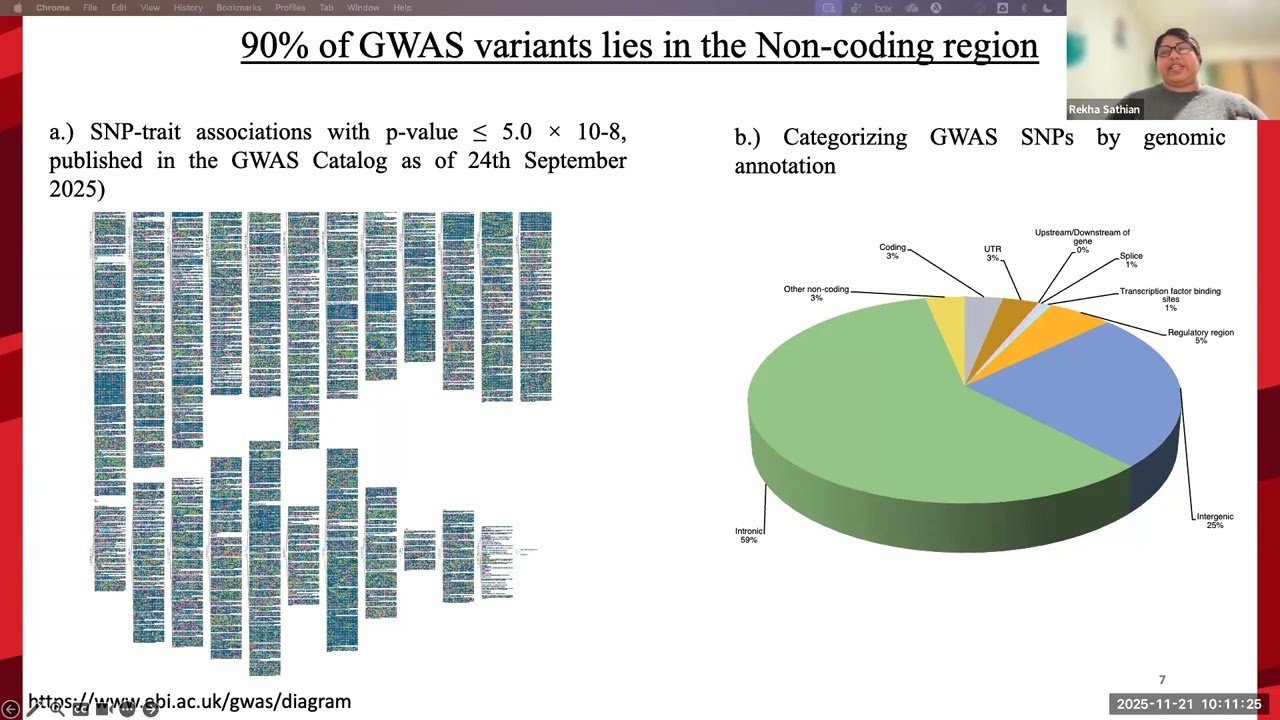
- Introduction to the importance of non-coding DNA and enhancers in gene regulation.
- Discussion of enhanceropathies and examples of enhancer mutations in diseases.
- Overview of computational methods for enhancer prediction, including feature-based, deep learning, and NLP-inspired models.
- Introduction to DNABERT and its architecture, and extensions like DNABERT-2 and DNABERT-S.
- Description of the dataset curation from ENCODE and the fine-tuning process for DNABERT-Enhancer.
- Performance evaluation of DNABERT-Enhancer models, including accuracy and comparison with other methods.
- Genome-wide application of the model, predicting ~1.82 million enhancers and validation against external databases.
- Identification of long enhancer regions and their biological significance.
- Application to predict allele-specific effects of genetic variants on enhancer activity.
- Therapeutic implications, including enhancer editing and targeting super-enhancers in cancer.
Cited Sources
- ENCODE Project — Used as the primary source for enhancer annotations and training data.
- DNABERT — Pre-trained model used as the base for fine-tuning.
- VISTA Enhancer Browser — Used for validation of predicted enhancers.
- SCREEN (ENCODE) — Registry of candidate cis-regulatory elements used for enhancer annotations.
- Wang et al. 2023, Genome Biology — Study on enhancer mutations in melanoma.
Concurring Sources
- ENCODE — Provides experimental data supporting enhancer annotations.
- VISTA Enhancer Browser — Validated enhancers that overlap with predictions.
- EnhancerAtlas — External database used for validation.
Dissenting Sources
- Potential overprediction of enhancers — The model predicts 1.82 million enhancers, which may include false positives due to the lack of functional validation for all predictions.
Contribution & Novelties
The presentation introduces DNABERT-Enhancer, a novel fine-tuned genomic language model for enhancer prediction that leverages contextual embeddings from DNABERT. The model outperforms existing methods and provides genome-wide predictions with high validation rates. The work also integrates variant effect prediction, offering a tool to interpret non-coding variants in enhancers. This contributes to the growing field of genomic language models and their application in regulatory genomics.
Pour aller plus loin :
- DNABERT-2 — A multi-species genomic language model with improved tokenization.
- EnhancerAtlas 2.0 — A comprehensive database of enhancers and their target genes.
- DeepVur — A model for predicting functionally disruptive variants (note: URL is illustrative, not verified).
106 words
Radar Profile
The radar profile shows high scores across all dimensions, indicating a well-rounded presentation with strong technical depth, reliable sources, and substantial information content. The lowest score is in 'quantite_information' relative to others, but it is still high, reflecting the focused scope of the talk.
💬 No comments were provided for analysis.