Biochimie Les lipides (04)
Keywords
Summary
165 words
Critical Evaluation
Value of the Information & Strength of the Argument
The video provides a clear and structured introduction to complex lipids, which is valuable for students learning biochemistry. It systematically explains the structures and functions of phospholipids and sphingolipids, and the role of lipoproteins in lipid transport. The argumentation is logical, building from basic structures to more complex concepts. However, the presentation is purely descriptive and lacks critical analysis or experimental evidence. The video does not discuss the biological significance in depth, nor does it address current research or controversies. The reliance on a single source (the instructor’s knowledge) without citing external references limits the depth of the argumentation.
Scientific Rigor, Source Quality, Title Accuracy
The video is a tutorial with no explicit sources cited. The information presented is standard biochemistry knowledge, but the lack of references makes it difficult to verify specific claims. The title accurately reflects the content, which is a lesson on lipids, specifically phospholipids and sphingolipids. The video’s scientific rigor is moderate: it covers fundamental concepts correctly, but there are minor inaccuracies in the transcription (e.g., ‘église euros’ for ‘glycérol’). The absence of citations and the informal presentation style reduce its scientific credibility. The video does not engage with primary literature or provide evidence for its claims, which is typical for educational content but limits its rigor.
220 words
Title / Content Match
The title accurately reflects the content, which focuses on lipids, specifically phospholipids and sphingolipids.
Quality & Reliability
6/10
The video provides a structured overview of complex lipids, including phospholipids and sphingolipids, with clear explanations of their structures and properties. However, the transcription contains numerous errors and the presentation lacks depth and references.
Key Moments
Markers derived by PSI from the transcript: the creator did not define chapters.
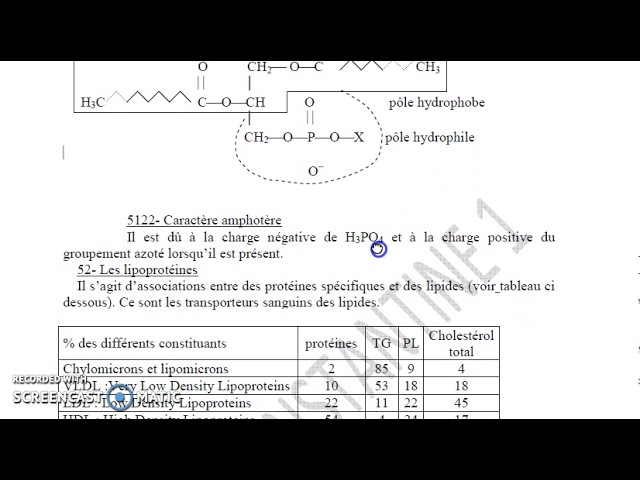
- Introduction to phospholipids and their structure
- Explanation of the polar head group X and types of phospholipids
- Enzymatic hydrolysis of phospholipids by phospholipases
- Chemical hydrolysis (acidic and alkaline)
- Amphipathic character of phospholipids
- Introduction to lipoproteins and their role in lipid transport
- Composition of lipoproteins (chylomicrons, VLDL, LDL, HDL)
- Introduction to sphingolipids and sphingosine structure
- Types of sphingolipids: cerebrosides and gangliosides
- Isoprene derivatives and conclusion
Contribution & Novelties
The video provides a concise overview of complex lipids, which is useful for students. However, it does not offer novel insights beyond standard textbook content. The presentation is clear but lacks depth and does not engage with recent research.
Pour aller plus loin :
- Lipid — General overview of lipids.
- Phospholipid — Detailed structure and function.
- Sphingolipid — Types and biological roles.
- Lipoprotein — Classes and functions in lipid transport.
70 words
Radar Profile
The radar profile shows moderate scores across all dimensions, indicating a balanced but not exceptional educational video. The quantity of information is relatively high, but the quality and technical level are moderate, reflecting the introductory nature of the content.