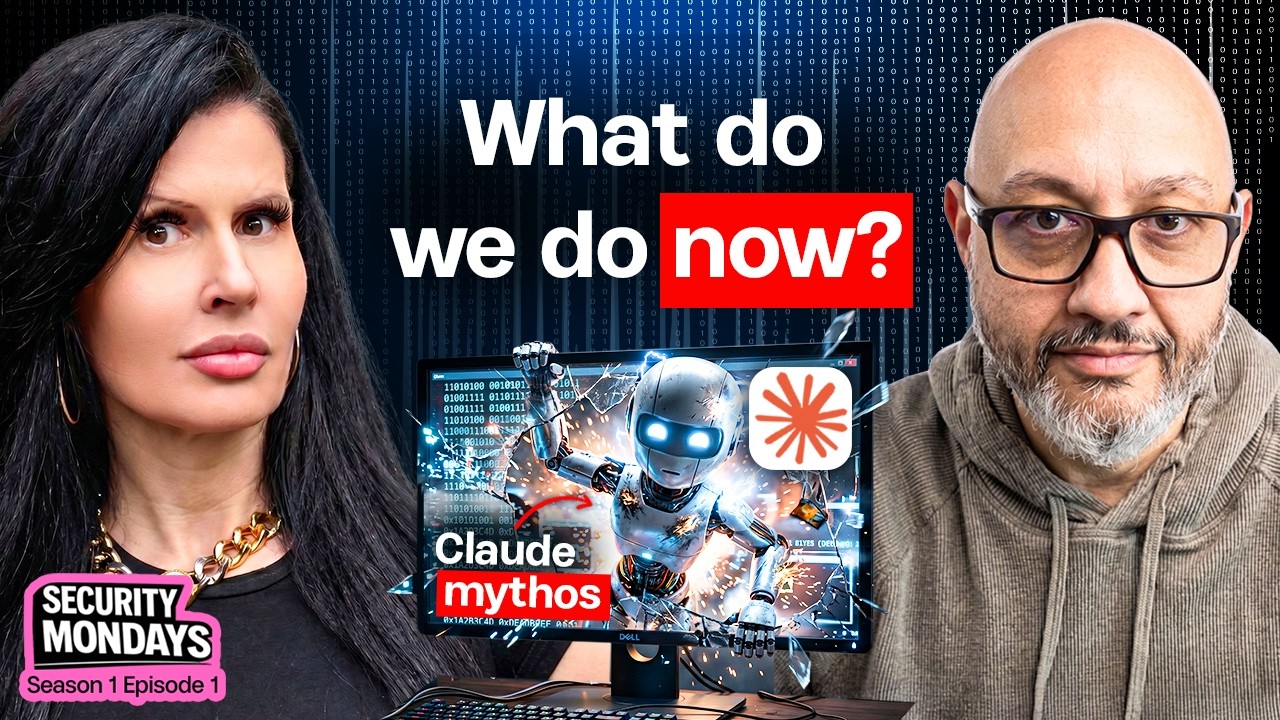
The Cybersecurity Skills You Need to Stay Relevant in 2026 | Rock Lambros | Security Mondays S1 Ep.1
Keywords
Summary
207 words
Critical Evaluation
Value of the Information & Strength of the Argument
The video provides substantial value by translating the Mythos release into actionable insights for security professionals. Lambros offers concrete frameworks, such as the five questions for leaders and a 90-day plan, which are directly applicable. His argumentation is solid, grounded in his extensive experience and references to real-world events and resources. He effectively argues that while AI will automate certain tasks, it will not eliminate the need for human judgment and contextual understanding. The discussion is balanced, acknowledging both the threats and opportunities presented by AI, and avoids sensationalism. The inclusion of specific tools and resources (e.g., OWASP, MITRE ATLAS, Promptfoo) enhances the practical value.
Scientific Rigor, Source Quality, Title Accuracy
The video demonstrates strong scientific rigor by referencing credible sources, including Anthropic’s official risk report and model card, as well as articles from TechCrunch, VentureBeat, and other reputable outlets. The sources are directly relevant to the discussion and are provided in the description for further reading. The title accurately reflects the content, focusing on the skills needed to stay relevant in cybersecurity. The discussion is well-structured and avoids unsupported claims, though some statements are based on personal experience and industry observations rather than formal studies. Overall, the sourcing is of high quality and enhances the video’s credibility.
217 words
Title / Content Match
The title accurately reflects the content, which focuses on the skills needed to stay relevant in cybersecurity as AI evolves.
Quality & Reliability
8/10
The video features a recognized expert (Rock Lambros) with extensive experience in AI security, and references credible sources such as Anthropic's official reports and major tech news outlets. The discussion is grounded in concrete examples and practical advice, though it is primarily opinion-based and lacks formal citations for all claims.
Key Moments
Markers derived by PSI from the transcript: the creator did not define chapters.
- Introduction to the episode and the topic of staying relevant in cybersecurity as AI evolves.
- Discussion of Anthropic's Mythos model and its implications for security teams.
- Rock Lambros explains which roles will contract and which will grow, emphasizing judgment and communication.
- Identification of critical skill gaps, including AI testing and identity governance for agents.
- Five questions every leader should ask their team to assess AI security posture.
- Advice on hiring beginners and training them in AI red teaming from day one.
- Practical resources for practitioners, including OWASP, MITRE ATLAS, and the Carlini loop.
- 90-day plan for practitioners to stay relevant, starting with OWASP and local models.
Cited Sources
- Anthropic Project Glasswing — Referenced as the project behind the Mythos model's capabilities.
- Anthropic Mythos system card and risk report — Mentioned as a detailed technical resource for understanding Mythos risks.
- Anthropic Frontier Red Team blog — Recommended for staying updated on AI red teaming research.
- NBC News article on Project Glasswing — Cited as a source for the limited release of Mythos.
- TechCrunch article on Mythos — Referenced for corrected organization count and security implications.
- VentureBeat article on Mythos — Cited for the claim that Mythos was deemed too dangerous to release.
- Fortune article on Mythos — Referenced for coverage of the Mythos model and cybersecurity implications.
- CyberScoop article on Project Glasswing — Mentioned as a source for the open-source software vulnerabilities found.
- Platformer article with Alex Stamos quote — Referenced for expert opinions on Mythos risks.
- Picus Security analysis of Glasswing Paradox — Cited for the 'Glasswing Paradox' analysis.
Concurring Sources
- OWASP Top 10 for LLM Applications — Aligns with the video's emphasis on AI-specific security risks and the need for red teaming.
- MITRE ATLAS — Provides a framework for AI attack techniques, supporting the video's recommendation for practitioners.
- Anthropic's Frontier Red Team blog — Supports the video's advice to follow Anthropic's research for staying updated.
Dissenting Sources
- None — No discordant sources were identified in the video.
External References
Contribution & Novelties
The video provides a timely and practical perspective on how AI is reshaping cybersecurity roles, offering concrete frameworks and resources for professionals to stay relevant. It goes beyond generic advice by addressing specific challenges like AI red teaming, identity governance for agents, and the need for continuous learning. The discussion of the ‘Glasswing Paradox’ and the five-question framework for leaders are particularly novel and actionable.
Pour aller plus loin :
- OWASP Top 10 for LLM Applications — Essential for understanding AI-specific security risks.
- MITRE ATLAS — Framework for adversarial tactics, techniques, and procedures against AI systems.
- Anthropic’s Claude Model Card — Detailed technical report on Mythos capabilities and risks.
- Promptfoo — Open-source tool for testing LLM applications.
- Ollama — Tool for running local language models for experimentation.
127 words
Radar Profile
The radar profile shows high scores in quantity and quality of information, reflecting the video's rich content and credible sources. The technical level is moderately high, suitable for professionals with some background in cybersecurity. Overall reliability is strong, supported by expert testimony and references to authoritative resources.
💬 No comments were provided for analysis.