TiDAR: Think in Diffusion, Talk in Autoregression (Paper Analysis)
Keywords
Summary
136 words
Critical Evaluation
Value of the Information & Strength of the Argument
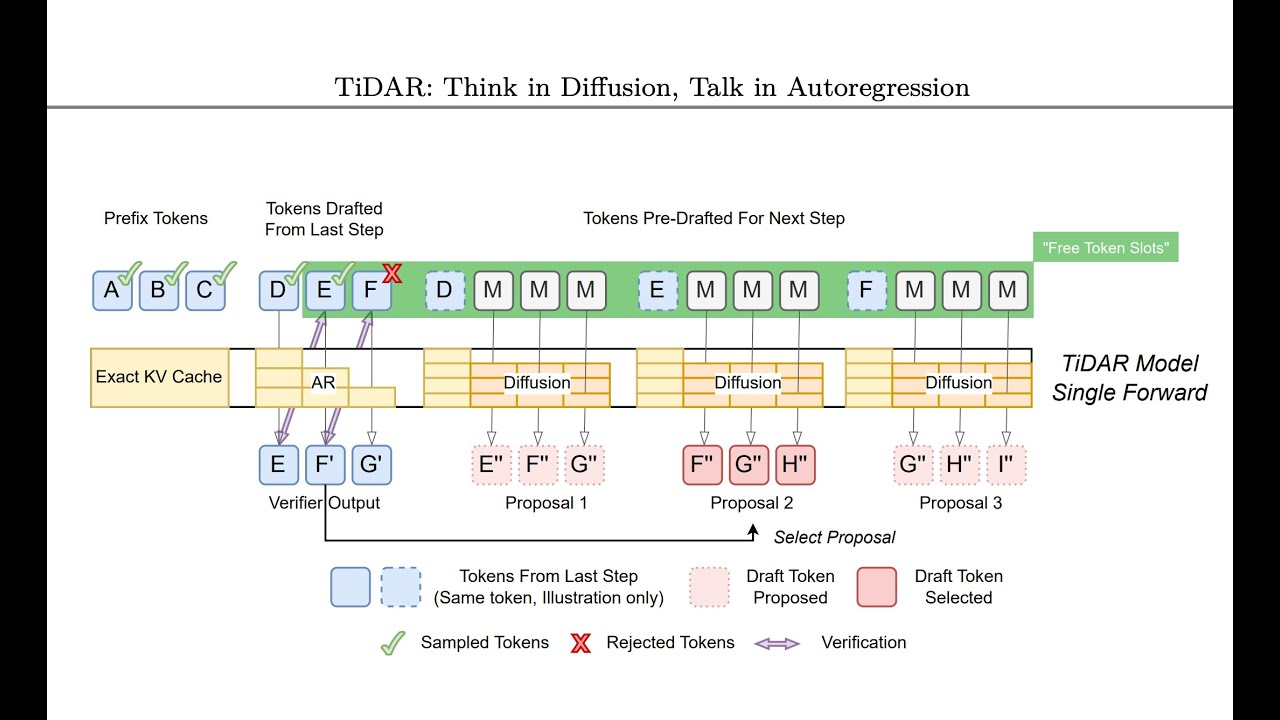
The video provides a clear and insightful explanation of the TiDAR architecture, breaking down complex concepts into understandable parts. The presenter effectively argues for the novelty and potential of TiDAR by contrasting it with existing methods like speculative decoding and pure diffusion models. He highlights the key insight of using unused GPU capacity, which is a compelling argument for the method’s efficiency. The explanation of rejection sampling and the single forward pass mechanism is thorough, making the technical details accessible. However, the video does not critically evaluate potential limitations or failure cases of TiDAR, and the presenter’s enthusiasm may overshadow a balanced assessment.
Scientific Rigor, Source Quality, Title Accuracy
The video is based on the TiDAR paper, and the presenter references the arXiv link in the description. The explanation is faithful to the paper’s content, and the presenter does not introduce unsupported claims. The title accurately reflects the content, which is a paper analysis. The video does not cite additional sources beyond the paper itself, which is appropriate for a paper analysis format. The presenter’s credentials and reputation in the AI community lend credibility to the analysis.
196 words
Title / Content Match
The title accurately reflects the content, which is a deep dive into the TiDAR architecture.
Quality & Reliability
8/10
The video is a detailed technical analysis of a research paper, presented by a known AI educator. The explanation is accurate and well-structured, but it is a secondary source and does not include independent verification of the paper's claims.
Key Moments
Markers derived by PSI from the transcript: the creator did not define chapters.
- Introduction to TiDAR and the problem of GPU underutilization in autoregressive decoding.
- Explanation of autoregressive models and causal attention masking.
- Discussion of diffusion language models and their limitations.
- Introduction to speculative decoding and its trade-offs.
- Overview of TiDAR's hybrid approach and the concept of 'free' drafting.
- Detailed walkthrough of the TiDAR architecture and attention masks.
- Explanation of rejection sampling and how TiDAR maintains AR quality.
- Discussion of the experimental results and speedups.
- Comparison with speculative decoding and other diffusion models.
- Conclusion and potential implications for future work.
Cited Sources
- TiDAR: Think in Diffusion, Talk in Autoregression — The paper being analyzed, providing the technical details and results.
Concurring Sources
- TiDAR: Think in Diffusion, Talk in Autoregression — The paper itself, which the video summarizes and analyzes.
External References
Contribution & Novelties
The video offers a clear and accessible explanation of a novel hybrid architecture that addresses a significant bottleneck in LLM inference. It highlights the innovative use of diffusion for drafting within an autoregressive framework, achieving AR-level quality with substantial speedups. The presenter’s explanation of the ‘free lunch’ concept—leveraging idle GPU capacity—is a key takeaway.
Pour aller plus loin :
- Diffusion Models — Provides background on diffusion models, which are central to TiDAR’s drafting mechanism.
- Speculative Decoding — The original speculative decoding paper, which TiDAR builds upon and improves.
- Attention Is All You Need — The foundational transformer paper, relevant to understanding attention mechanisms and KV caches.
106 words
Radar Profile
The radar profile shows high scores across all dimensions, indicating a well-rounded and informative video. The strongest aspects are the quantity of information and technical depth, while the weakest is the overall reliability, which is still high but slightly lower due to the lack of independent verification.
💬 No comments were provided for analysis.