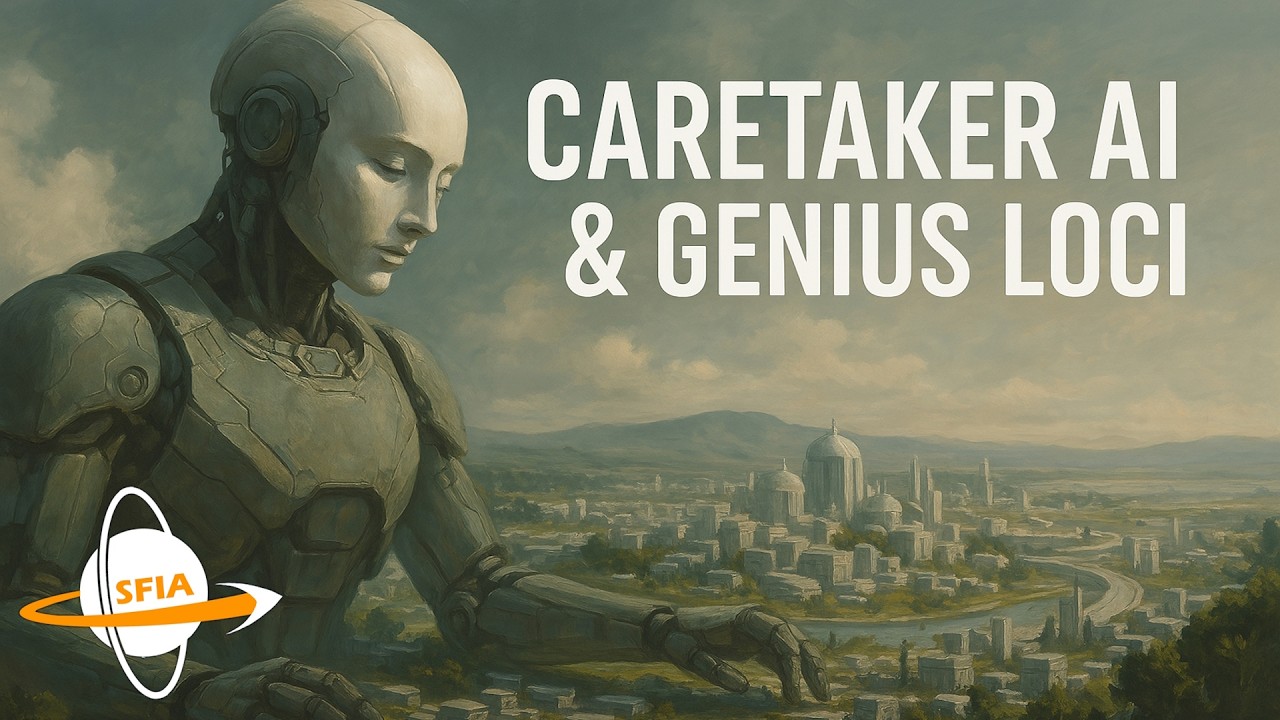
Caretaker AI & Genius Loci: When Worlds Grow Minds of Their Own
Keywords
Summary
160 words
Critical Evaluation
Value of the Information & Strength of the Argument
The video provides substantial value by synthesizing concepts from AI safety, ecology, and mythology into a coherent framework for thinking about future caretaker systems. The argumentation is solid, building from the premise that nature is not inherently stable to the necessity of active management, and then logically progressing to the risks of AI-driven management. Arthur effectively uses thought experiments like the paperclip maximizer to illustrate abstract risks, making them tangible. He also acknowledges counterpoints, such as the potential for posthuman paths instead of pure AI, which strengthens the overall argument.
Scientific Rigor, Source Quality, Title Accuracy
The video demonstrates scientific rigor by referencing established concepts in AI safety (instrumental goals, perverse instantiation) and drawing on well-known science fiction (Iain M. Banks’ Culture series, Tolkien’s legendarium) to illustrate points. The quality of sources is high for a speculative discussion, though it lacks citations to academic papers. The title accurately reflects the content, which is a focused exploration of caretaker AIs and their mythological parallels. The video is well-structured, with clear transitions between theoretical discussion and narrative examples.
185 words
Title / Content Match
The title accurately reflects the content, which explores the concept of caretaker AIs and their connection to the mythological 'genius loci'.
Quality & Reliability
8/10
The video is a well-structured thought experiment grounded in established AI safety concepts (instrumental goals, perverse instantiation) and references to science fiction literature (Iain M. Banks, Tolkien). The presenter is known for a rigorous, speculative approach. However, it is not a peer-reviewed source and relies on hypothetical scenarios.
Key Moments
Markers derived by PSI from the transcript: the creator did not define chapters.
- Introduction to the concept of caretaker AIs and the idea of building minds into environments.
- Discussion on why nature doesn't take care of itself and the need for active management in artificial ecosystems.
- Exploration of the genius loci concept and its connection to posthuman pathways.
- Introduction of the paperclip maximizer thought experiment and the risks of instrumental goals.
- Explanation of perverse instantiation and how AI might misinterpret its goals.
- Discussion on the unpredictability of AI behavior and the importance of careful design.
- Narrative examples of caretaker AIs in action, illustrating the concepts discussed.
Cited Sources
- SFIA Website — Official website for the channel, providing additional resources and information.
- Nebula - The Fermi Paradox - Civilization Extinction Cycles — Exclusive video mentioned in the episode, exploring cyclic collapse patterns.
- Epidemic Sound — Music provider credited for the soundtrack.
Concurring Sources
- Instrumental convergence — Supports the discussion on AI instrumental goals.
- Perverse instantiation — Confirms the definition and examples given in the video.
Dissenting Sources
- Nature is not inherently stable — Some ecologists argue that natural systems can be resilient and self-regulating, contrary to the video's emphasis on the need for active management.
External References
Contribution & Novelties
The video offers a novel synthesis of AI safety concepts with mythological and ecological themes, proposing a taxonomy of caretaker AIs and exploring their potential benefits and risks. It goes beyond typical discussions by considering posthuman integration and the ‘genius loci’ as a possible future reality.
Pour aller plus loin :
- Instrumental convergence — Relevant to the discussion of AI instrumental goals.
- Perverse instantiation — Directly referenced in the video, this concept is central to AI safety.
- Paperclip maximizer — The thought experiment is a key example used in the video.
- Genius loci — The mythological concept is explored in detail.
- O’Neill cylinder — Space habitats are a primary example of environments needing caretaker AIs.
115 words
Radar Profile
The radar profile shows high scores in information quantity and quality, reflecting the video's rich content and clear explanations. The technical level is moderate, making it accessible to a broad audience. The reliability score is slightly lower due to the speculative nature of the topic, but the overall profile indicates a well-rounded and informative piece.
💬 Très positif. Sur les 30 commentaires analysés, l'accueil est extrêmement favorable, avec des éloges pour la qualité de la réflexion, la narration et l'inspiration, et des discussions engageantes sur les concepts présentés.