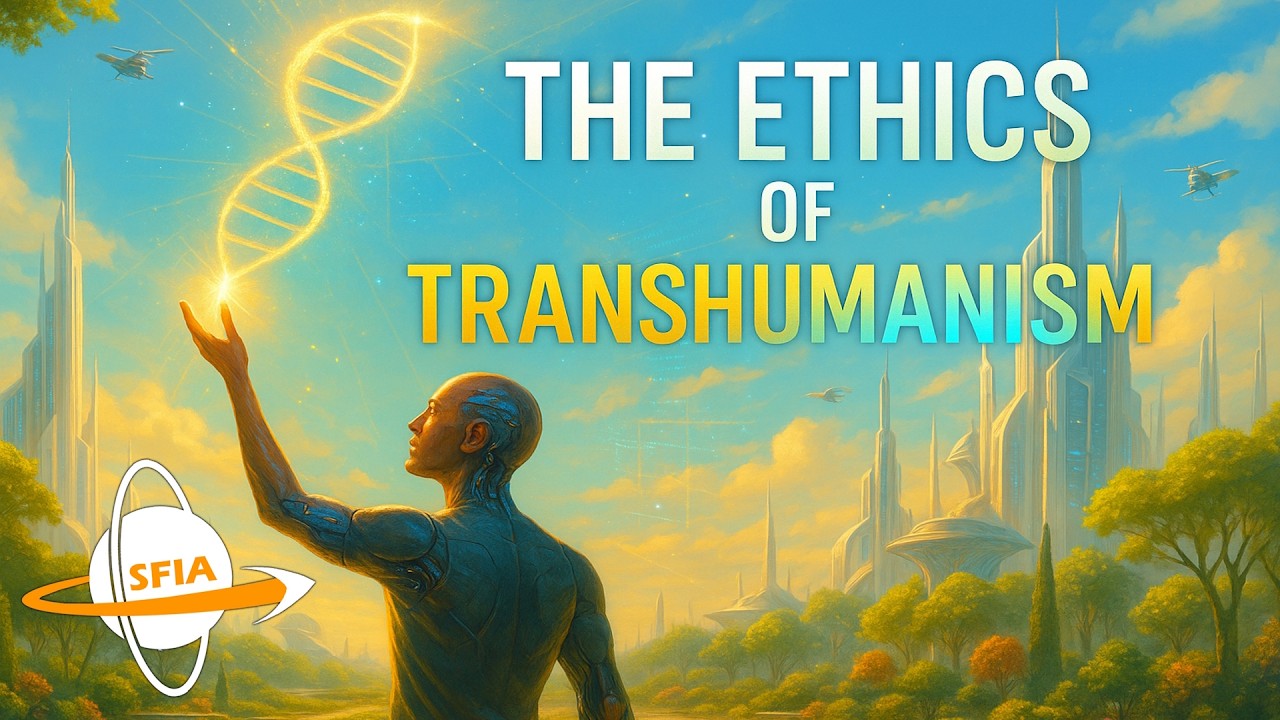
The Ethics of Transhumanism - Dreaming of More, Without Losing What We Are
Keywords
Summary
182 words
Critical Evaluation
Value of the Information & Strength of the Argument
The video offers substantial value by presenting a thorough and nuanced ethical analysis of transhumanism. Arthur effectively balances pro and con arguments, acknowledging the moral imperative to reduce suffering while also highlighting the dangers of inequality and coercion. He uses historical context, such as Huxley’s eugenicist views, to ground the discussion and draws on philosophical frameworks like natural law. The argumentation is solid, with clear reasoning and examples, though it relies more on rhetorical persuasion than empirical evidence. The inclusion of diverse perspectives, such as the deaf community’s view, adds depth and demonstrates intellectual honesty. However, the video could benefit from more concrete references to academic literature or case studies to strengthen its claims.
Scientific Rigor, Source Quality, Title Accuracy
The video demonstrates high rigor in its ethical reasoning and historical accuracy, but it lacks explicit citations to academic sources. Arthur references Julian Huxley’s essay and mentions Nick Bostrom’s work, but does not provide direct links or detailed bibliographic information. The title accurately reflects the content, which is a balanced exploration of transhumanism’s ethical dimensions. The video’s structure with chapters enhances clarity, and the creator’s transparency about his own stance adds credibility. However, the absence of formal citations may limit its use as a scholarly reference. The description includes links to the creator’s website and social media, but no direct sources for the claims made. Overall, the video is intellectually rigorous but could be improved by incorporating more verifiable references.
249 words
Title / Content Match
The title accurately reflects the content, which explores the ethical dilemmas of transhumanism while emphasizing the tension between enhancement and preserving humanity.
Quality & Reliability
8/10
High-quality ethical analysis with balanced arguments, historical context, and clear reasoning. The author discloses his own stance and acknowledges complexity. Minor limitations include lack of citations to academic sources and reliance on personal interpretation.
Chapters
- Intro
- The Promise and Peril of Transhumanism
- Origins of Transhumanism
- Subjective vs. Objective Improvements – Where Do We Draw the Line?
- Nature and Morality – Three Views of Natural Law
- The Road Ahead – What Does It Mean to Be Human?
- The Moral Case for Transhumanism
- The Risks & Dangers of Transhumanism
- Navigating the Ethical Landscape - How Do We Proceed?
- The Transhuman Future: Utopia, Dystopia, or Something Else?
- Final Reflections: What Does It Mean to Be Human?
Cited Sources
- Epidemic Sound — Music provided for the video
- Isaac Arthur's Website — Official website for additional content and information
- Nebula - Mass Drivers on the Moon — Exclusive video mentioned in the description
- Nebula Subscription — Link to subscribe to Nebula with a discount
- Nebula Lifetime Membership — Link to purchase a lifetime membership
- Gift Nebula Subscription — Link to gift a Nebula subscription
- Reddit Community — Community discussion forum
- Subscribestar — Support platform for the creator
Concurring Sources
- Transhumanism (Wikipedia) — Provides a broad overview of transhumanism, aligning with the video's definitions and historical context.
- Nick Bostrom's 'Why I Want to be a Posthuman When I Grow Up' — Referenced in the video, discusses posthuman values and aligns with the critique of transhumanism's conservatism.
Dissenting Sources
- The Case Against Perfection by Michael Sandel — Sandel argues that genetic enhancement undermines the 'giftedness' of life, a perspective that challenges the video's more permissive stance.
Contribution & Novelties
The video provides a comprehensive and accessible overview of transhumanist ethics, synthesizing historical context, philosophical arguments, and practical concerns. It stands out for its balanced treatment, acknowledging both the moral imperative for enhancement and the risks of inequality and coercion. The discussion of the spectrum of coercion and the cultural relativity of enhancement adds nuance often missing in popular discourse. The video also effectively connects transhumanism to broader existential questions about human identity and purpose.
Pour aller plus loin :
- Transhumanism (Wikipedia) — Overview of the movement and its key concepts.
- Nick Bostrom’s ‘Why I Want to be a Posthuman When I Grow Up’ — Directly referenced in the video, explores posthuman values.
- Julian Huxley’s ‘Transhumanism’ (1957) — Original essay that coined the term.
- Bioethics (Stanford Encyclopedia of Philosophy) — Academic resource on ethical issues in biology and medicine.
139 words
Radar Profile
The radar profile shows high scores in information quantity, quality, and technical level, with a slightly lower but still strong reliability score. This indicates a well-researched and intellectually engaging video that is both informative and credible, though it could benefit from more explicit sourcing.
💬 Très positif. Sur les 30 commentaires analysés, les spectateurs expriment un fort enthousiasme pour le contenu, beaucoup partageant des expériences personnelles avec des technologies d'amélioration et soutenant le transhumanisme, tout en appréciant la nuance de la présentation.