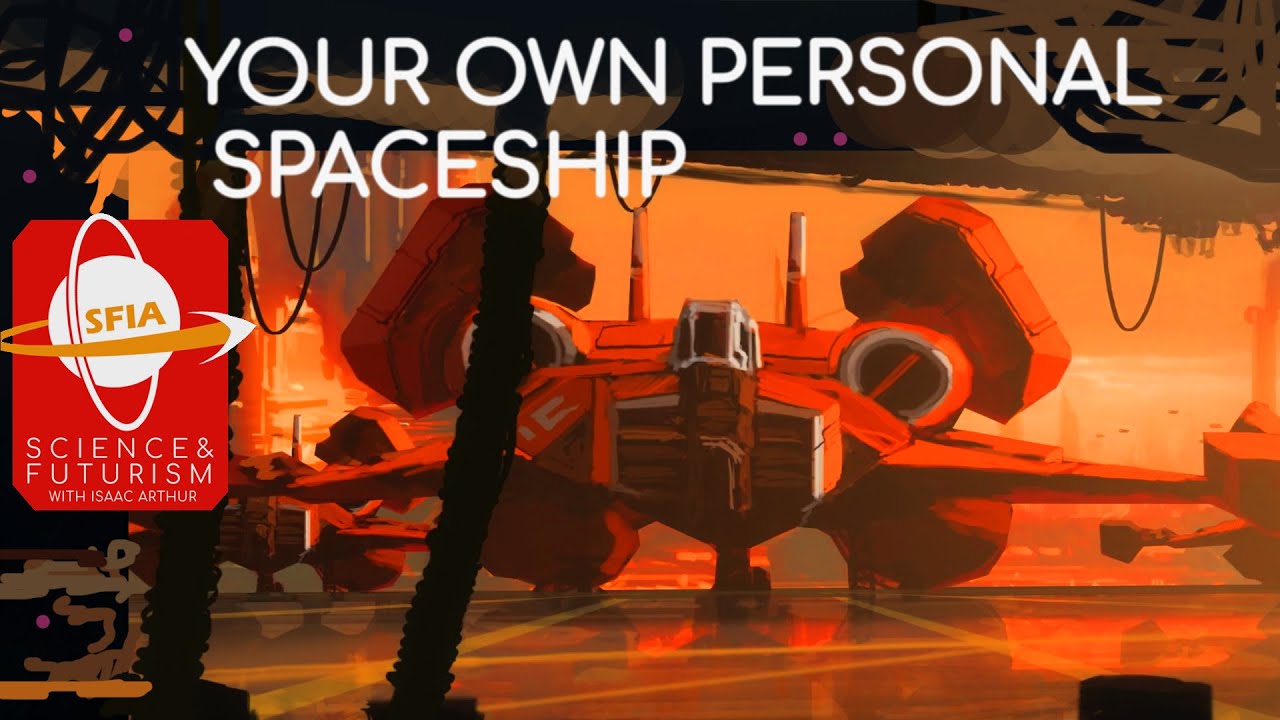
Your Own Personal Spaceship
Keywords
Summary
145 words
Critical Evaluation
Value of the Information & Strength of the Argument
The video provides a comprehensive and well-reasoned analysis of the topic. It systematically breaks down the challenges of personal spaceflight, from the tyranny of the rocket equation to the practicalities of heat management and safety. The argumentation is solid, building from known physics and engineering principles to plausible future scenarios. Arthur is careful to distinguish between near-term possibilities and speculative technologies, and he provides concrete examples and calculations to support his points. The discussion of beam-powered spaceplanes as a promising pathway is particularly insightful, as it addresses both the technical and regulatory aspects. The video also considers economic factors, such as the cost of fuel and the potential for a space economy, adding depth to the analysis.
Scientific Rigor, Source Quality, Title Accuracy
The video demonstrates a high level of scientific rigor, with accurate explanations of concepts like the rocket equation, exhaust velocity, and specific impulse. Arthur references his own previous episodes for deeper dives into specific topics, which is a good practice, though he does not cite external peer-reviewed sources. The title accurately reflects the content, which is a broad exploration of the subject. The video is well-structured and the information is presented in a logical flow. The lack of formal citations is a minor weakness, but the content is consistent with established aerospace knowledge.
225 words
Title / Content Match
The title accurately reflects the content, which explores the feasibility and various technological routes to owning a personal spaceship.
Quality & Reliability
8/10
The video provides a well-structured, scientifically grounded overview of the technological and economic pathways to personal spaceflight, drawing on established physics and engineering concepts. It clearly distinguishes between near-term plausible technologies and speculative ones, and avoids overclaiming. The presentation is consistent with current aerospace knowledge, though it does not cite specific peer-reviewed sources.
Key Moments
Markers derived by PSI from the transcript: the creator did not define chapters.
- Introduction to the dream of owning a personal spaceship and the scope of the episode.
- Discussion of current launch costs and the role of fuel in the overall cost.
- Explanation of the rocket equation and its implications for Earth-to-orbit travel.
- Introduction of cycler spacecraft as a concept for interplanetary travel.
- Discussion of nuclear-powered spaceships and their potential for off-world use.
- Introduction of beam-powered spaceplanes as a plausible near-term option for Earth.
- Exploration of more speculative technologies like inertial mass modification and antimatter drives.
- Conclusion summarizing the pathways to personal spaceflight and the challenges ahead.
Cited Sources
- Isaac Arthur Website — Official website of the channel, providing additional resources and episode information.
- Brilliant.org — Sponsor of the episode, offering STEM learning resources.
- SFIA Episode Chronology — Spreadsheet listing all episodes of the Science & Futurism with Isaac Arthur series.
- Nebula — Streaming platform where the channel's content is also available.
- Patreon — Patreon page for supporting the channel.
- Subscribestar — Alternative platform for supporting the channel.
- Reddit Community — Subreddit for discussions about the channel's content.
- Twitter — Twitter account of Isaac Arthur.
- Discord Server — Discord server for the community.
- ArtStation - Jakub Grygier — Cover art by Jakub Grygier.
- Sergey Cheremisinov YouTube — Music used in the episode.
- Stellardrone Bandcamp — Music used in the episode.
- Miguel Johnson SoundCloud — Music used in the episode.
- Aerium SoundCloud — Music used in the episode.
Concurring Sources
- SpaceX — SpaceX's reusable rockets are a real-world example of reducing launch costs, aligning with the video's discussion of cost reduction.
- NASA - Space Launch System — NASA's SLS is an example of a heavy-lift rocket, though its costs are high, contrasting with the video's vision of cheaper access.
Dissenting Sources
- No discordant sources found — The video's content is consistent with established aerospace knowledge and does not contradict mainstream scientific consensus.
Contribution & Novelties
The video provides a comprehensive and accessible overview of the technological pathways to personal spaceflight, synthesizing concepts from rocketry, orbital mechanics, and future energy systems. It offers a balanced view, distinguishing between near-term plausible options like beam-powered spaceplanes and more speculative ones like inertial mass modification. The discussion of the economic and regulatory aspects adds a practical dimension not often covered in similar content.
Pour aller plus loin :
- Rocket equation — The fundamental equation governing rocket propulsion, central to the video’s discussion of fuel requirements.
- Beam-powered propulsion — The concept of using external energy beams to power spacecraft, a key near-term option discussed.
- Spaceplane — A vehicle that can operate both in the atmosphere and in space, relevant to the video’s discussion of personal spaceplanes.
- Nuclear thermal rocket — A type of nuclear propulsion mentioned as a potential option for off-world use.
- Orbital ring — A concept for space infrastructure that could facilitate personal space travel, mentioned in the video.
161 words
Radar Profile
The radar profile shows high scores in quantity of information, quality of information, and technical level, indicating a content-rich and well-explained video. The slightly lower score in global reliability reflects the lack of formal citations, but the overall profile suggests a highly informative and reliable source for science communication.
💬 Très positif. Sur les 30 commentaires analysés, le public exprime un enthousiasme marqué pour le sujet et la qualité de la présentation, avec de nombreux commentaires soulignant l'inspiration et l'utilité pour l'écriture de science-fiction.