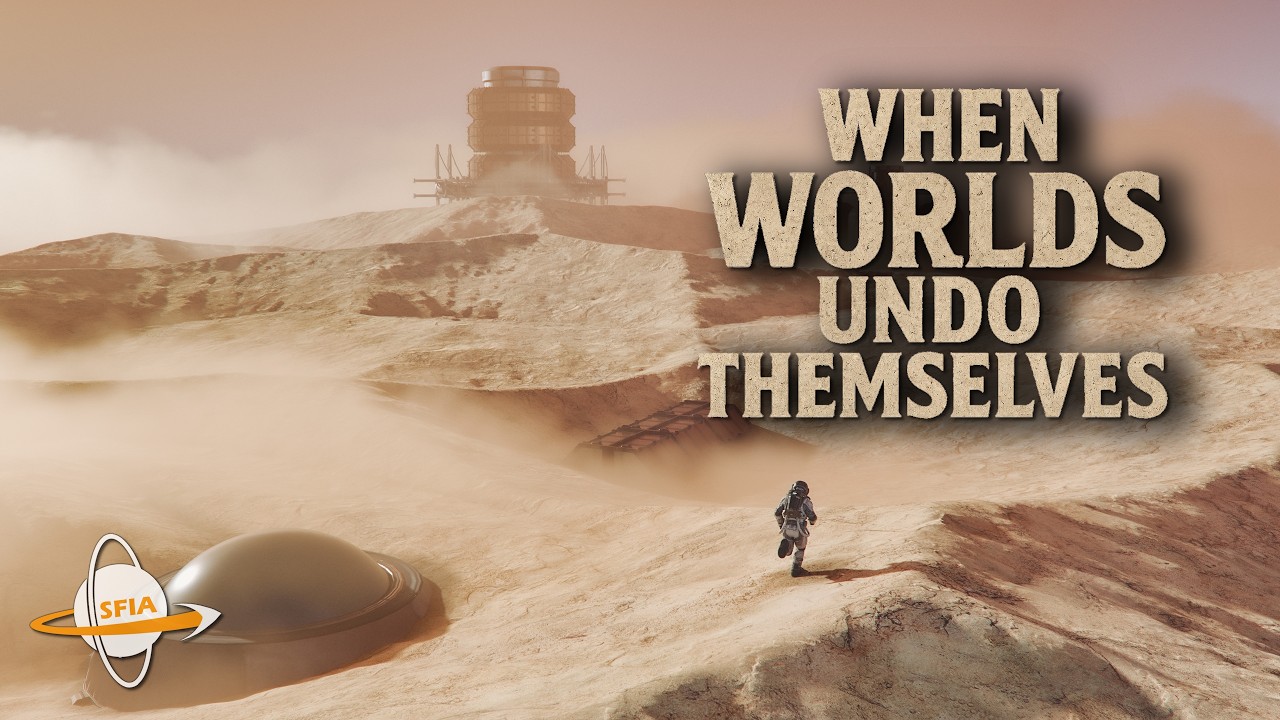
Abandoned Space Colonies - How Worlds Can Unterraform Themselves
Keywords
Summary
176 words
Critical Evaluation
Value of the Information & Strength of the Argument
The video provides substantial value by systematically deconstructing a complex speculative topic. It offers a clear framework for understanding colony failure, breaking down causes into environmental, human, and technological factors. The use of case studies (Kaluga-4, Proxima B, Valhalla) effectively illustrates these concepts in a narrative form, making the ideas more tangible. The argumentation is logically sound, building from general principles to specific examples and then to broader implications. The discussion of abandonment timelines and restoration adds depth, considering both the physical and social dimensions of decay and recovery. The video avoids oversimplification, acknowledging the interplay of multiple factors and the possibility of different outcomes. However, the speculative nature of the content means that the arguments are based on plausible extrapolation rather than empirical evidence, which is appropriate for the genre but limits its direct scientific applicability.
Scientific Rigor, Source Quality, Title Accuracy
The video demonstrates a high level of scientific rigor in its reasoning, consistently grounding speculative scenarios in known scientific principles such as ecology, planetary science, and engineering. The quality of sources is limited by the format; the video does not cite specific scientific papers, but it references well-known works of science fiction (Asimov, Herbert) and real-world historical analogies (e.g., collapse of civilizations). The title accurately reflects the content, focusing on the concept of ‘unterraforming’ and the fate of abandoned colonies. The video’s internal logic is consistent, and it clearly distinguishes between established science and speculative extrapolation. The description provides links to the creator’s website, Patreon, and other platforms, but these are not direct scientific sources. Overall, the video is scientifically informed and intellectually honest, though it does not provide a formal bibliography.
284 words
Title / Content Match
The title accurately reflects the content, which explores the concept of 'unterraforming' and the life cycle of abandoned space colonies.
Quality & Reliability
8/10
The video presents a well-structured speculative analysis grounded in scientific principles (ecology, planetary science, engineering). It uses hypothetical case studies to illustrate concepts, clearly distinguishing between established science and speculative scenarios. The reasoning is logical and internally consistent, though it lacks direct citations to specific scientific literature.
Chapters
- Intro
- Why Colonies Fail
- Ecological Collapse in Non-Earth Environments
- Case Study – Kaluga-4, Oxygen Depletion
- Unterraforming – How a World Reverts or Mutates
- Abandonment Timelines
- Case Study – Proxima B
- Nebula
- Restoration & Resettlement
- Case Study – Valhalla
- System-Level Context
- Long-Term Patterns in a Galactic Civilization
Cited Sources
- Nebula - Epidemic Sound — Music courtesy
- Isaac Arthur's Website — Official website
- Nebula - Isaac Arthur — Nebula platform for exclusive content
- Rifftrax on Nebula — Promotional link for Rifftrax
- The Fermi Paradox - Civilization Extinction Cycles — Exclusive video on Nebula
- Reddit - r/IsaacArthur — Community discussion forum
- SubscribeStar - Isaac Arthur — Support page
Concurring Sources
- Terraforming - Wikipedia — General concept of terraforming, which the video builds upon.
- Ecological collapse - Wikipedia — Real-world examples of ecosystem collapse, analogous to the video's scenarios.
Contribution & Novelties
The video’s original contribution lies in its systematic exploration of the concept of ‘unterraforming’—the process by which terraformed worlds revert or mutate after abandonment. It provides a taxonomy of failure modes and abandonment timelines, using illustrative case studies to make the ideas concrete. This fills a gap in popular science communication, which often focuses on the initial terraforming process but rarely considers the long-term fate of such projects. The video also integrates social and political factors into the analysis, recognizing that colony collapse is not purely a technical issue.
Pour aller plus loin :
- Terraforming on Wikipedia — Provides background on the concept and its scientific basis.
- Ecological collapse on Wikipedia — Relevant to the discussion of ecosystem failure.
- Space habitat on Wikipedia — Discusses the engineering and sustainability of orbital habitats.
- Gaia hypothesis — Offers a theoretical framework for understanding self-regulating systems, relevant to terraformed worlds.
147 words
Radar Profile
The radar profile shows high scores in quantity and quality of information, with a moderate technical level and slightly lower reliability. This indicates a content-rich video that is scientifically informed but relies on speculative scenarios, making it more of a thought experiment than a rigorous scientific analysis.
💬 Très positif. Sur les 30 commentaires analysés, la grande majorité exprime une appréciation enthousiaste du contenu, avec des références à des œuvres de science-fiction et des remerciements pour la qualité de la vidéo, malgré quelques remarques sur une fin abrupte.