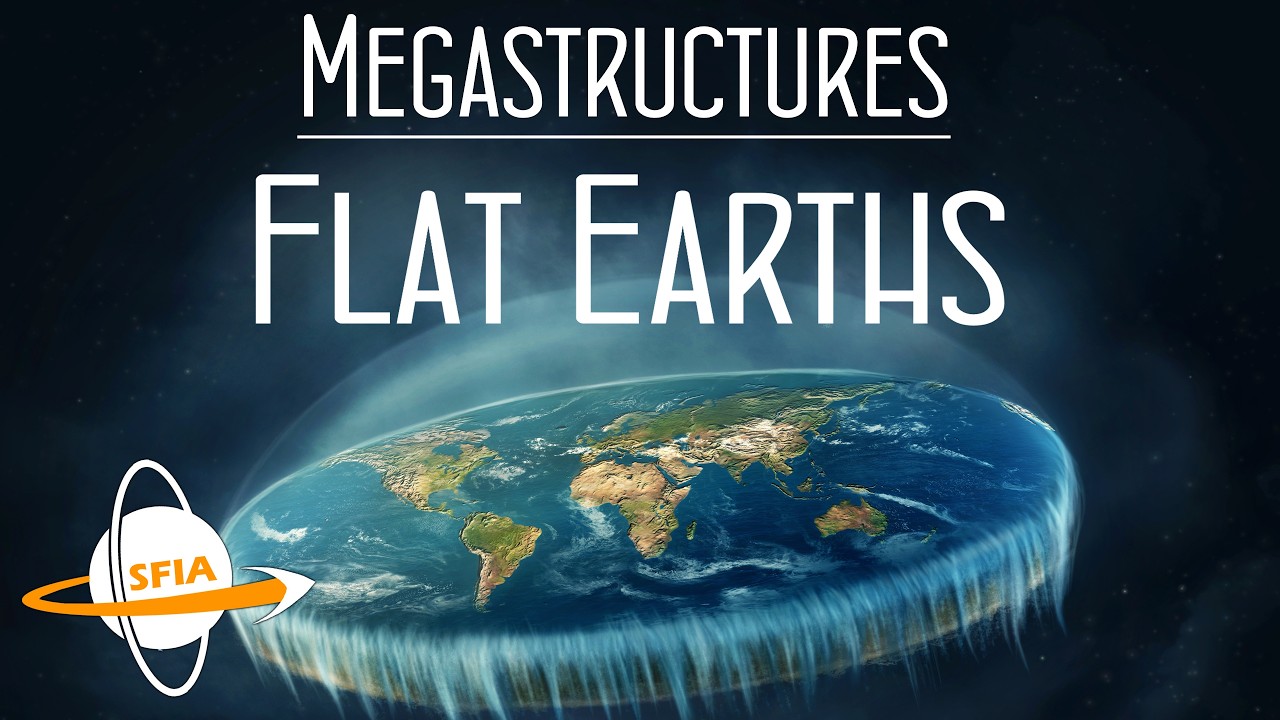
Flat Earth Megastructures
Keywords
Summary
182 words
Critical Evaluation
Value of the Information & Strength of the Argument
The video provides substantial value by systematically deconstructing the physics and engineering of flat planets, offering a rigorous thought experiment grounded in real concepts like orbital rings, active support, and mass distribution. The argumentation is logical and coherent, building from basic principles to complex variations, and it effectively addresses potential objections, such as the mass inefficiency, by reframing these structures as mass storage. The reasoning is solid, though it remains speculative by nature, clearly distinguishing between established science and extrapolation.
Scientific Rigor, Source Quality, Title Accuracy
The scientific rigor is high for a speculative topic; the presenter consistently references established physics and engineering concepts, and the internal logic is sound. The video does not cite specific external sources, but it builds on a well-known body of work in megastructure theory. The title accurately reflects the content, avoiding any confusion with the Flat Earth conspiracy theory. The description provides links to the channel’s website, Patreon, and other resources, but these are not direct citations to scientific literature.
175 words
Title / Content Match
The title accurately reflects the content, which focuses on the engineering and design of flat planetary megastructures, not the Flat Earth conspiracy theory.
Quality & Reliability
8/10
The video presents a well-reasoned, scientifically grounded exploration of hypothetical megastructures, building on established physics concepts (gravity, orbital rings, active support) and clearly distinguishing speculation from known science. The reasoning is internally consistent and acknowledges uncertainties.
Key Moments
Markers derived by PSI from the transcript: the creator did not define chapters.
- Introduction to the concept of flat planets and the assumption of mass-based gravity.
- Discussion on the flawed assumptions about spherical planets and the advantages of flat ones.
- Explanation of using orbital rings for active support to maintain a flat shape.
- Introduction of variations like Pancake Planets and Ripple Worlds.
- Analysis of lighting options, including hovering mirrors and Sun-Moons.
- Discussion on the practical purposes of flat planets as mass storage and tourist attractions.
- Exploration of scaling up flat planets and the challenges of spin and gravity.
- Consideration of using black holes as power sources for lighting.
- Summary of the benefits and potential uses of flat planets in a future civilization.
Cited Sources
- Brilliant — Sponsor of the video, offering educational content.
- Isaac Arthur's Website — Official website for the channel and additional resources.
- Nebula — Streaming platform where the video is also available.
- Patreon — Support page for the channel.
- Subscribestar — Alternative support page.
- Reddit Community — Community discussion forum.
- Soundcloud Audio Version — Audio-only version of the episode.
- Soundcloud Narration-Only Version — Narration-only audio version.
Concurring Sources
- Orbital ring — The concept is central to the construction method discussed in the video.
- Alderson disk — A larger flat megastructure variant, mentioned in the video.
External References
Contribution & Novelties
The video offers a novel, systematic engineering analysis of flat planetary megastructures, moving beyond simple speculation to consider structural integrity, gravity distribution, and lighting solutions. It integrates concepts like orbital rings and active support in a creative way, and it reframes these structures as practical mass storage, adding a new perspective to megastructure discussions.
Pour aller plus loin :
- Orbital ring — A key concept for active support, directly relevant to the construction method discussed.
- Alderson disk — A larger flat megastructure variant, mentioned in the video.
- Dyson sphere — Related megastructure concept, providing context for large-scale engineering.
- Active support — The principle behind using orbital rings and other support mechanisms.
- Modified Newtonian dynamics — Referenced in the video as a hypothetical alternative gravity model.
125 words
Radar Profile
The radar profile shows high scores in information quantity and quality, with a strong technical level, indicating a dense and well-structured presentation. The slightly lower reliability score reflects the speculative nature of the topic, though the reasoning is grounded in physics.
💬 Très positif. Sur les 30 commentaires analysés, l'écrasante majorité exprime un enthousiasme marqué pour l'épisode, avec des blagues sur le titre et des discussions constructives sur les concepts présentés, sans critiques négatives notables.