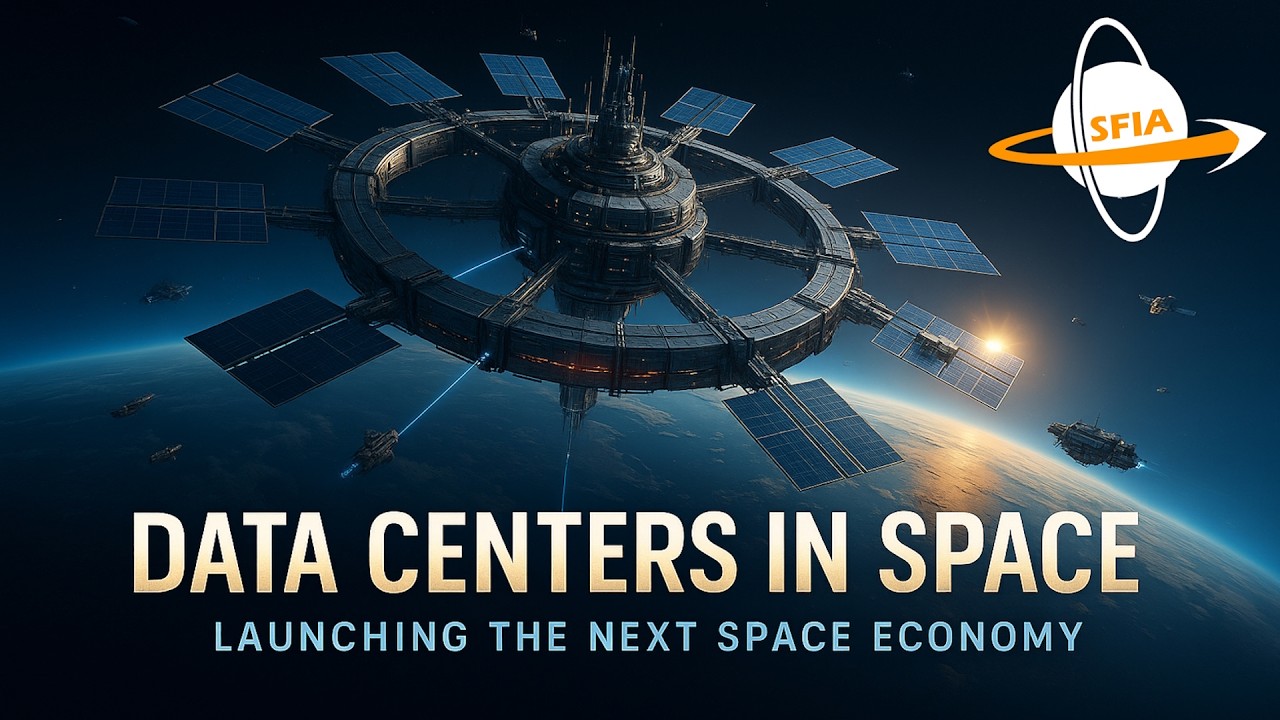
Why Data Centers in Space Could Launch a New Space Economy
Keywords
Summary
182 words
Critical Evaluation
Value of the Information & Strength of the Argument
The video provides substantial value by synthesizing current trends in AI, energy, and space technology into a coherent vision. It offers a well-reasoned argument for why orbital data centers might be economically viable before other space industries, citing the immediate demand for computation and the synergy with space-based solar power. The argumentation is logically structured, moving from the problem (energy and cooling constraints) to the solution (orbital data centers) and addressing counterarguments such as latency and radiation. Arthur is careful to distinguish between near-term possibilities and long-term speculation, and he acknowledges the significant engineering hurdles. The use of analogies (telegraph cables, fiber optics) strengthens the persuasive case.
Scientific Rigor, Source Quality, Title Accuracy
The video demonstrates scientific rigor by grounding its arguments in established physics and engineering principles, such as the advantages of vacuum cooling and the challenges of radiation. While it does not cite specific academic papers, it references credible concepts like the Matrioshka Brain and mentions real-world initiatives (Starlink, Kuiper, NASA laser communications). The title accurately reflects the content, which focuses on the potential of orbital data centers to catalyze a space economy. The video is a form of science communication that blends factual information with speculative futurism, but it clearly labels speculation as such. The lack of formal citations is typical for this genre, but the reasoning is transparent and based on plausible assumptions.
236 words
Title / Content Match
The title accurately reflects the content, which focuses on the potential of orbital data centers to catalyze a space economy.
Quality & Reliability
8/10
The video presents a well-structured, reasoned argument grounded in known physics and engineering principles, with references to current trends and credible concepts. It clearly distinguishes speculation from established science and acknowledges challenges.
Key Moments
Markers derived by PSI from the transcript: the creator did not define chapters.
- Introduction: predictions by Bezos and Altman, and the concept of a Matrioshka Brain.
- The energy and cooling demands of terrestrial data centers.
- Advantages of space: constant sunlight, vacuum cooling, no zoning issues.
- The economic incentives: base load power, synergy with space-based solar.
- Architecture of orbital data centers: modular satellites, laser communication, latency challenges.
- Engineering challenges: launch costs, radiation, maintenance, and potential mitigations.
- The economics: orbital data centers as a loss leader for the space economy.
- Analogies with telegraph cables and fiber optics; the potential for orbital industrial parks.
- Conclusion: a server rack in orbit as the first step toward a space-based civilization.
Cited Sources
- Isaac Arthur Website — Official website of the channel, providing additional resources and episodes.
- Nebula — Streaming platform where the channel's content is available.
- Reddit - r/IsaacArthur — Community forum for discussion of the channel's content.
- Subscribestar — Platform for supporting the creator.
Concurring Sources
- Space-based solar power — The video's discussion of using solar power in orbit aligns with the broader concept of space-based solar power.
- Matrioshka Brain — The video references this concept as a long-term vision for space-based computation.
Dissenting Sources
- Comment on vacuum cooling — A viewer comment questions the claim that vacuum cooling is straightforward, noting that heat rejection in space is actually challenging due to the lack of a medium for conduction/convection. This is a valid technical nuance that the video simplifies.
Contribution & Novelties
The video contributes a fresh perspective by framing orbital data centers as a potential ’loss leader’ that could bootstrap a broader space economy, rather than just a standalone concept. It synthesizes current trends in AI, energy, and space technology into a coherent and economically plausible vision. The discussion of using space-based solar power locally for computation, rather than beaming it to Earth, is a notable innovative angle.
Pour aller plus loin :
- Matrioshka Brain — The concept of a star-powered megastructure dedicated to computation, directly referenced in the video.
- Space-based solar power — The idea of collecting solar energy in space and transmitting it to Earth, which the video discusses as a complementary technology.
- Van Allen radiation belt — The radiation environment that poses challenges for electronics in orbit, as mentioned in the video.
- Laser communication in space — The technology for high-bandwidth data transmission between satellites and Earth, relevant to the proposed architecture.
154 words
Radar Profile
The radar profile shows high scores across all dimensions, with a slight dip in technical depth due to the accessible presentation style. The video balances information quantity and quality well, making it a reliable source for understanding the concept of orbital data centers.
💬 Très positif. Sur les 30 commentaires analysés, l'écrasante majorité exprime enthousiasme et soutien, avec des discussions techniques constructives et des remerciements pour la qualité du contenu.