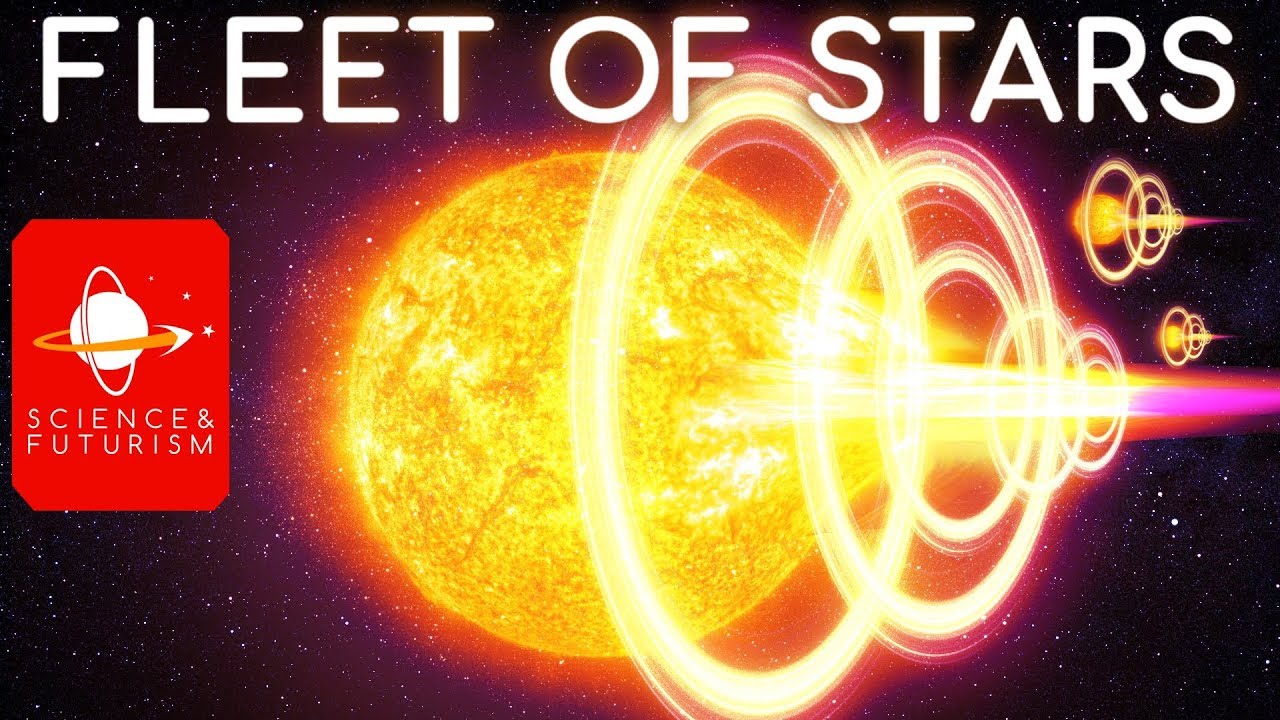
Fleet of Stars
Keywords
Summary
172 words
Critical Evaluation
Value of the Information & Strength of the Argument
The video provides a high value of information by systematically presenting a range of stellar engineering concepts, from well-known ideas like the Shkadov thruster to more speculative ones like the Quasar Drive. The argumentation is solid, as Isaac Arthur carefully explains the physics behind each method, including the trade-offs in acceleration and speed, and grounds the discussion in established principles like the rocket equation and light momentum. He also addresses potential motivations and applications, such as compacting galaxies or transporting mass, which adds depth to the speculative content. The reasoning is logical and internally consistent, making complex concepts accessible without oversimplifying.
Scientific Rigor, Source Quality, Title Accuracy
The scientific rigor is high, as the video builds on established concepts in astrophysics and engineering, such as the Shkadov thruster and starlifting, and extends them with plausible extrapolations. Isaac Arthur is careful to distinguish between known physics and speculative applications, and he references prior episodes and related works for further reading. The quality of sources is good, with the description providing links to relevant resources, though the video itself does not cite specific academic papers. The title ‘Fleet of Stars’ accurately reflects the content, which discusses moving stars as spaceships and the concept of fleets of stars. The content is well-structured and the presenter’s expertise is evident, contributing to the overall reliability.
229 words
Title / Content Match
The title 'Fleet of Stars' accurately reflects the content, which discusses moving stars as spaceships and the concept of fleets of stars.
Quality & Reliability
8/10
The video presents a well-structured, scientifically grounded exploration of stellar engineering concepts, referencing established ideas like the Shkadov thruster and extending them with plausible extrapolations. The presenter distinguishes between known physics and speculative applications, maintaining intellectual honesty. However, the content is largely theoretical and lacks direct empirical validation, and the presenter occasionally names concepts without formal citations.
Key Moments
Markers derived by PSI from the transcript: the creator did not define chapters.
- Introduction to the concept of moving stars and the need for redundancy on long voyages.
- Discussion of the energy costs of interstellar travel and the rationale for using stars as ships.
- Explanation of the Shkadov Thruster, its principles, and its limitations.
- Introduction of the Helios Drive, a starlifting-based plasma rocket engine.
- Overview of the Nova and Supernova Drives, using stellar explosions for propulsion.
- Description of the Quasar Drive, using a black hole as an efficient photon engine.
- Discussion of the motivations for moving stars, including compacting galaxies and intergalactic transport.
- Cultural implications of generation ships and references to science fiction literature.
- Conclusion and teaser for the next episode on colonizing black holes.
Cited Sources
- SpaceHabs — Graphics by Bryan Versteeg, used in the video.
- Isaac Arthur Website — Official website for the channel and forums.
- Nebula — Streaming platform where episodes are available.
- SoundCloud - Fleet of Stars Audio — Audio-only version of the episode.
- SoundCloud - Fleet of Stars Narration Only — Narration-only version of the episode.
- Reddit - r/IsaacArthur — Community discussion forum.
- Subscribestar — Support platform for the channel.
- ArtStation - Jakub Grygier — Cover art by Jakub Grygier.
- ArtStation - Sergio Botero — Graphics by Sergio Botero.
- ArtStation - Jeremy Jozwik — Graphics by Jeremy Jozwik.
- Kai Engel — Music by Kai Engel.
- Markus Junnikkala — Music by Markus Junnikkala.
- Lombus Bandcamp — Music by Lombus.
- Stellardrone Bandcamp — Music by Stellardrone.
Concurring Sources
- Shkadov thruster - Wikipedia — The concept of using mirrors to move a star, as discussed in the video.
- Stellar engine - Wikipedia — Overview of stellar engines, including the Shkadov thruster and other concepts.
- Generation ship - Wikipedia — The concept of long-duration interstellar travel, central to the episode.
External References
Contribution & Novelties
The video offers a comprehensive and accessible synthesis of stellar engineering concepts, presenting them in a coherent framework that connects theoretical physics with speculative engineering. It introduces the ‘Helios Drive’ as a named concept and systematically compares various star drives, highlighting their trade-offs. The discussion of using quasar drives for intergalactic travel and the idea of compacting galaxies are particularly novel and thought-provoking.
Pour aller plus loin :
- Shkadov thruster — The original concept of using mirrors to move a star.
- Stellar engine — Overview of different types of stellar engines.
- Generation ship — Concept of long-duration interstellar travel.
- Kardashev scale — Classification of civilizations by energy consumption, relevant to K2 civilizations.
- Black hole starship — Concept of using black holes for propulsion.
123 words
Radar Profile
The radar profile shows high scores across all dimensions, with particularly strong performance in quantity of information and technical level. The video is information-dense and technically sophisticated, while maintaining a high level of reliability and quality. This indicates a well-balanced and authoritative presentation of speculative but scientifically grounded concepts.
💬 Très positif. Sur les 30 commentaires analysés, l'enthousiasme est unanime, avec des éloges pour la créativité et la rigueur du contenu, et des références humoristiques aux concepts présentés.