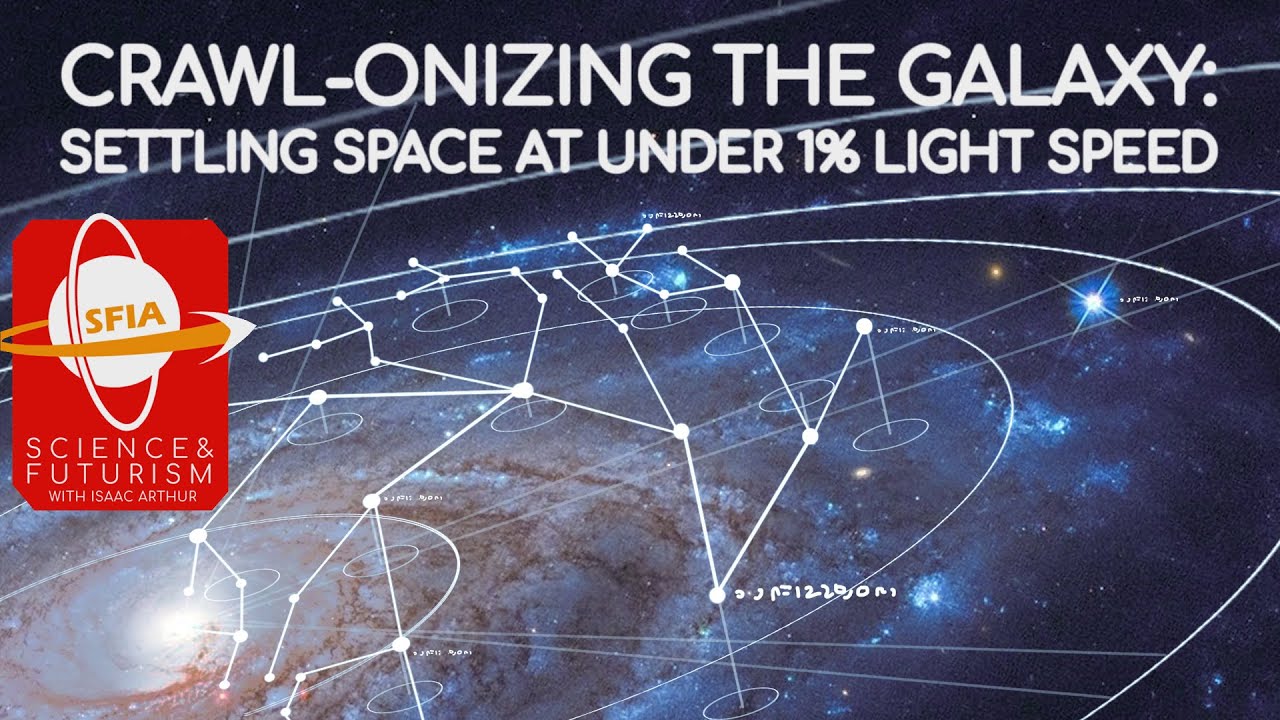
Crawlonizing The Galaxy: Settling Space At Ultra-Low Speeds
Keywords
Summary
157 words
Critical Evaluation
Value of the Information & Strength of the Argument
The video provides substantial value by systematically addressing a plausible alternative to FTL travel, grounding its arguments in known physics and engineering constraints. Arthur’s argumentation is solid: he clearly explains the cube-law of collision energy, the rocket equation, and the economic trade-offs of speed versus safety. He also introduces creative solutions like relay stations and Oort Cloud habitats, which are logically derived from the premise. The reasoning is transparent, with assumptions stated, and the speculative elements are clearly flagged as such.
Scientific Rigor, Source Quality, Title Accuracy
The video demonstrates scientific rigor by acknowledging uncertainties and avoiding overclaiming. It references concepts like the Oort Cloud and fusion propulsion without formal citations, but the information is consistent with current scientific understanding. The title accurately reflects the content, and the video’s speculative nature is clearly communicated. The lack of formal sources is a minor weakness, but the internal consistency and logical structure compensate.
160 words
Title / Content Match
The title accurately reflects the content, which explores the feasibility and implications of colonizing the galaxy at sub-relativistic speeds.
Quality & Reliability
8/10
The video presents a well-reasoned speculative analysis grounded in known physics, with clear explanations of assumptions and limitations. It cites no formal sources but references concepts like the Oort Cloud and fusion propulsion, and the argumentation is internally consistent.
Key Moments
Markers derived by PSI from the transcript: the creator did not define chapters.
- Introduction to the concept of crawlonizing and the speed limits discussed.
- Discussion of the dangers of interstellar dust and debris at various speeds.
- Analysis of the economic and social implications of multi-millennial voyages.
- Introduction of Oort Cloud habitats and their role in colonization.
- Proposal of relay stations and interstellar highways for faster travel and communication.
- Discussion of digital consciousness and teleportation via light-speed data.
- Conclusion on the feasibility of galaxy-wide colonization at ultra-low speeds.
Cited Sources
- Brilliant.org — Sponsor of the video, offering STEM learning resources.
- Isaac Arthur's Website — Official website for the channel and additional content.
- Nebula — Streaming platform where Isaac Arthur's content is available.
- ArtStation - Jakub Grygier — Cover art by Jakub Grygier.
- Reddit - r/IsaacArthur — Community discussion forum for the channel.
- Subscribestar - Isaac Arthur — Platform for supporting the channel.
- Epidemic Sound — Music used in the video.
Concurring Sources
- PBS Space Time - The Fermi Paradox — A video that also suggests slow interstellar travel as a solution to the Fermi paradox, as mentioned in the comments.
Contribution & Novelties
The video’s original contribution is the systematic exploration of the ‘crawlonizing’ concept, which is often overlooked in favor of FTL or high-speed travel. It provides a detailed analysis of the engineering, economic, and social challenges, and proposes innovative solutions like Oort Cloud habitats and relay stations. This reframes the Fermi Paradox by suggesting that slow expansion is a plausible explanation for the lack of observable alien civilizations.
Pour aller plus loin :
- Fermi paradox — Discusses the contradiction between the high probability of alien civilizations and the lack of evidence, relevant to the video’s implications.
- Generation ship — A concept central to the video’s discussion of multi-generational voyages.
- Oort cloud — The video’s proposal to use Oort Cloud resources for habitats and relay stations.
- Interstellar travel — General overview of the challenges and methods, including slow-boat approaches.
137 words
Radar Profile
The radar profile shows high scores in information quantity and quality, with a moderate technical level. The video is well-balanced, with strong content and reliability, though it remains speculative in nature.
💬 Très positif. Sur les 30 commentaires analysés, la grande majorité exprime une admiration pour la qualité du contenu et la profondeur de l'analyse, avec des discussions constructives sur les concepts présentés.