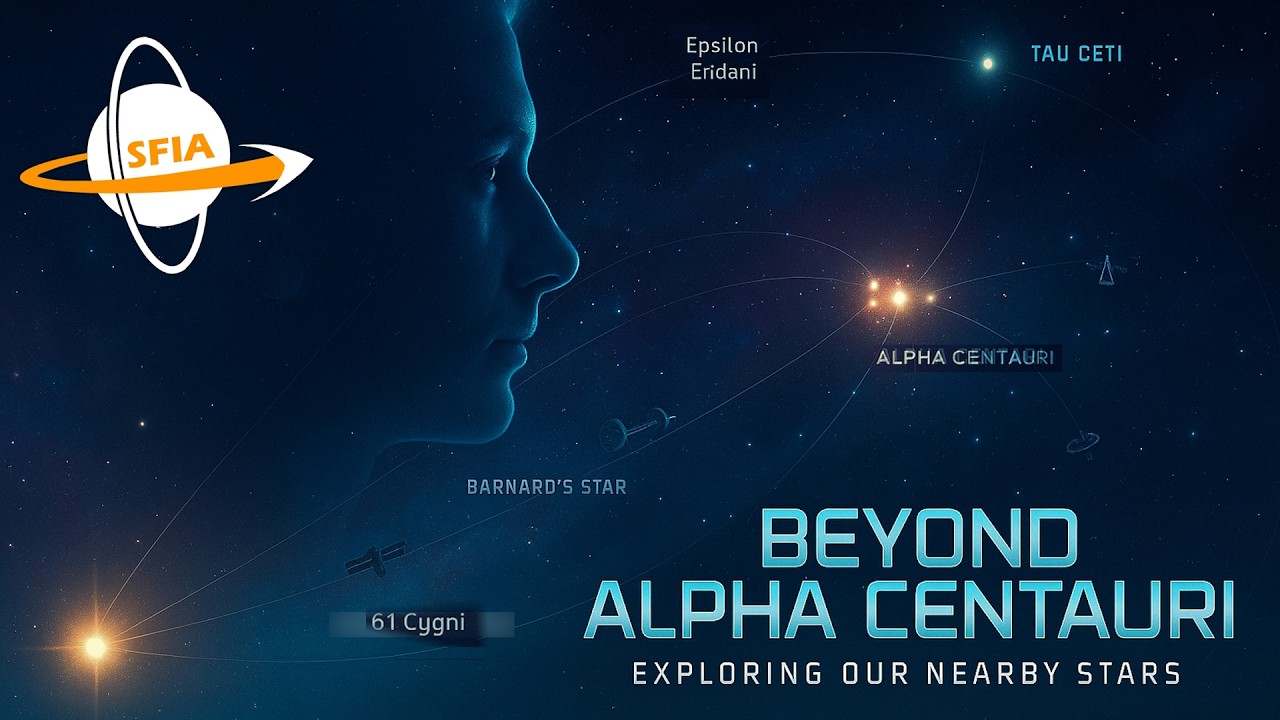
Beyond Alpha Centauri: Exploring Nearby Stars
Keywords
Summary
188 words
Critical Evaluation
Value of the Information & Strength of the Argument
The video provides substantial value by compiling detailed information about numerous nearby star systems, including their spectral types, distances, luminosities, and known exoplanets. It goes beyond simple enumeration by analyzing the implications for settlement, such as the effects of tidal locking, the potential for star boosting, and the use of mirrors to adjust light spectra. The argumentation is logically structured, moving from the immediate neighborhood to a broader survey, and then to settlement timelines. Isaac Arthur presents speculative concepts (e.g., beam-powered propulsion, O’Neill cylinders) as plausible extensions of current physics, clearly distinguishing between established science and future possibilities. The reasoning is coherent and well-supported by references to prior episodes and general astronomical knowledge.
Scientific Rigor, Source Quality, Title Accuracy
The video demonstrates scientific rigor by using accurate astronomical data (distances, luminosities, spectral classifications) that align with current knowledge. Isaac Arthur is known for his careful research, and the episode cites specific systems and their properties without overstating certainty. The description includes links to Nebula, Patreon, and social media, but no direct scientific sources are listed; however, the content itself is consistent with established exoplanet and stellar data. The title accurately reflects the content, and the video’s structure (chapters) helps organize the information. The creator’s comments indicate a minor editing glitch, but this does not affect the scientific content.
227 words
Title / Content Match
The title accurately reflects the content: the video systematically explores stars beyond Alpha Centauri within 25 light-years, discussing their characteristics and settlement potential.
Quality & Reliability
8/10
The video presents a scientifically grounded overview of nearby stellar systems, relying on established astronomical data and plausible engineering concepts. Isaac Arthur is known for rigorous, well-researched content, and the episode includes specific stellar parameters (distances, luminosities, spectral types) consistent with current knowledge. The speculative elements are clearly framed as projections, not certainties.
Chapters
Cited Sources
- Nebula (streaming platform) — Mentioned in the video as the platform for exclusive content and early access to episodes.
- Autonomous Space Industry (Nebula exclusive) — Referenced in the video as a related episode exploring AI and robotics in space industry.
- Scav (Nebula original) — Mentioned as a Nebula original documentary about a scavenger hunt at the University of Chicago.
- SFIA Reddit community — Linked in the description as a community for discussion.
- Subscribestar support page — Linked in the description as a way to support the channel.
Concurring Sources
- List of nearest stars (Wikipedia) — Confirms the distances and spectral types of stars mentioned in the video, such as Barnard's Star, Wolf 359, and Tau Ceti.
- Exoplanet catalog (NASA Exoplanet Archive) — Supports the existence of exoplanets around nearby stars like Proxima Centauri and Tau Ceti, as referenced in the video.
External References
Contribution & Novelties
The video’s original contribution lies in synthesizing current astronomical data about nearby stars into a coherent framework for future interstellar settlement. It goes beyond simple lists by discussing practical considerations such as light spectrum modification, star boosting, and the potential of rogue planets as settlement sites. The emphasis on building habitats rather than finding Earth-like planets is a recurring theme that challenges common science fiction tropes.
Pour aller plus loin :
- List of nearest stars — Provides a comprehensive catalog of stars within 25 light-years, useful for verifying the systems mentioned.
- Habitable zone — Relevant to the discussion of where planets might be suitable for life.
- O’Neill cylinder — A key concept for space habitats, central to the video’s settlement vision.
- Project Daedalus — A historical study of interstellar fusion propulsion, relevant to the propulsion methods discussed.
137 words
Radar Profile
The radar profile shows high scores across all dimensions, indicating a well-rounded and reliable video. The strongest aspects are the quantity and quality of information, while the technical level is slightly lower, reflecting the accessible presentation style. Overall, the video is a solid resource for understanding the potential for interstellar settlement.
💬 Très positif. Sur les 30 commentaires analysés, les spectateurs expriment un enthousiasme marqué pour le contenu, saluent la qualité des informations et la clarté des explications, et partagent des références culturelles (comme Wolf 359) et des suggestions constructives.