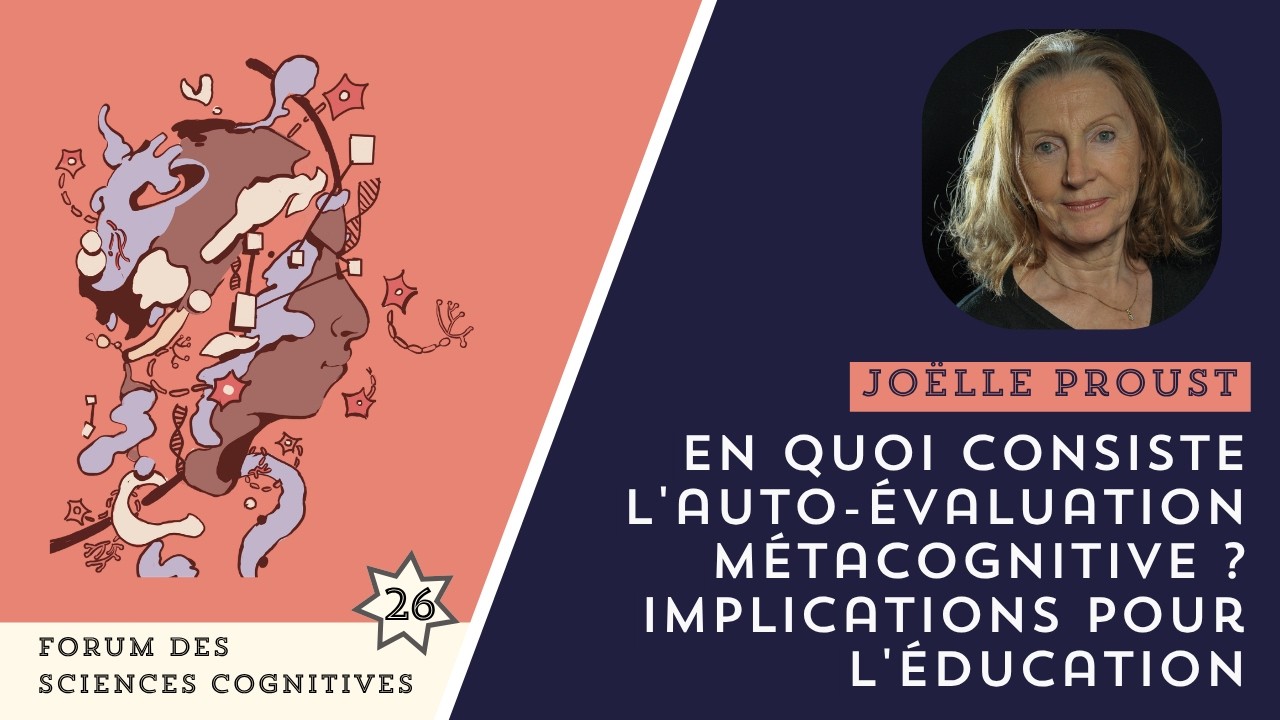
JOËLLE PROUST - En quoi consiste l’auto-évaluation métacognitive ? Implications pour l’éducation
Keywords
Summary
203 words
Critical Evaluation
The conference provides a comprehensive and insightful overview of metacognitive self-evaluation and its relevance to education. Joëlle Proust, a leading researcher in the field, demonstrates deep expertise and presents complex ideas in an accessible manner. The content is well-structured, starting with foundational questions and progressively building to more nuanced discussions of mechanisms and practical applications. The distinction between implicit and explicit metacognition is particularly valuable, as it clarifies the different ways in which self-evaluation occurs and how they can be leveraged in educational settings. The talk is grounded in established research, referencing key figures such as John Hattie and Stanislas Dehaene, and it draws on a wide range of studies from cognitive psychology and neuroscience. However, the presentation is primarily an expert opinion rather than a systematic review, and some claims could benefit from more explicit citations to specific studies. The discussion of socio-cognitive biases, such as stereotypes, is timely and important, but it could be more detailed in terms of the mechanisms and evidence. The practical implications for educators are clear and actionable, emphasizing the need to move away from transmission-based teaching and towards fostering metacognitive skills. The title accurately reflects the content, and the talk successfully addresses both the conceptual foundations and the educational implications. Overall, this is a high-quality presentation that offers valuable insights for educators and researchers alike, though it may be more suited to an audience with some background in cognitive science.
237 words
Title / Content Match
The title accurately reflects the content, which focuses on metacognitive self-evaluation and its educational implications.
Quality & Reliability
8/10
The speaker is a recognized expert in metacognition, and the content is grounded in established research, though it is a conference presentation rather than a peer-reviewed publication.
Key Moments
Markers derived by PSI from the transcript: the creator did not define chapters.
- Introduction and framing of the talk's objectives.
- Discussion of the three key educational questions.
- Definition of metacognition and its components.
- Distinction between implicit and explicit metacognition.
- Mechanisms of metacognitive self-regulation.
- Role of curiosity in learning.
- Impact of socio-cognitive biases on self-evaluation.
- Practical implications for educators.
- Conclusion and quiz.
Cited Sources
- Cognivence website — Organizer of the Forum des Sciences Cognitives where the talk was given.
Concurring Sources
- Metacognition and Self-Regulated Learning — General concept of metacognition.
Contribution & Novelties
The talk provides a clear and accessible synthesis of metacognitive research, emphasizing the distinction between implicit and explicit metacognition and its implications for education. It highlights the importance of self-evaluation in learning and offers practical guidance for educators.
Pour aller plus loin :
- Metacognition - Wikipedia — Overview of metacognition and its components.
- Visible Learning by John Hattie — Research on effective teaching practices.
- Stanislas Dehaene’s work — Cognitive neuroscience and education.
72 words
Radar Profile
The radar profile shows high scores in information quantity, quality, and reliability, with a slightly lower technical level, indicating a well-balanced presentation that is both informative and accessible.