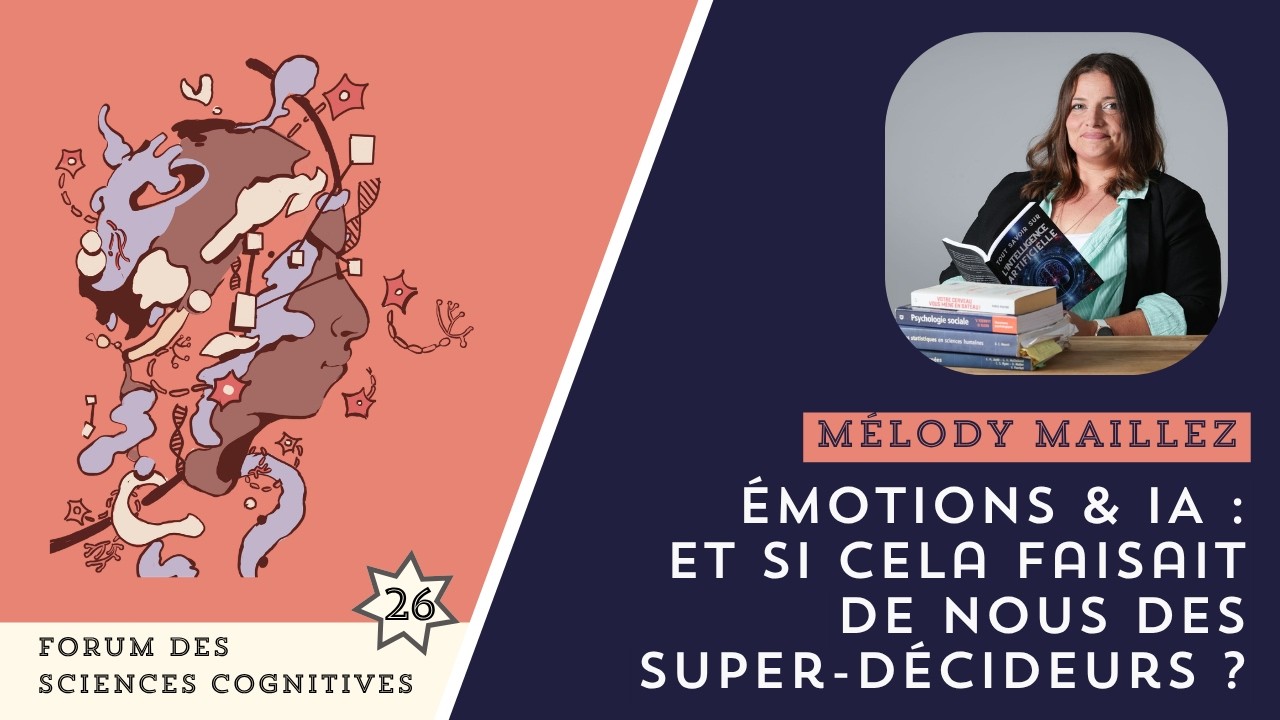
MÉLODY MAILLEZ - Les émotions et l'IA : et si cela faisait de nous des super-décideurs ?
Keywords
Summary
225 words
Critical Evaluation
The talk provides a solid overview of established research on emotions and decision-making, grounded in appraisal theories and experimental evidence. The speaker effectively explains complex concepts like heuristic vs. analytical processing with clear examples and a well-designed experiment (Tiedens & Linton, 2001). The presentation is engaging and accessible, using a relatable scenario (chocolate cake and smartphone) to illustrate incidental emotions. However, the title promises a focus on AI, but AI is only briefly mentioned at the end, which may disappoint viewers expecting a deeper discussion on human-AI interaction. The speaker’s argumentation is logically coherent, but she does not critically evaluate the limitations of the cited studies (e.g., artificial lab settings, reliance on self-reported emotions). She also does not discuss potential replication issues or alternative theories. The sources are not explicitly cited during the talk, but the description provides a link to the organizing association’s website, which may contain further resources. The Q&A segment adds value by addressing audience questions, but the responses are not always deeply elaborated. Overall, the talk is informative and scientifically sound, but it could benefit from more explicit citations and a more balanced treatment of AI’s role. The adéquation titre/contenu is weak, as the AI aspect is underdeveloped, which slightly lowers the overall score.
208 words
Title / Content Match
The title suggests a focus on AI and emotions, but the talk primarily covers emotional influences on decision-making with only a brief mention of AI at the end, making the title somewhat misleading.
Quality & Reliability
7/10
The talk is based on established psychological research (e.g., Lerner & Keltner, Tiedens & Linton) and presents experimental evidence accurately. However, it is a popular science presentation without detailed citations or peer-review context, and the speaker's own research is not detailed.
Key Moments
Markers derived by PSI from the transcript: the creator did not define chapters.
- Introduction: speaker introduces herself and the topic of emotions and AI in decision-making.
- Thought experiment: chocolate cake and smartphone purchase illustrating incidental emotions.
- Explanation of appraisal theories and six dimensions of cognitive evaluation.
- Discussion of certainty as a key dimension influencing heuristic vs. analytical processing.
- Detailed description of Tiedens and Linton (2001) experiment on sadness and persuasion.
- Limitations of single-shot decisions and introduction of feedback in real-life decisions.
- Brief mention of AI's potential role in improving decision-making and our reluctance to use it.
- Q&A session: audience questions on AI, emotional regulation, and practical applications.
Cited Sources
- Cognivence - Association des étudiant·es en sciences cognitives d'Île-de-France — Organizing association's website, likely containing event details and resources.
Concurring Sources
- Lerner, J. S., & Keltner, D. (2000). Beyond valence: Toward a model of emotion-specific influences on judgement and choice. Cognition & Emotion, 14(4), 473-493. — Cited as foundational work on emotion-specific effects on risk perception.
- Tiedens, L. Z., & Linton, S. (2001). Judgment under emotional certainty and uncertainty: The effects of specific emotions on information processing. Journal of Personality and Social Psychology, 81(6), 973-988. — The experiment described in detail in the talk.
Contribution & Novelties
The talk synthesizes existing research on emotions and decision-making, highlighting the role of certainty in determining processing style. It offers a clear explanation of how incidental emotions can bias choices, and briefly suggests that AI could help mitigate these biases by providing objective feedback. However, the AI aspect is underdeveloped and the talk does not present novel research findings.
Pour aller plus loin :
- Appraisal Theory — Foundational theory for understanding emotional dimensions.
- Lerner & Keltner (2000) — Original study on fear and anger affecting risk perception.
- Tiedens & Linton (2001) — Study on certainty and processing style.
- Heuristic vs. Systematic Processing — Model explaining dual processing.
107 words
Radar Profile
The radar profile shows high scores in information quality and reliability, reflecting the talk's grounding in established research. However, the quantity of information is moderate, and the technical level is accessible, indicating a balance between depth and accessibility. The overall reliability is strong, but the lack of explicit citations and the underdeveloped AI aspect prevent a perfect score.