Bristol Quiet Areas Plan 2025 - CCRI Seminar 14/05/26
Keywords
Summary
162 words
Critical Evaluation
Value of the Information & Strength of the Argument
The presentation provides valuable insights into the process of co-creating an inclusive map for quiet spaces, highlighting the importance of lived experience and iterative feedback. The argumentation is solid, grounded in the project’s methodology and preliminary findings. However, it is largely descriptive and lacks critical analysis of potential limitations or alternative approaches.
Scientific Rigor, Source Quality, Title Accuracy
The presentation references several sources, including the Hush City project, Natural England standards, and data from Tranquil City and Bristol City Council. The title accurately reflects the content. The scientific rigor is moderate, as the project is ongoing and results are preliminary. The speaker’s expertise in landscape architecture and the involvement of an advisory group lend credibility.
124 words
Title / Content Match
The title accurately reflects the content, which focuses on the Bristol Quiet Areas Plan and its development.
Quality & Reliability
7/10
The presentation is grounded in a funded research project (EPSRC) and references established frameworks (Hush City, Natural England standards). However, it is primarily a project overview with limited peer-reviewed citations and relies heavily on anecdotal insights.
Key Moments
Markers derived by PSI from the transcript: the creator did not define chapters.
- Introduction to the Hush City project and the importance of quiet spaces for health.
- Discussion of noise pollution as a major environmental health issue.
- Overview of the project team and partners.
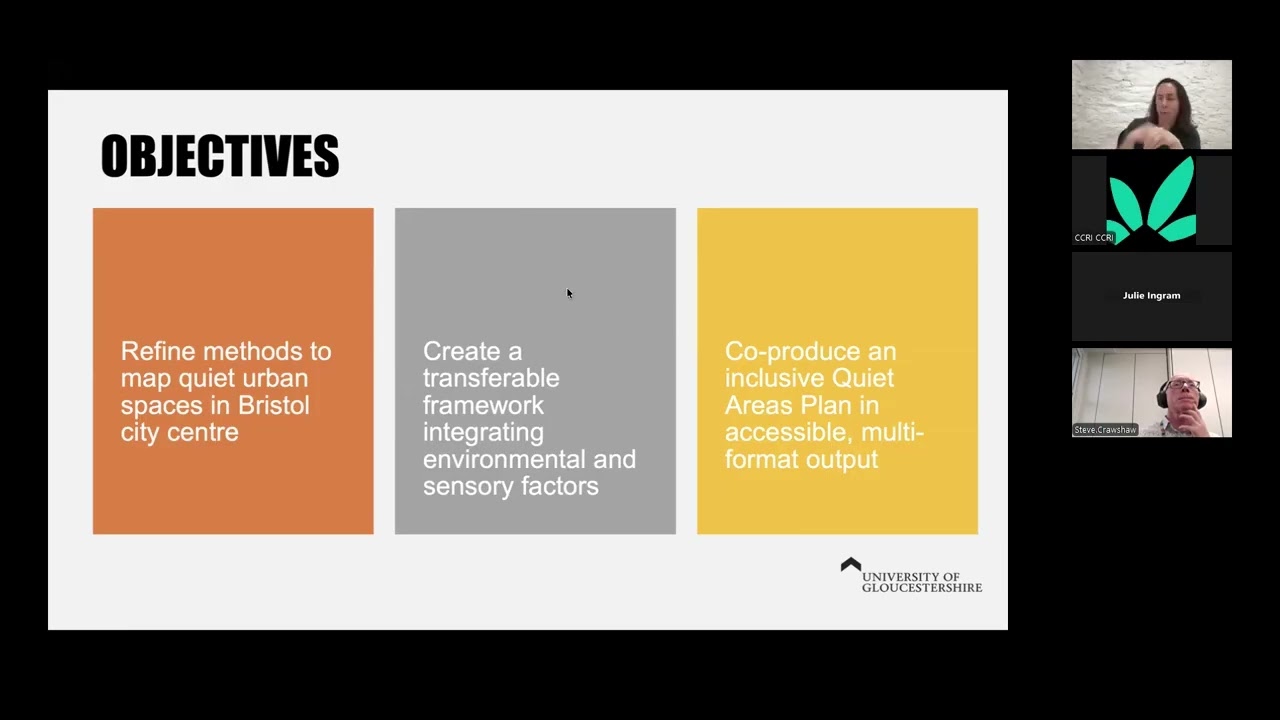
- Explanation of the project's objectives and methodology.
- Selection of the three sites and criteria used.
- Preliminary insights from sound walks and accessibility audits.
- Workshop on website design and sensory mapping examples.
- Upcoming events and launch plans.
Cited Sources
- Bristol Quiet Areas Plan — Project website with more information.
Concurring Sources
- Hush City — Global citizen science project on quiet areas.
Contribution & Novelties
The project’s novelty lies in its citizen-led, co-creative approach to mapping quiet spaces specifically for neurodivergent individuals, combining qualitative soundscape data with quantitative environmental data. It aims to produce a transferable framework for other cities.
Pour aller plus loin :
- Hush City — The citizen science app used for sound walks.
- Natural England Accessible Natural Greenspace Standard — Reference for green space accessibility standards.
- Tranquil City — Consultancy providing wellbeing data sets.
72 words
Radar Profile
The radar profile shows a balanced distribution across all dimensions, with slightly higher scores in information quality and reliability, indicating a well-rounded presentation with solid content and credible sources.