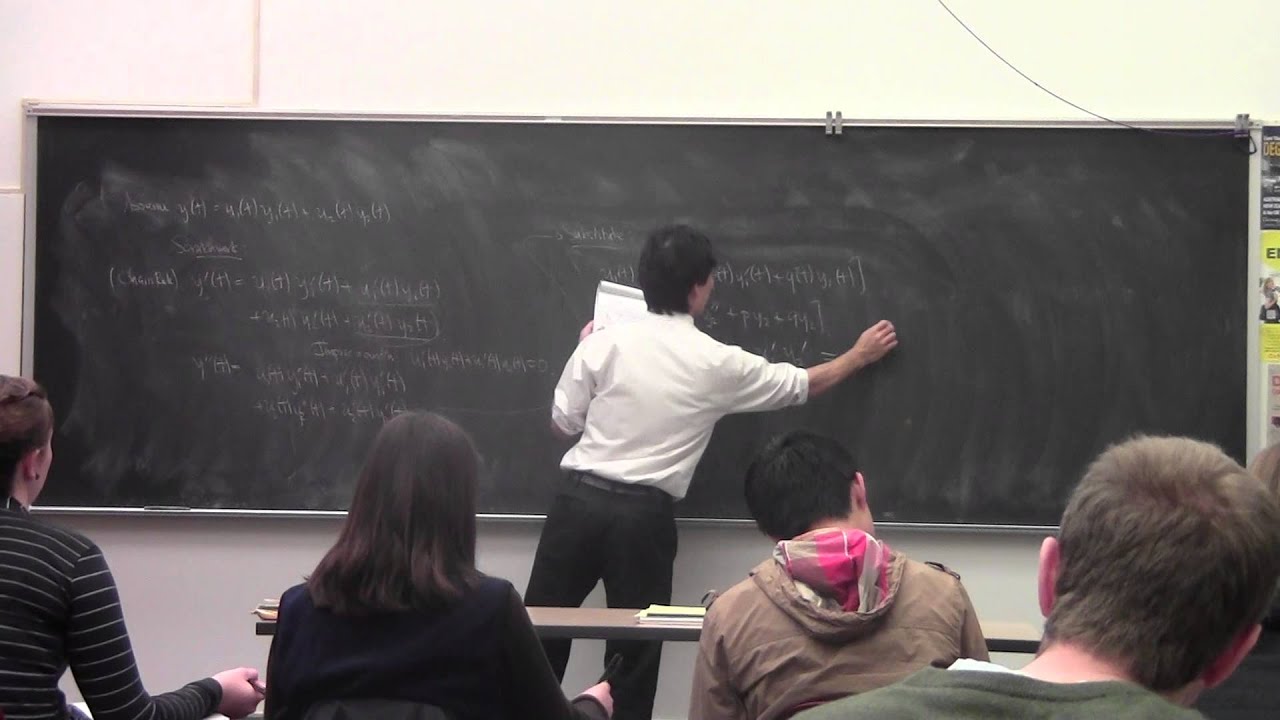
Math 111 Differential Equations Lecture 12.2 3.7.2 Variation of parameters
Keywords
Summary
145 words
Critical Evaluation
Value of the Information & Strength of the Argument
The lecture provides a clear and correct derivation of the variation of parameters method. The argumentation is logical, starting from the assumption of a particular solution form and systematically deriving the conditions needed. The use of the Wronskian to ensure invertibility is well-explained. The connection to D’Alembert’s method is noted, providing conceptual insight. The value lies in its pedagogical clarity, though it does not offer new mathematical insights beyond standard textbook material.
Scientific Rigor, Source Quality, Title Accuracy
The mathematical rigor is high; the derivation is standard and accurate. However, no external sources are cited, and the lecture relies solely on the instructor’s explanation. The title accurately reflects the content. The informal style, including a personal anecdote, does not detract from the scientific content but may affect perceived professionalism. No comments were provided for analysis.
144 words
Title / Content Match
The title accurately describes the content: a lecture on variation of parameters in differential equations.
Quality & Reliability
7/10
The lecture is mathematically sound, presenting the standard method of variation of parameters for second-order linear ODEs. The derivation is clear and correct, though the presentation is informal and includes a personal anecdote. No external sources are cited, but the mathematical content is accurate.
Key Moments
Markers derived by PSI from the transcript: the creator did not define chapters.
- Introduction to variation of parameters and its relation to D'Alembert's method.
- Assumption of particular solution form with variable coefficients.
- Imposition of condition to simplify second derivative.
- Derivation of system of equations for u1' and u2'.
- Use of Wronskian and matrix inversion to solve the system.
- Final formula for particular solution in integral form.
- Summary and connection to homogeneous solution.
Contribution & Novelties
The lecture provides a clear pedagogical exposition of the variation of parameters method, emphasizing the underlying logic and connection to D’Alembert’s method. It does not introduce new mathematical results but serves as an effective tutorial.
Pour aller plus loin :
- Variation of parameters (Wikipedia) — Provides a comprehensive overview and examples.
- Wronskian (Wikipedia) — Explains the determinant used to test linear independence.
- Ordinary differential equation (Wikipedia) — Background on ODEs and solution methods.
73 words
Radar Profile
The radar profile shows high scores in quality of information, technical level, and reliability, with a slightly lower score in quantity of information due to the short duration. The lecture is technically dense and reliable, making it a solid educational resource.