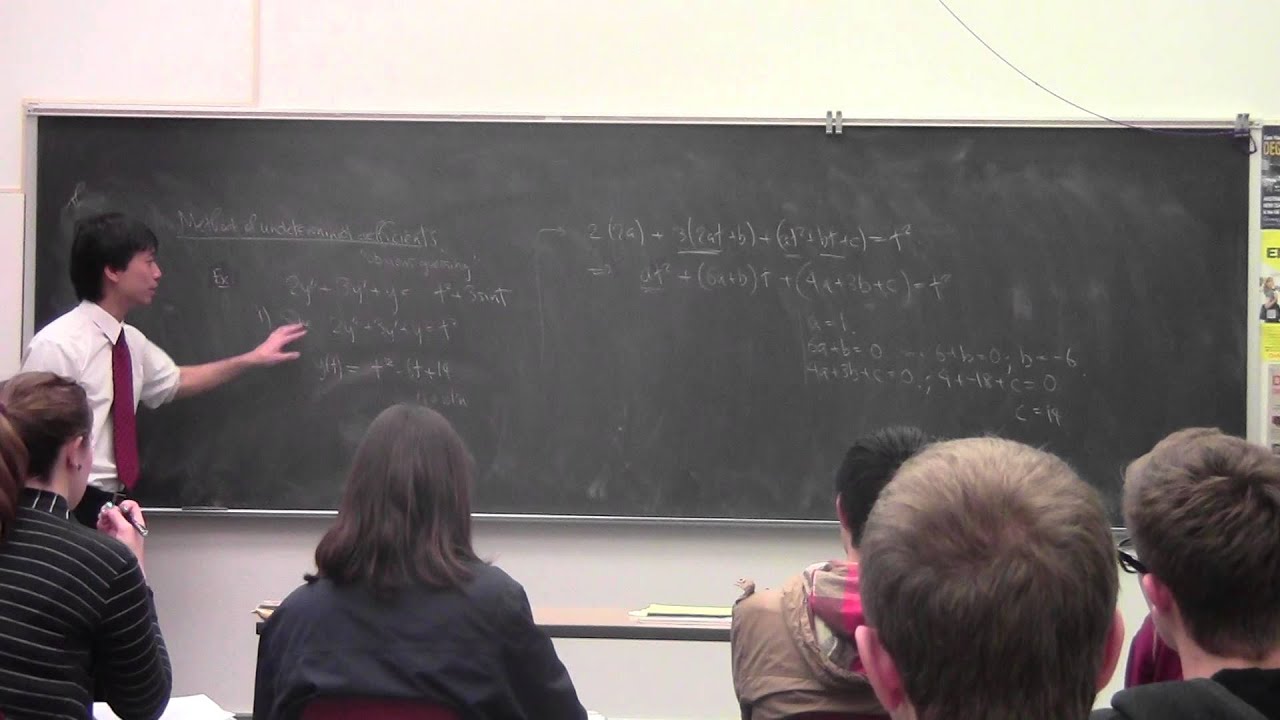
Math 111 Differential Equations Lecture 12.1 3.7.1 Undetermined coefficients
Keywords
Summary
206 words
Critical Evaluation
Value of the Information & Strength of the Argument
The lecture provides a clear and systematic explanation of the method of undetermined coefficients, which is a valuable technique for solving linear ODEs. The instructor uses concrete examples to illustrate the process, making the method accessible. He also explains the underlying reasoning, such as why the coefficients must match and why the guess must not be a solution to the homogeneous equation. The argumentation is solid, with each step logically derived and verified. The discussion of the failure case and the remedy of multiplying by t is particularly instructive. The lecture is well-structured and builds on previous knowledge, making it a useful resource for students.
Scientific Rigor, Source Quality, Title Accuracy
The lecture is mathematically rigorous, with correct derivations and appropriate use of terminology. The instructor does not cite external sources, which is typical for a lecture on a standard topic. The title accurately reflects the content, and the lecture is consistent with standard textbooks on differential equations. The instructor’s explanations are precise, and he addresses potential misunderstandings, such as the need to solve the homogeneous equation first. The content is reliable and aligns with established mathematical theory.
197 words
Title / Content Match
The title accurately describes the content: a lecture on the method of undetermined coefficients for differential equations, covering section 3.7.1.
Quality & Reliability
8/10
The lecture is mathematically rigorous, with clear step-by-step derivations and correct application of the method of undetermined coefficients. The instructor demonstrates the method through examples, addresses potential pitfalls, and connects to the theory of linear differential equations. The content is accurate and well-structured, though it is a standard topic with no novel contributions.
Key Moments
Markers derived by PSI from the transcript: the creator did not define chapters.
- Introduction to the method of undetermined coefficients and the overall strategy for solving non-homogeneous ODEs.
- First example: solving for a polynomial forcing term (t^2 + 3t + 17).
- Second example: solving for a trigonometric forcing term (3 sin t).
- Combining particular solutions and solving the homogeneous equation.
- Discussion of potential pitfalls and the need to adjust guesses when they are homogeneous solutions.
- Example of a failure case and the remedy of multiplying by t.
- Mention of the method of variation of parameters as an alternative.
- Solving the homogeneous equation for the examples and presenting the general solution.
Contribution & Novelties
The lecture provides a clear and detailed explanation of the method of undetermined coefficients, with a focus on practical problem-solving. It effectively addresses common student difficulties, such as the failure case and the need to multiply by t. The lecture is a valuable educational resource for students learning differential equations.
Pour aller plus loin :
- Method of undetermined coefficients - Wikipedia — Provides a comprehensive overview of the method, including examples and variations.
- Variation of parameters - Wikipedia — An alternative method for solving non-homogeneous ODEs, mentioned in the lecture.
- Linear differential equation - Wikipedia — Background on linear ODEs and their solutions.
103 words
Radar Profile
The radar profile shows high scores in quality, technical level, and reliability, with a slightly lower score in quantity of information. This indicates a focused, rigorous lecture that provides solid content but may not cover an extensive range of topics. The balance suggests a well-structured educational resource.