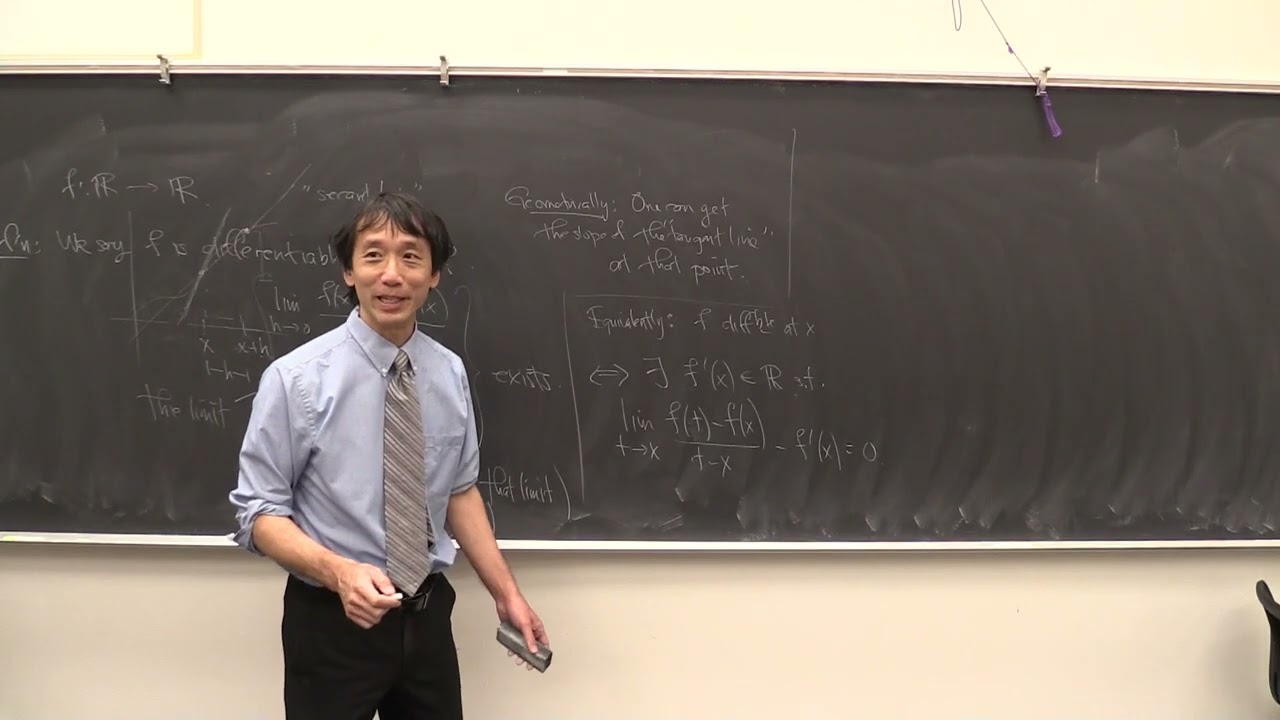
Math 131 030226 What is differentiability
Keywords
Summary
161 words
Critical Evaluation
Value of the Information & Strength of the Argument
The lecture provides a rigorous and insightful treatment of differentiability. It goes beyond the standard calculus presentation by introducing an equivalent definition based on linear approximation, which offers a deeper conceptual understanding. The proofs are clear and well-motivated, with the instructor explaining the strategy behind each step (e.g., ‘squeezing in’ the term you want to control). The argumentation is solid, as each proof is logically sound and builds on previously established results. The value lies in the pedagogical approach that emphasizes multiple perspectives, which is beneficial for students.
Scientific Rigor, Source Quality, Title Accuracy
The lecture is mathematically rigorous, with precise definitions and proofs. The instructor does not cite external sources during the lecture, but he mentions William Thurston’s article ‘On Proof and Progress in Mathematics’ as a reference for having multiple models of a concept. The title accurately reflects the content, as the lecture focuses on the definition and basic properties of differentiability. No comments were provided for analysis.
169 words
Title / Content Match
The title accurately reflects the content: the lecture focuses on the concept of differentiability, its definition, and basic properties.
Quality & Reliability
8/10
Lecture by a university instructor (likely a professor) presenting rigorous definitions and proofs of differentiability, including the equivalence of the limit definition and the linear approximation definition, and proving differentiability implies continuity and the product rule. The content is mathematically sound and presented with pedagogical clarity.
Key Moments
Markers derived by PSI from the transcript: the creator did not define chapters.
- Introduction to chapter on differentiation; asking students for definition of differentiability.
- Formal definition of differentiability using the limit of the difference quotient.
- Equivalent definition using linear approximation: f(t) = f(x) + f'(x)(t-x) + u(t)(t-x) with u(t) -> 0.
- Interpretation: differentiability means the function is 'basically a line' when zoomed in; reference to Thurston's article.
- Proof that differentiability implies continuity using the limit definition.
- Alternative proof of differentiability implies continuity using the linear approximation definition.
- Statement of basic properties: sum rule, product rule, quotient rule.
- Proof of the sum rule using the linear approximation definition.
- Proof of the product rule using the limit definition, with a 'cleverly chosen zero'.
Cited Sources
- On Proof and Progress in Mathematics — Mentioned by the instructor as an article that discusses multiple ways of understanding mathematical concepts, specifically the derivative.
Concurring Sources
- On Proof and Progress in Mathematics — The instructor's reference to Thurston's article aligns with the lecture's emphasis on multiple conceptual models.
Contribution & Novelties
The lecture provides a clear and rigorous exposition of differentiability, emphasizing an equivalent definition via linear approximation that is often not highlighted in introductory calculus. This perspective helps students understand why differentiability is a stronger condition than continuity. The proofs are presented with pedagogical strategies that are valuable for learners.
Pour aller plus loin :
- On Proof and Progress in Mathematics — Thurston’s article on multiple models of mathematical concepts.
- Differentiable function - Wikipedia — Overview of differentiability and related concepts.
- Derivative - Wikipedia — Comprehensive treatment of derivatives and their interpretations.
92 words
Radar Profile
The radar profile shows high scores in information quantity, quality, and technical level, with a slightly lower but still strong reliability score. This indicates a lecture that is rich in content, rigorous, and technically demanding, while being reliable in its mathematical correctness.