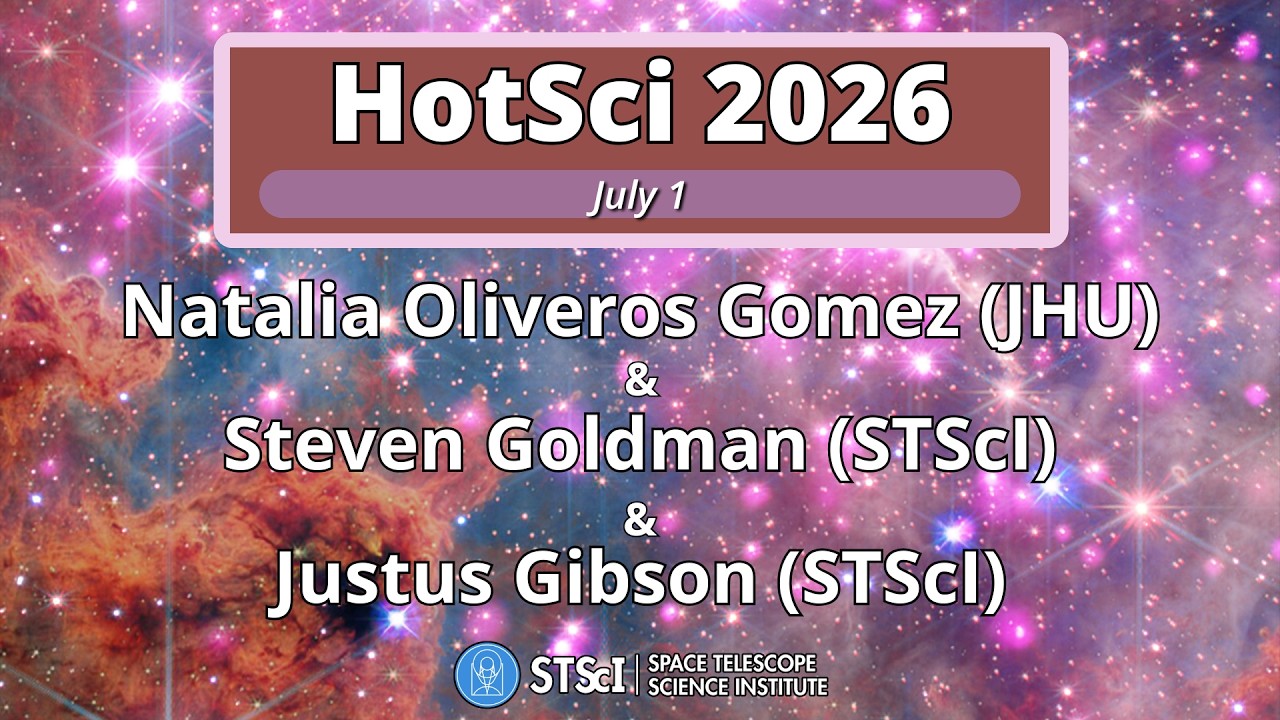
STScI/JHU 2026 HotSci Series -- July 1st
Keywords
Summary
206 words
Critical Evaluation
Value of the Information & Strength of the Argument
The value of the information is high, as the talks present original research with detailed data and analysis. The speakers provide clear context, methodology, and preliminary results. The argumentation is solid, with each talk building a logical case from observations to interpretations. For instance, Oliveros Gomez carefully compares variability amplitudes across molecular bands and uses atmospheric retrievals to support the hypothesis of thermochemical instabilities. Goldman presents observational evidence that challenges theoretical predictions, strengthening the case for revising dust formation models. Gibson uses detailed modeling to argue for prolate geometries, a surprising result. The talks are well-structured and supported by data, though some results are preliminary and warrant further investigation.
Scientific Rigor, Source Quality, Title Accuracy
The scientific rigor is high, as the talks are based on observations from major facilities like JWST and Hubble, and the speakers are affiliated with reputable institutions. The sources cited include specific programs (e.g., GO-2965, JADES survey) and prior work (e.g., Boyer et al.). The title accurately reflects the content, as it is a colloquium series. The adequacy between title and content is strong, with each talk directly addressing the announced topics. No comments were provided, so no analysis of public trends is possible.
208 words
Title / Content Match
The title accurately reflects the content: a series of scientific talks from the STScI/JHU HotSci series on July 1st.
Quality & Reliability
8/10
The video presents three original research talks from a scientific colloquium, featuring detailed data, methods, and preliminary results. The speakers are researchers from JHU and STScI, and the content is consistent with current astrophysical research. However, as a colloquium, the results are preliminary and not yet peer-reviewed in this format.
Key Moments
Markers derived by PSI from the transcript: the creator did not define chapters.
- Introduction by Annabella Meech, presenting the three speakers.
- Natalia Oliveros Gomez begins her talk on brown dwarf variability in WISE 1049AB.
- Oliveros Gomez explains the use of JWST NIRSpec/MIRI time-resolved spectroscopy.
- Oliveros Gomez presents results on variability amplitudes and thermochemical instabilities.
- Oliveros Gomez discusses atmospheric retrievals and the role of inclination.
- Steven Goldman begins his talk on AGB dust production in DDO 68.
- Goldman presents the Hubble/WFC3 observations and the discovery of oxygen-rich AGB stars in metal-poor environment.
- Justus Gibson begins his talk on ultra-red flattened objects observed with JWST.
Cited Sources
- JWST GO-2965 program — Mentioned as the source of NIRSpec/MIRI observations for WISE 1049AB.
- JADES survey — Used for JWST imaging of GOODS fields to identify ultra-red galaxies.
- Boyer et al. (DUSTING survey) — Previous work on AGB stars in metal-poor galaxies, including DDO 68.
Concurring Sources
- Boyer et al. 2015 (DUSTING survey) — Previous detection of AGB stars in metal-poor galaxies, supporting the new findings.
- Vos et al. 2022 (brown dwarf variability) — Studies on brown dwarf variability and atmospheric dynamics.
Dissenting Sources
- Theoretical models predicting suppression of silicate dust at low metallicity — The talk challenges these models by finding oxygen-rich AGB stars producing dust in DDO 68.
Contribution & Novelties
The video provides original research contributions: first observational evidence linking thermochemical instabilities to brown dwarf variability, a large sample of oxygen-rich AGB stars in an extremely metal-poor galaxy challenging dust formation models, and a population of prolate galaxies at cosmic noon. These findings advance our understanding of substellar atmospheres, dust production, and galaxy morphology.
Pour aller plus loin :
- Brown dwarf — Overview of brown dwarfs and their characteristics.
- Asymptotic giant branch — Detailed explanation of AGB stars and their role in dust production.
- James Webb Space Telescope — Information on the JWST mission and its capabilities.
- Galaxy morphological classification — Context for the prolate galaxy shapes discussed.
108 words
Radar Profile
The radar profile shows high scores across all dimensions, indicating a scientifically robust and informative video. The quantity and quality of information are strong, with a high technical level and good reliability. The video is suitable for an audience with some astrophysics background.