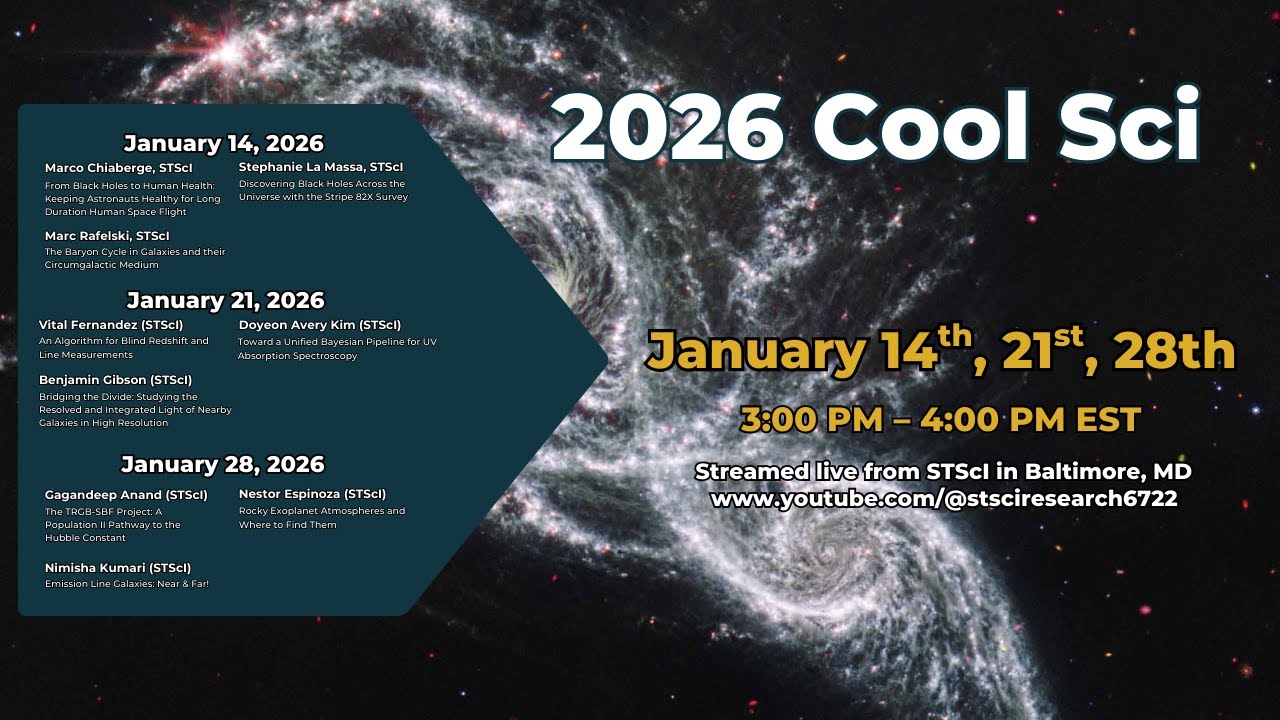
CoolSci 2026: Celebrating STScI Achievement in Astronomical Research Award Winners
Keywords
Summary
124 words
Critical Evaluation
Value of the Information & Strength of the Argument
The talks provide valuable insights into cutting-edge astronomical research and interdisciplinary applications. Chiaberge’s argument for jumping exercise is supported by experimental data showing significant increases in cartilage thickness and volume in mice, with a clear hypothesis and methodology. La Massa’s presentation on Stripe 82X is well-structured, explaining the survey design and its importance for understanding obscured AGN. Rafelski’s talk synthesizes results from multiple surveys, providing a coherent picture of the baryon cycle. The argumentation is solid, with each speaker presenting evidence and logical reasoning. However, the video is a recording of a seminar, so some details are abbreviated, and the audience interaction is limited.
Scientific Rigor, Source Quality, Title Accuracy
The scientific rigor is high, as the speakers are experts and present peer-reviewed research. Chiaberge’s study was published in a Nature partner journal, and La Massa and Rafelski reference established surveys and collaborations. The sources are not explicitly cited in the video, but the research is based on published work. The title accurately reflects the content, and the talks are well-organized. The video does not include a formal citation list, but the research is credible. The audience appears engaged, and the Q&A sessions are brief.
204 words
Title / Content Match
The title accurately reflects the content: a celebration of STScI award winners presenting their research.
Quality & Reliability
8/10
The video presents three research talks by STScI scientists, covering peer-reviewed work (e.g., published in Nature partner journals) and established survey results. The content is technical and appears accurate, with clear methodology and references to published studies. Minor limitations include the informal setting and lack of detailed citations in the video itself.
Key Moments
Markers derived by PSI from the transcript: the creator did not define chapters.
- Introduction and welcome to CoolSci 2026, celebrating STScI award winners.
- Marco Chiaberge begins his talk on black holes and human health.
- Chiaberge discusses the risks of spaceflight and the need for new exercise countermeasures.
- Chiaberge presents the mice jumping experiment and results.
- Stephanie La Massa begins her talk on discovering black holes with Stripe 82X.
- La Massa explains the importance of obscured AGN and the survey design.
- Marc Rafelski begins his talk on the baryon cycle in galaxies.
- Rafelski presents results from the MUDF, KAGG, and Qz5 surveys.
- Conclusion and closing remarks.
Cited Sources
- Jumping exercise improves cartilage health in mice (Nature partner journal) — Mentioned by Marco Chiaberge as the published paper from his team's study.
- Stripe 82X survey — Presented by Stephanie La Massa as the wide-area X-ray survey she works on.
- MUSE Ultra Deep Field (MUDF) — Mentioned by Marc Rafelski as one of the surveys used to study the baryon cycle.
- KCWI Analysis of Gas around Galaxies (KAGG) survey — Mentioned by Marc Rafelski as a survey expanding the sample of galaxies associated with DLAs.
- Qz5 survey — Mentioned by Marc Rafelski as a survey of z~5 quasars.
Concurring Sources
- NASA Human Research Program — Provides information on the risks of spaceflight and countermeasures, aligning with Chiaberge's talk.
- Sloan Digital Sky Survey — The Stripe 82 region is part of SDSS, providing multi-wavelength data for the survey.
- XMM-Newton — One of the X-ray observatories used in the Stripe 82X survey.
Contribution & Novelties
The video provides a unique interdisciplinary perspective, linking astronomy with human physiology. Chiaberge’s work on jumping exercise as a countermeasure for cartilage degradation is novel and has potential applications for both astronauts and patients on Earth. La Massa’s Stripe 82X survey contributes to our understanding of obscured AGN, a population that is often missed in other surveys. Rafelski’s synthesis of multiple surveys offers a comprehensive view of the baryon cycle, with new constraints on the cosmic HI mass density. These talks highlight the importance of multi-wavelength observations and interdisciplinary collaboration.
Pour aller plus loin :
- Active galactic nucleus — Overview of AGN and their importance.
- Circumgalactic medium — Definition and role in galaxy evolution.
- Microgravity effects on human body — NASA’s overview of physiological effects of spaceflight.
- Plyometrics — Exercise technique relevant to jumping exercise.
- Baryon cycle — Related to galaxy evolution and gas cycling.
145 words
Radar Profile
The radar profile shows high scores across all dimensions, indicating a well-balanced and informative video. The high technical level and reliability scores reflect the expertise of the presenters and the scientific rigor of the content. The quantity and quality of information are also strong, making this a valuable resource for those interested in astronomy and space science.
💬 No comments were provided for analysis.