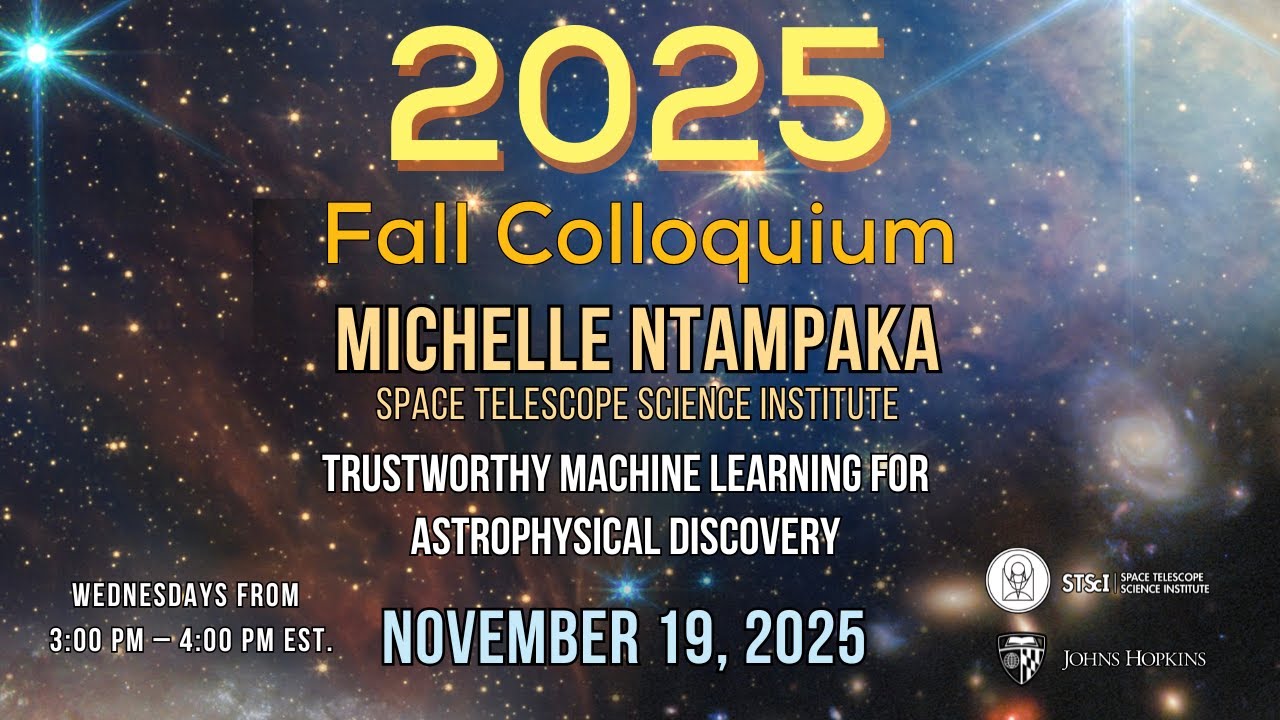
Trustworthy Machine Learning for Astrophysical Discovery
Keywords
Summary
143 words
Critical Evaluation
Value of the Information & Strength of the Argument
The talk provides valuable insights into the application of machine learning in cosmology, emphasizing the importance of interpretability and domain adaptation. Ntampaka argues convincingly that machine learning can be a powerful tool for discovery, but only if models are understood and validated. She supports her arguments with concrete examples from her own research, such as the CNN for cluster mass estimation and the analysis of the velocity distribution function. The argumentation is logical and well-structured, though it relies heavily on the speaker’s own work and may not fully address alternative perspectives.
Scientific Rigor, Source Quality, Title Accuracy
The talk demonstrates scientific rigor by referencing published studies, such as the work on texture vs. shape in CNNs and the Datasaurus Dozen. However, the sources are not explicitly cited in the video description, and the talk is a colloquium presentation rather than a peer-reviewed publication. The title accurately reflects the content, and the talk is well-organized. The speaker’s expertise and the inclusion of specific examples enhance the credibility of the presentation.
178 words
Title / Content Match
The title accurately reflects the content, focusing on the development and application of trustworthy machine learning methods in astrophysics.
Quality & Reliability
8/10
The talk is given by an expert in the field, with a clear methodological approach and references to published work. However, it is a colloquium presentation, not a peer-reviewed publication, and some claims are based on the speaker's own research without external validation.
Key Moments
Markers derived by PSI from the transcript: the creator did not define chapters.
- Introduction to the talk and the interdisciplinary nature of the research.
- Discussion of cosmology as an ideal sandbox for machine learning.
- Explanation of galaxy clusters and their role as cosmological probes.
- Presentation of the velocity distribution function and its implications for sigma-8 tension.
- Introduction to the use of convolutional neural networks for cluster mass estimation.
- Discussion of interpretability and the model's ability to ignore cluster cores.
- Example of a cluster that behaved differently, highlighting the importance of interpretation.
- Discussion of the Datasaurus Dozen and the limitations of summary statistics.
- Discussion of texture vs. shape in CNNs and its implications for cosmology.
- Conclusion and call for using machine learning as a scientific partner.
Cited Sources
- IllustrisTNG simulation — Used for mock observations of galaxy clusters.
- Chandra X-ray Observatory — Simulated observations for the CNN.
- Fritz Zwicky's 1933 paper on dark matter — Historical context for dark matter in galaxy clusters.
- eROSITA mission — Recent results on cluster cosmology.
- Datasaurus Dozen — Illustrates the limitations of summary statistics.
Concurring Sources
- IllustrisTNG simulation — Used for mock observations, consistent with the speaker's approach.
- Chandra X-ray Observatory — Simulated observations, consistent with the speaker's approach.
Dissenting Sources
- eROSITA results — The speaker mentions that eROSITA results may have put the sigma-8 tension to rest, but she notes a remaining delicate tension.
Contribution & Novelties
The talk contributes to the field by advocating for interpretable and trustworthy machine learning in astrophysics, demonstrating with concrete examples how models can be used as scientific partners. It highlights the importance of domain adaptation and the need to validate models against simulations. The speaker’s work on the velocity distribution function offers a new approach to constraining cosmological parameters.
Pour aller plus loin :
- Interpretable Machine Learning — A comprehensive guide to interpretability methods.
- Domain Adaptation — Overview of techniques for adapting models to new domains.
- Galaxy Cluster Mass Estimation — Overview of methods used to estimate cluster masses.
99 words
Radar Profile
The radar profile shows high scores in quantity and quality of information, as well as reliability, with a slightly lower score in technical level, indicating that the talk is accessible but still rigorous. The overall balance suggests a well-rounded presentation suitable for an expert audience.
💬 No comments were provided for analysis.