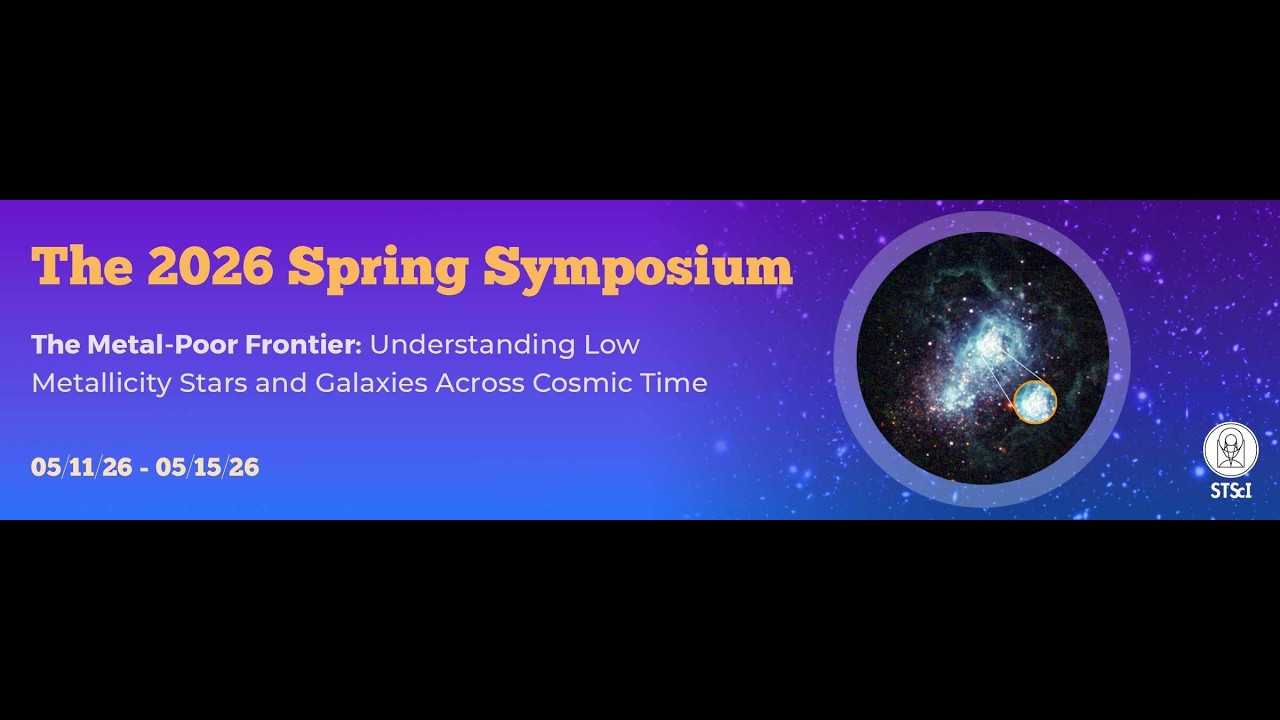
2026 Spring Symposium: Day 4 | Session 15
Keywords
Summary
138 words
Critical Evaluation
Value of the Information & Strength of the Argument
The video provides valuable insights into current research on low-metallicity stars and galaxies. The first talk offers a comprehensive overview of chemical evolution models, demonstrating their power in constraining nucleosynthesis and galaxy formation processes. The speaker presents a strong argument for the use of abundance ratios as diagnostic tools, supported by comparisons with observational data. The second talk raises critical questions about the reliability of nebular abundance determinations, highlighting potential systematic errors. The argumentation is solid, grounded in established astrophysical theory and recent observations, but the format limits the depth of explanation.
Scientific Rigor, Source Quality, Title Accuracy
The scientific rigor is high, as the talks are given by experts in the field and reference current research. The sources cited are not explicitly listed, but the content aligns with published literature on chemical evolution and nebular physics. The title accurately reflects the content, as it is a session of a symposium dedicated to the low-metallicity universe. The video is a recording of a live event, so the quality is typical of conference presentations, with occasional technical issues.
186 words
Title / Content Match
The title accurately reflects the content: it is a session of the 2026 Spring Symposium, focusing on low-metallicity stars and galaxies.
Quality & Reliability
8/10
The video is a recording of a scientific symposium session, featuring expert talks on chemical evolution and nebular physics. The content is technical and based on established research, but it is a conference presentation, not peer-reviewed publication. The quality is high, but the format limits depth and verification.
Key Moments
Markers derived by PSI from the transcript: the creator did not define chapters.
- Introduction and announcements about the dinner and logistics.
- Chiaki Kobayashi begins her talk on chemical evolution.
- Discussion of one-zone chemical evolution models and their predictions.
- Presentation of hydrodynamical simulations and their comparison with observations.
- Discussion of nitrogen-to-oxygen ratios and the role of rotating massive stars.
- Q&A session following Kobayashi's talk.
- Eduardo Méndez-Delgado begins his talk on nebular abundance uncertainties.
- Discussion of Case B recombination and thermal uniformity assumptions.
- Q&A session following Méndez-Delgado's talk.
Cited Sources
- STScI 2026 Spring Symposium — The symposium is the context for the talks.
Concurring Sources
- STScI 2026 Spring Symposium — The symposium is the context for the talks.
Contribution & Novelties
The video provides an overview of current research on low-metallicity systems, highlighting recent advances in chemical evolution modeling and the challenges in interpreting nebular abundances. The first talk emphasizes the utility of abundance ratios in constraining galaxy formation and feedback, while the second raises important caveats about abundance determinations. The content is valuable for researchers in the field, but it is not a primary research output.
Pour aller plus loin :
- Galactic chemical evolution — Overview of the field.
- Nucleosynthesis — Background on element production.
- James Webb Space Telescope — Context for observations of high-redshift galaxies.
96 words
Radar Profile
The radar profile shows high scores in all dimensions, indicating a technically dense and reliable presentation. The highest score is in technical level, reflecting the advanced nature of the content, while the slightly lower scores in quantity and quality of information are due to the format of a conference session.
💬 No comments were provided for analysis.