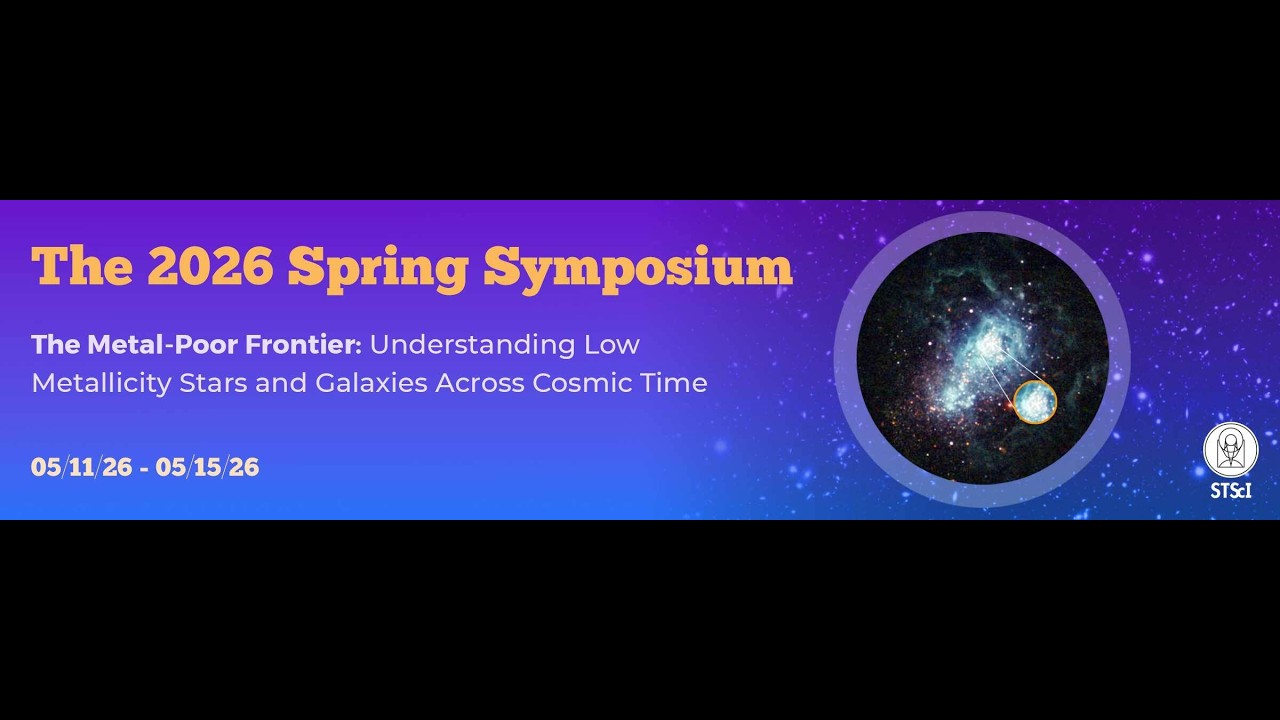
2026 Spring Symposium: Day 3 | Session 11
Keywords
Summary
136 words
Critical Evaluation
Value of the Information & Strength of the Argument
The session provides valuable insights into the current state of research on low-metallicity stars and galaxies. The talks present a combination of observational results, theoretical models, and open questions, offering a comprehensive overview. The argumentation is generally solid, with speakers supporting their claims with data and referencing recent studies. However, some speculative aspects, such as chemically homogeneous evolution, are presented with appropriate caution. The discussion highlights the complexity of stellar feedback and the need for multi-wavelength observations and improved models.
Scientific Rigor, Source Quality, Title Accuracy
The scientific rigor is high, with speakers referencing peer-reviewed studies and presenting data from surveys like the BLOOM survey. The sources cited are relevant and credible. The title accurately reflects the content, which is a session of a scientific symposium. The adequacy between title and content is good, as the talks directly address the symposium’s theme. The session does not include any commercial or promotional content.
161 words
Title / Content Match
The title accurately reflects the content, which is a session of the 2026 Spring Symposium focused on low-metallicity stars and galaxies.
Quality & Reliability
8/10
The video is a recording of a scientific symposium session, featuring expert talks and discussions. The content is technical and appears to be based on current research, but the transcription is incomplete and contains informal remarks, limiting verification.
Key Moments
Markers derived by PSI from the transcript: the creator did not define chapters.
- Introduction and announcements by the session chair.
- Talk on hard photons in a metal-poor universe begins.
- Discussion on very massive stars and Wolf-Rayet stars.
- Presentation of BLOOM survey results on binary fractions.
- Talk on stripped stars and their detection challenges.
- Discussion on chemically homogeneous evolution and rotation.
- Presentation on nitrogen enrichment in massive stars.
- Q&A and discussion on overshooting and mixing.
- Further talks and panel discussion.
- Closing remarks and end of session.
Cited Sources
- BLOOM survey — Mentioned as a multi-epoch spectroscopic survey of massive stars in the SMC.
- GRAVITY+ collaboration — Resolved a binary system in another galaxy, providing mass estimates.
- Clansky et al. — Modeling of stripped stars at different metallicities.
- Ludwigal et al. — Published a list of stripped star candidates in the Magellanic Clouds.
- Bloomberg et al. — Forward modeling of stripped star populations to account for observational biases.
- Lenon et al. — Study of rotation rates in BLOOM survey stars, suggesting enhanced overshooting.
- Malchant and Pablo — Paper on nitrogen enrichment in massive stars, submitted for publication.
Concurring Sources
- BLOOM survey — Provides data on binary fractions and stellar properties in the SMC, supporting the discussion.
- GRAVITY+ collaboration — Resolved a binary in another galaxy, consistent with the presence of massive binaries.
Dissenting Sources
- Clansky et al. — Their models suggest that stripped stars at low metallicity may be cooler and less ionizing, contrasting with the expectation that they are hot and efficient ionizers.
Contribution & Novelties
The session provides a comprehensive overview of current research on low-metallicity stars and galaxies, highlighting recent findings and open questions. It emphasizes the importance of binary interactions, stellar mixing, and the role of massive stars in shaping the ionizing radiation and chemical enrichment of the early universe. The talks also discuss the challenges in detecting stripped stars and the potential of chemically homogeneous evolution, offering a balanced perspective on these topics.
Pour aller plus loin :
- Wolf–Rayet star — Overview of Wolf-Rayet stars, their properties, and formation channels.
- Stellar evolution — General concepts of stellar evolution, including the role of mass loss and binary interactions.
- James Webb Space Telescope — Information on JWST and its capabilities for observing distant galaxies and stars.
122 words
Radar Profile
The radar profile shows high scores in technical level and information quality, reflecting the advanced scientific content. The lower score in quantity of information is due to the incomplete transcription, but the session covers a wide range of topics. Overall, the profile indicates a highly specialized and reliable source.