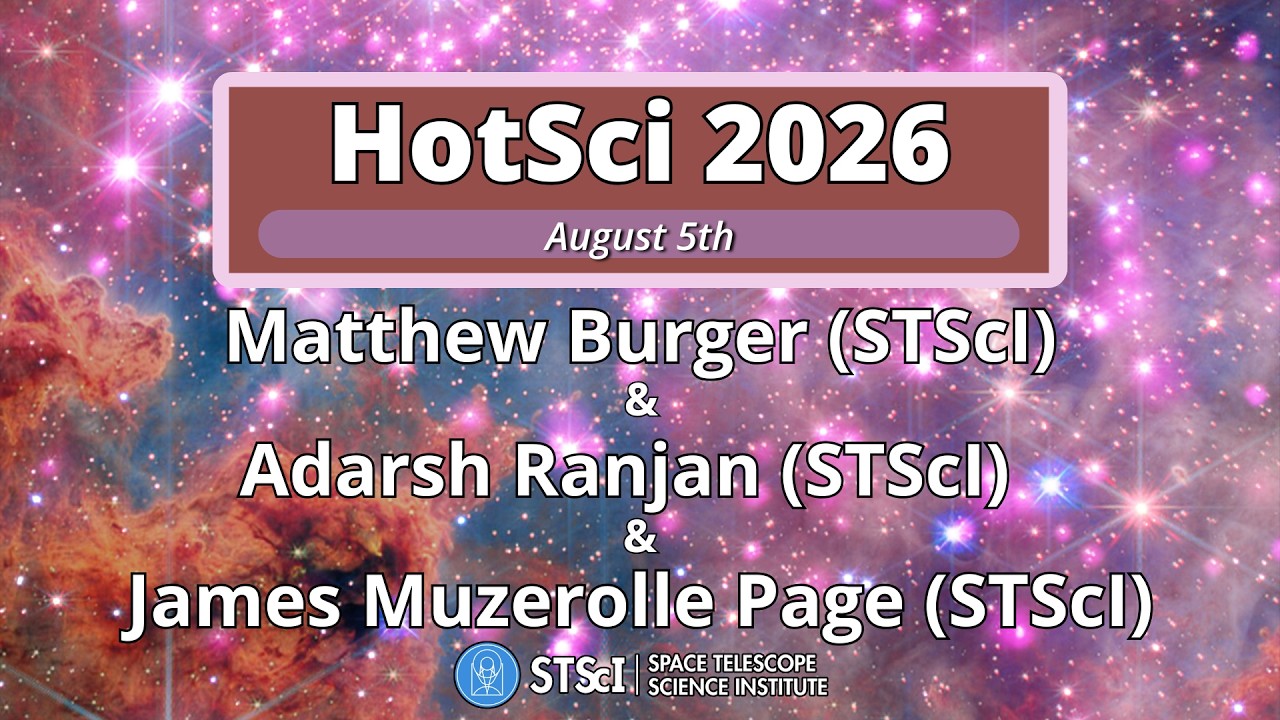
STScI/JHU 2026 HotSci Series -- August 5
Keywords
Summary
197 words
Critical Evaluation
Value of the Information & Strength of the Argument
The video provides substantial scientific value by presenting original research findings from three distinct areas of astrophysics. Each talk is well-structured, with clear hypotheses, methodology, and results. The arguments are supported by observational data and modeling, and the speakers acknowledge uncertainties and open questions. The talks are technically detailed, making them valuable for researchers in the field. The Q&A sessions add depth by addressing potential concerns and clarifying points.
Scientific Rigor, Source Quality, Title Accuracy
The scientific rigor is high, as the talks are based on peer-reviewed research and use data from reputable observatories like MESSENGER, HST, and JWST. The speakers reference specific papers and instruments, and the methodology appears sound. The title accurately reflects the content, which is a series of scientific talks. The video is a recording of a seminar, so it is not a formal publication, but the content is credible and well-presented.
155 words
Title / Content Match
The title accurately describes the content: a series of scientific talks presented at the STScI/JHU HotSci series on August 5, 2026.
Quality & Reliability
8/10
The video presents three original research talks by STScI researchers, with detailed methodology and references to published work. The content is technical and appears scientifically rigorous, though it is a seminar recording without peer review.
Key Moments
Markers derived by PSI from the transcript: the creator did not define chapters.
- Introduction to the HotSci series and first speaker Matthew Burger.
- Burger explains the concept of surface-bounded exospheres and their importance.
- Discussion of sodium exosphere observations from MESSENGER and ground-based telescopes.
- Burger presents modeling of sodium escape and the role of radiation pressure.
- Q&A session for the first talk.
- Adarsh Ranjan begins his talk on star-forming galaxies.
- Ranjan discusses resolved H II regions in DDO 68 and M83.
- Comparison of UV and optical metallicity diagnostics.
- Q&A session for the second talk.
- James Muzerolle Page presents on protostellar accretion outbursts.
Cited Sources
- Potter & Morgan 1985 — Discovery of sodium in Mercury's exosphere.
- Potter & Morgan 1986 — Further observations of sodium exosphere.
- MESSENGER mission — Spacecraft observations of Mercury's exosphere.
- Barl 2020 — UV metallicity diagnostics for galaxies.
- JWST/NIRSpec — Observations of protostellar accretion outbursts.
Concurring Sources
- Potter & Morgan 1985 — Discovery of sodium exosphere, consistent with Burger's talk.
- MESSENGER mission — Data used in Burger's talk, consistent with published results.
Dissenting Sources
- None — No discordant sources were identified within the video.
Contribution & Novelties
The video presents original research findings: new insights into Mercury’s exospheric sodium escape, resolved studies of star-forming galaxies across metallicities, and JWST observations of periodic accretion outbursts. These contribute to understanding planetary exospheres, galaxy evolution, and star formation.
Pour aller plus loin :
- Exosphere — Overview of exospheres, relevant to the first talk.
- Mercury’s sodium tail — Information on Mercury’s exosphere and sodium tail.
- JWST — Context for the second and third talks.
- H II region — Relevant to the second talk on star-forming regions.
- Accretion (astrophysics) — Relevant to the third talk on protostellar accretion.
96 words
Radar Profile
The radar profile shows high scores across all dimensions, indicating a technically dense and reliable scientific seminar. The balance between information quantity, quality, technical level, and reliability is strong, with no significant weaknesses.
💬 No comments were provided for analysis.