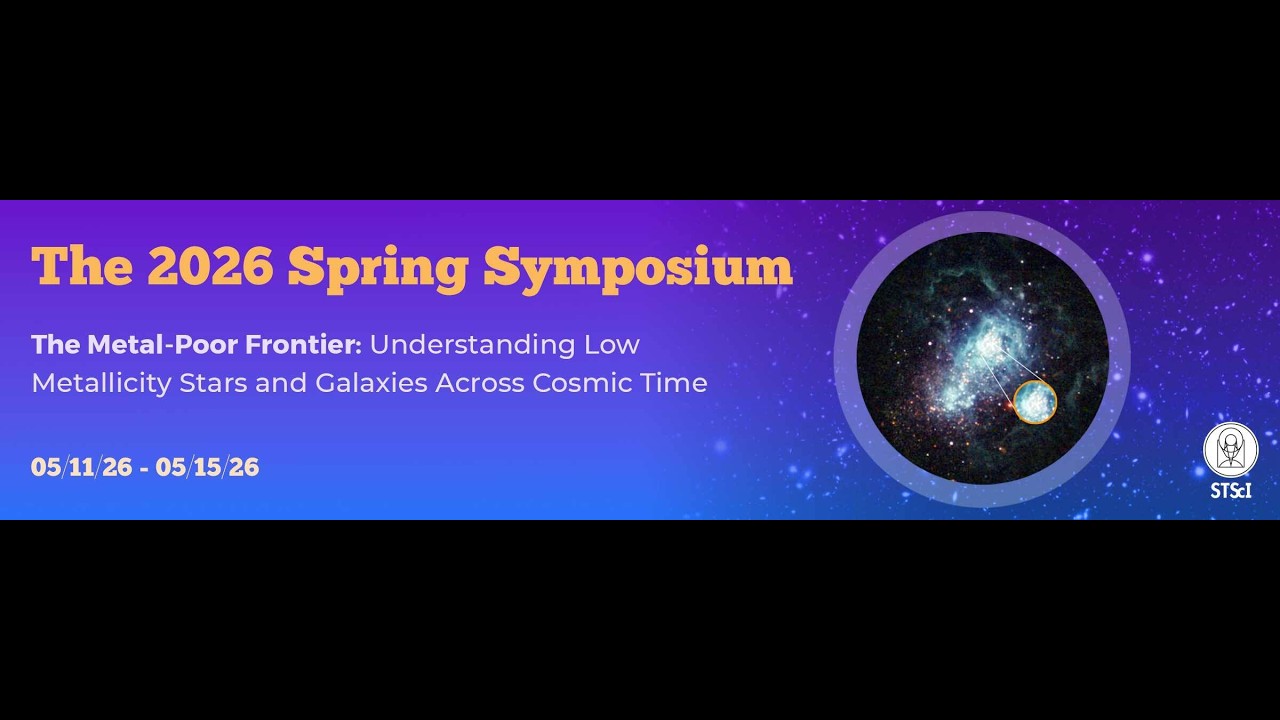
2026 Spring Symposium: Day 2 | Session 7
Keywords
Summary
185 words
Critical Evaluation
Value of the Information & Strength of the Argument
The talk provides a comprehensive overview of current theoretical and numerical challenges in low-metallicity star formation. It synthesizes recent research and highlights open questions, making a strong case for the importance of small-scale ISM physics. The argumentation is well-supported by references to simulations and observations, though it is primarily a review of problems rather than presenting new solutions. The speaker effectively communicates the complexity and interconnectedness of physical processes, from chemistry to magnetic fields, and their impact on the IMF and galaxy evolution.
Scientific Rigor, Source Quality, Title Accuracy
The presentation is scientifically rigorous, with references to specific simulations (e.g., ‘collibbr’, ‘popsicle’) and observational results (e.g., JWST, Gaia DR3). The title accurately reflects the session’s focus on low-metallicity stars and galaxies. The speaker acknowledges uncertainties and the need for further research, demonstrating scientific caution. The talk is part of a symposium, indicating peer-reviewed context, though the recording includes informal audience interactions.
160 words
Title / Content Match
The title accurately reflects the content: a session of the STScI Spring Symposium focused on low-metallicity stars and galaxies.
Quality & Reliability
8/10
High-quality scientific symposium with expert speakers presenting current research and open problems. The content is well-structured and based on established astrophysical knowledge, though it is a recording of a live event with informal elements.
Key Moments
Markers derived by PSI from the transcript: the creator did not define chapters.
- Introduction to the session and the importance of low-metallicity environments.
- Overview of the low-metallicity universe and the diversity of environments.
- Discussion of ISM conditions in early galaxies observed with JWST.
- Challenges in cooling and chemistry at low metallicities.
- Importance of shielding effects in dust-poor gas.
- Role of magnetic fields in star formation at low metallicities.
- Radiation feedback and its coupling with chemistry.
- Stochasticity and its impact on star formation outcomes.
- Introduction to the 'popsicle' project and its goals.
- Discussion on the IMF at low metallicities and potential variations.
Cited Sources
- STScI 2026 Spring Symposium — The symposium's official page, providing context for the session.
- JWST — Mentioned as the observatory providing key observations of high-redshift galaxies.
Concurring Sources
- JWST observations of high-redshift galaxies — Supporting the need to understand low-metallicity ISM.
Contribution & Novelties
The talk synthesizes current knowledge and identifies key open questions in low-metallicity star formation, emphasizing the need for multi-scale simulations. It highlights the importance of magnetic fields and non-equilibrium chemistry, which are often overlooked. The ‘popsicle’ project represents a novel approach to simulating star formation with full physics, aiming to produce realistic IMFs.
Pour aller plus loin :
- Initial Mass Function — Relevant to the discussion of IMF variations.
- Stellar feedback — Key process in regulating star formation.
- Magnetohydrodynamics — Essential for understanding magnetic field effects in simulations.
88 words
Radar Profile
The radar profile shows high scores across all dimensions, indicating a well-balanced and informative presentation. The talk is strong in technical depth and reliability, with a good amount of information. The overall quality is high, making it a valuable resource for researchers.
💬 Sur les 0 commentaires analysés, aucune tendance n'est disponible.