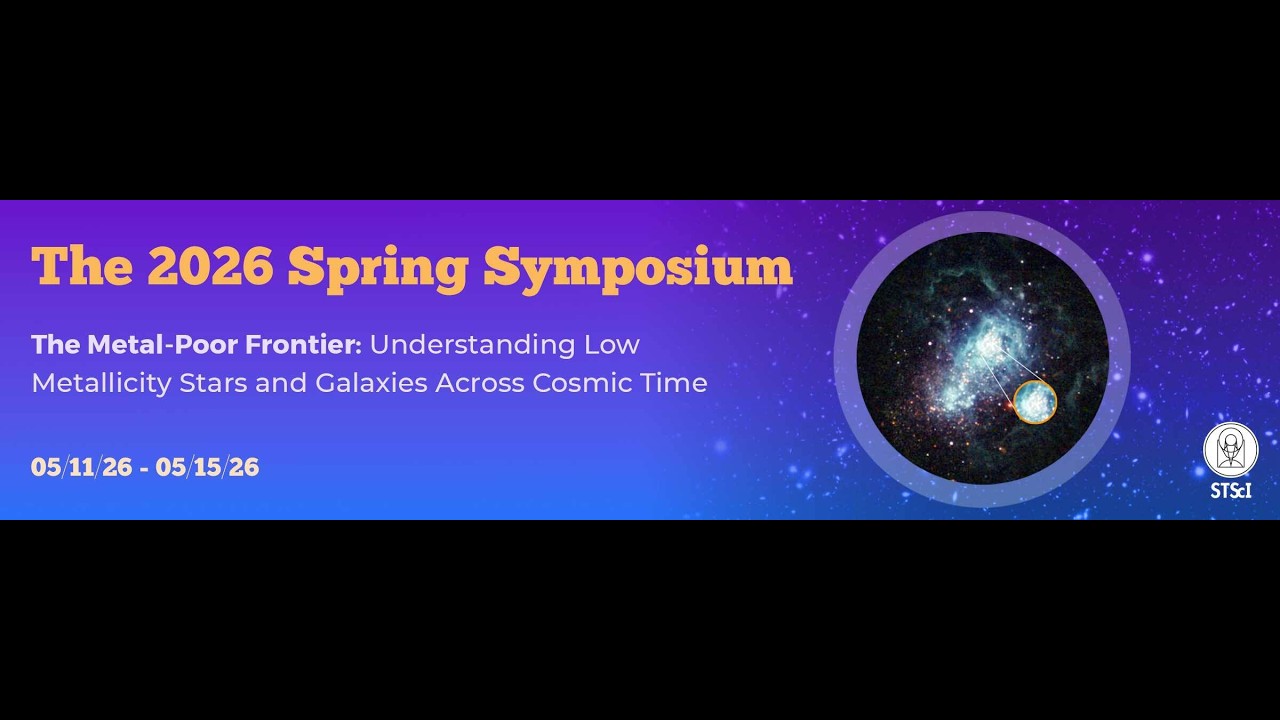
2026 Spring Symposium: Day 2 | Session 6
Keywords
Summary
156 words
Critical Evaluation
Value of the Information & Strength of the Argument
The presentations provide valuable insights into the low-metallicity universe. The first talk offers new observational evidence on the nature of little red dots, using the deepest spectrum of an LRD to date, and argues that the gas is metal-enriched, which has implications for black hole formation models. The argumentation is based on detailed spectral analysis and comparisons with models. The second talk presents a comprehensive stellar population analysis of I Zw 18, combining UV and near-IR photometry to reconstruct its star formation history, showing that it is not a young galaxy but has had a low star formation rate for most of its life. The argumentation is solid, using synthetic CMD fitting and careful photometry.
Scientific Rigor, Source Quality, Title Accuracy
The presentations are scientifically rigorous, with clear methodology and references to recent JWST and HST data. The speakers cite specific programs (e.g., GLIMPSE, EMBER) and papers (e.g., by Matthee et al.) in their talks. The title accurately reflects the content, which is a session on low-metallicity stars and galaxies. The sources are credible, as they are based on peer-reviewed research and large observational programs. The title is appropriate and does not overstate the content.
204 words
Title / Content Match
The title accurately reflects the content: it is a session of the 2026 Spring Symposium, focusing on low-metallicity stars and galaxies.
Quality & Reliability
8/10
The video is a scientific symposium session with presentations by researchers, likely peer-reviewed or at least expert-level. The content is technical and specific, with references to JWST data and recent studies. However, as a symposium, it may contain preliminary results and opinions not yet fully peer-reviewed.
Key Moments
Markers derived by PSI from the transcript: the creator did not define chapters.
- Introduction and start of session
- Vasilia Corf begins talk on dense gas around little red dots
- Discussion of deep spectrum and metal lines in LRDs
- Q&A on the origin of metal lines in LRDs
- Jako Bolini begins talk on I Zw 18 stellar populations
- Presentation of star formation history of I Zw 18
- Discussion of massive stars in I Zw 18
- Q&A on stellar mass fraction and future work
Cited Sources
- GLIMPSE program — Mentioned as a deep photometric and spectroscopic program on lensed fields
- EMBER program — Mentioned as a program providing stacked spectra of LRDs
- Matthee et al. (2023) — Referenced for nitrogen-enhanced galaxies and LRDs
Concurring Sources
- Matthee et al. (2023) — Referenced for nitrogen-enhanced galaxies and LRDs, supporting the metal enrichment argument.
Contribution & Novelties
The session provides new observational constraints on the nature of low-metallicity systems. The first talk presents the deepest spectrum of a little red dot, revealing metal enrichment in the dense gas, which challenges direct collapse black hole models. The second talk offers a detailed star formation history of I Zw 18, resolving its stellar populations and showing that it is not a young galaxy but has had a low star formation rate for most of its history.
Pour aller plus loin :
- Little Red Dots — Overview of the mysterious compact objects discovered by JWST.
- Direct collapse black hole — Theoretical model for black hole formation in metal-free gas.
- I Zwicky 18 — The blue compact dwarf galaxy studied in the second talk.
- JWST — The space telescope providing the data.
131 words
Radar Profile
The radar profile shows high scores in information quantity, quality, technical level, and reliability, indicating a dense, expert-level scientific session with strong content. The low number of views and likes suggests a niche audience, but the content is highly specialized and valuable for researchers.