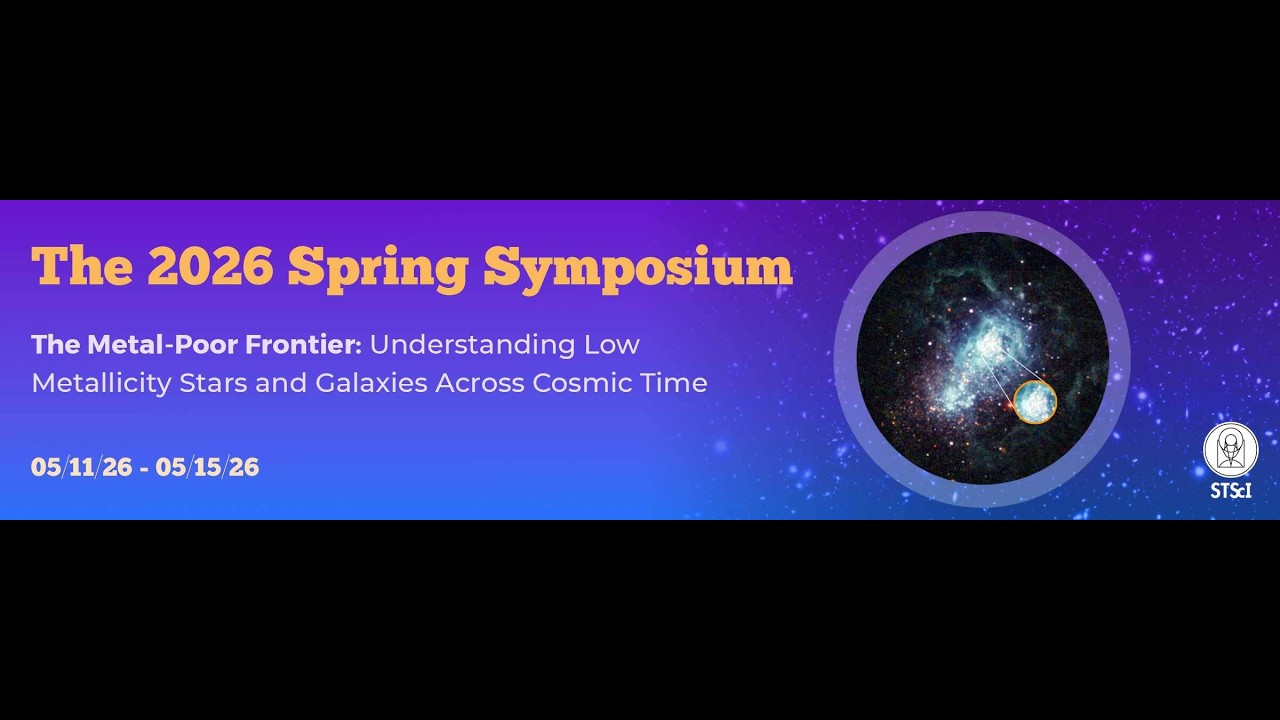
2026 Spring Symposium: Day 2 | Session 5
Keywords
Summary
149 words
Critical Evaluation
Value of the Information & Strength of the Argument
The talk provides a comprehensive overview of recent research on low-metallicity star clusters, combining local and high-redshift observations. The argumentation is solid, based on data from JWST programs and simulations. The speaker effectively connects observations to theoretical models, such as the formation of intermediate-mass black holes. However, some claims are speculative, such as the link between cluster density and black hole formation, and the speaker acknowledges uncertainties in metallicity measurements.
Scientific Rigor, Source Quality, Title Accuracy
The talk is scientifically rigorous, with references to specific JWST programs and simulations. The speaker cites work by colleagues and acknowledges limitations. The title accurately reflects the content, which focuses on low-metallicity environments. The presentation is well-structured, but as a symposium talk, it lacks the detailed methodology of a peer-reviewed paper. The speaker also mentions the baseball game and logistics, which are not scientific content.
150 words
Title / Content Match
The title accurately reflects the session's focus on low-metallicity stars and galaxies, as the talk covers star cluster formation in low-metallicity environments from local to high redshift.
Quality & Reliability
8/10
The content is a scientific symposium presentation by an expert (Angela Damo) from a recognized institution (STScI). It presents original research findings and literature reviews, with references to specific JWST programs and simulations. The methodology is rigorous, but the presentation is a talk, not a peer-reviewed paper, and some claims are based on preliminary results.
Key Moments
Markers derived by PSI from the transcript: the creator did not define chapters.
- Introduction and logistics
- Start of Angela Damo's talk on star clusters in low-metallicity galaxies
- Discussion of local dwarf galaxies and star cluster formation
- Comparison of simulations and observations of cluster formation
- Timescales of embedded cluster phases and PDR destruction
- High-redshift star clusters and the Cosmic Gems arc
- Cluster mass function and stochastic sampling
- Stellar surface densities and implications for intermediate-mass black holes
- Summary and conclusions
- Q&A session
Cited Sources
- JWST Programs (e.g., GLIMPSE, Cosmic Gems) — Mentioned as key observational programs for studying star clusters at high redshift.
- Simulations of dwarf galaxies — Referenced for comparing star cluster formation in low-metallicity environments.
Concurring Sources
- JWST Early Release Science Programs — Supporting observations of high-redshift galaxies and star clusters.
Contribution & Novelties
The talk synthesizes recent JWST findings on low-metallicity star clusters, highlighting the stochastic nature of cluster formation and the potential for intermediate-mass black hole formation in dense clusters. It provides a framework for connecting local and high-redshift observations.
Pour aller plus loin :
- JWST — Official JWST site for mission details and latest results.
- Intermediate-mass black hole — Overview of IMBHs and formation theories.
- Globular cluster — Background on globular clusters and their formation.
74 words
Radar Profile
The radar profile shows high scores in information quantity, technical level, and reliability, indicating a dense, expert-level presentation. The quality of information is also high, but slightly lower due to some speculative interpretations. Overall, the talk is a valuable contribution to the field.
💬 No comments were provided for analysis.