Tizian Wenzel: On the optimal shape parameter for kernel methods and beyond
Keywords
Summary
187 words
Critical Evaluation
Value of the Information & Strength of the Argument
The talk provides a novel theoretical contribution to a long-standing problem in kernel methods. The value lies in establishing a rigorous framework that connects the shape parameter to approximation rates via power spaces and superconvergence. The argumentation is solid, building on established results in kernel approximation theory and interpolation theory. The speaker clearly explains the assumptions and the reasoning behind the main results, including the role of the integral operator and the boundary conditions. The example with the exponential kernel effectively illustrates the theory. However, the talk is technical and assumes familiarity with reproducing kernel Hilbert spaces and Sobolev spaces, which may limit its accessibility. The presentation is well-structured, but the depth of the proofs is only sketched, leaving some details to the preprint.
Scientific Rigor, Source Quality, Title Accuracy
The talk is scientifically rigorous, with clear definitions and theorems. The speaker cites relevant literature, including the recent theory on sharp direct and inverse statements, and mentions his own preprint. The sources are appropriate for the topic. The title accurately reflects the content, focusing on the optimal shape parameter and its theoretical underpinnings. The talk does not include any commercial content or sponsorship.
202 words
Title / Content Match
The title accurately reflects the content: the talk focuses on the optimal shape parameter for kernel methods, with a theoretical framework and applications.
Quality & Reliability
8/10
The talk presents a rigorous mathematical framework based on established theory of kernel approximation, with clear assumptions and proofs sketched. The results are presented as a preprint, and the speaker is an expert in the field. However, the talk is a seminar presentation, not a peer-reviewed publication, and the details are condensed.
Key Moments
Markers derived by PSI from the transcript: the creator did not define chapters.
- Introduction and motivation: interpolation with RBF kernels and the shape parameter.
- Overview of the talk: background on kernels, power spaces, direct/inverse statements, optimal shape parameter, applications.
- Background on kernels: definition, examples (Matern), and kernel interpolation.
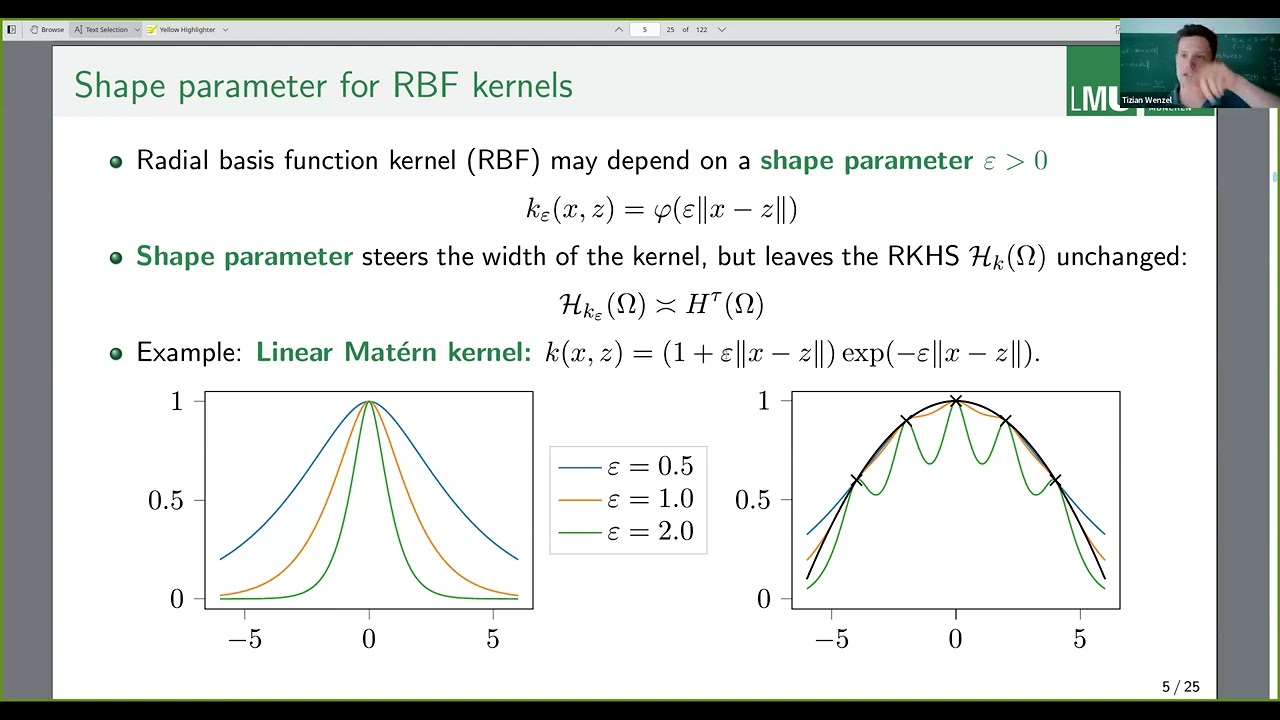
- Introduction of Sobolev kernels and the shape parameter; effect on the native space.
- Geometric quantities: fill distance, separation distance, quasi-uniformity.
- Mercer theorem and power spaces; overview of the space diagram.
- Sharp direct statements: smoothness implies approximation rates.
- Inverse statements: approximation rates imply smoothness; saturation.
- One-to-one correspondence between power space smoothness and approximation rates.
- Parameterized Sobolev kernels and the effect of shape parameter on power spaces.
- Example: exponential kernel on unit interval; optimal shape parameter epsilon=1.
- Numerical illustration: error vs shape parameter for different numbers of points.
- Discussion of perturbations and practical implications.
- Conclusion and outlook.
Cited Sources
- On the optimal shape parameter for kernel methods and beyond (preprint) — The speaker mentions this preprint as the basis for the talk.
- Sharp direct and inverse statements for kernel-based approximation — Referenced as the recently established theory that the work leverages.
Concurring Sources
- Scattered Data Approximation — Classical reference for kernel-based approximation theory.
Contribution & Novelties
The talk provides a novel theoretical framework for selecting the optimal shape parameter in RBF kernel methods, linking it to superconvergence phenomena. The key contribution is the identification of the optimal shape parameter as the one that places the target function in the image of the integral operator, leading to faster convergence rates. This is achieved through a one-to-one correspondence between power space smoothness and approximation rates, established via sharp direct and inverse statements. The framework is general enough to cover parameterized Sobolev kernels, including those used in machine learning.
Pour aller plus loin :
- Radial basis function — Provides background on RBF methods.
- Reproducing kernel Hilbert space — Essential for understanding the theoretical setting.
- Sobolev space — Relevant to the smoothness assumptions.
- Mercer’s theorem — Basis for the power space construction.
- Superconvergence — Concept central to the talk’s results.
140 words
Radar Profile
The radar profile shows high scores in technical level and information quality, reflecting the advanced mathematical content and rigorous presentation. The quantity of information is moderate, as the talk is a seminar rather than a comprehensive review. The overall reliability is high due to the speaker's expertise and the theoretical nature of the work.