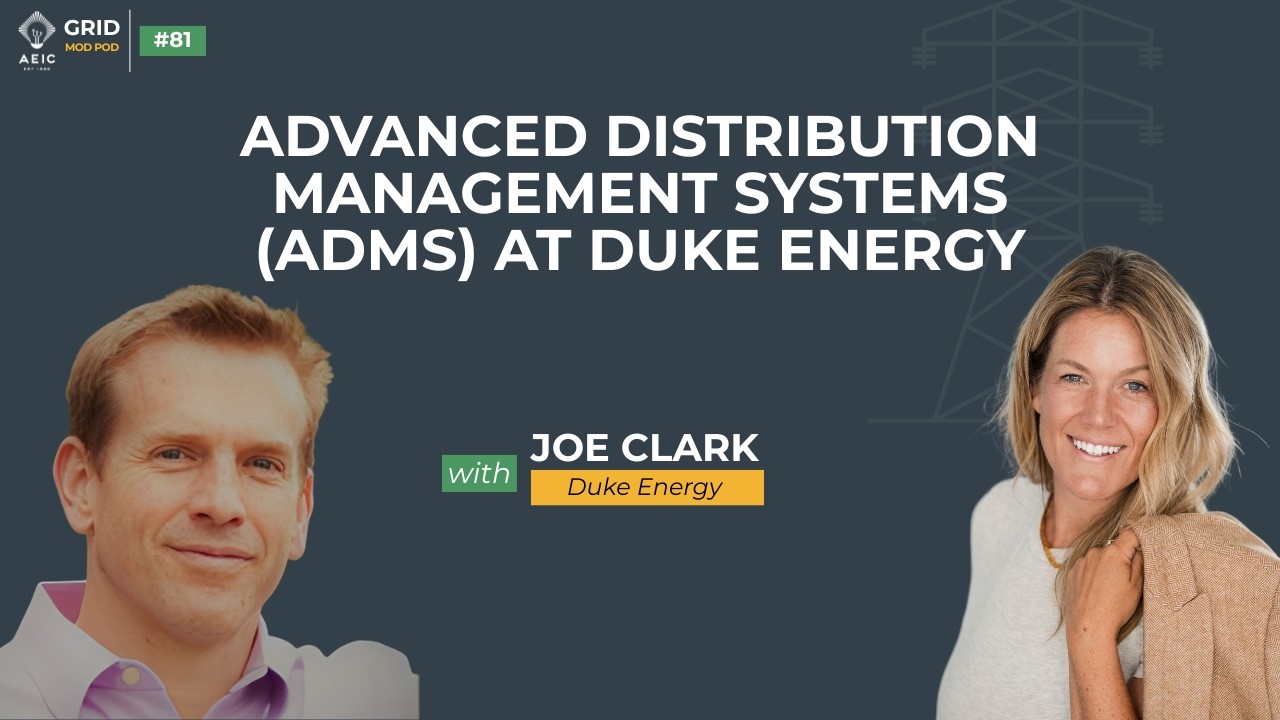
Advanced Distribution Management Systems (ADMS) at Duke Energy | Grid Mod Pod Ep. 81 with Joe Clark
Keywords
Summary
183 words
Critical Evaluation
Value of the Information & Strength of the Argument
The value of the information lies in its practical, real-world insights from a utility professional directly involved in ADMS deployment. Joe Clark provides specific examples, such as the scaling from 20 to 240 circuits and the importance of business integration, which are actionable for other utilities. The argumentation is solid, grounded in experience and concrete outcomes. However, it is largely anecdotal and lacks quantitative data or comparative analysis, which limits its generalizability. The discussion is persuasive but relies on the authority of the speaker rather than empirical evidence.
Scientific Rigor, Source Quality, Title Accuracy
The scientific rigor is moderate; the content is an expert opinion rather than a peer-reviewed study. The sources cited are limited to the AEIC website, LinkedIn, and Spotify, which are organizational and promotional rather than academic. The title accurately reflects the content, and the discussion is coherent and well-structured. The lack of external references or data to support claims reduces the overall rigor, but the practical experience shared adds credibility. The adéquation between title and content is high, as the episode directly addresses ADMS at Duke Energy.
190 words
Title / Content Match
The title accurately reflects the content, which focuses on ADMS at Duke Energy, featuring Joe Clark.
Quality & Reliability
7/10
The content is an expert interview with a product manager from Duke Energy, providing practical insights into ADMS implementation. It is not peer-reviewed but offers credible industry experience. The discussion is grounded in real-world examples and emphasizes process and organizational factors.
Chapters
- Introduction to ADMS & grid reliability
- Overview of LVM & FISR applications
- Guest Joe Clark introduction & role
- Core challenge: faster outage restoration
- Infrastructure & workstreams for enablement
- Success stories from the Carolinas
- Importance of early business-team involvement
- Need for strong IT & operations communication
- Key qualities for utility professionals
- Cost comparison: FISR vs LVM
Cited Sources
- AEIC Website — Organization hosting the podcast and providing industry knowledge.
- AEIC LinkedIn — Social media presence for AEIC.
- Grid Mod Pod on Spotify — Podcast platform for the series.
Concurring Sources
- AEIC Website — The organization's mission aligns with the podcast's content on utility knowledge sharing.
Contribution & Novelties
The episode provides a practitioner’s perspective on ADMS implementation, highlighting the importance of organizational factors such as business integration and IT/OT communication. It offers a case study from Duke Energy that demonstrates the scalability of FISR when properly managed. The discussion on the need for ’translators’ between IT and grid engineering is a valuable insight not commonly covered in technical literature.
Pour aller plus loin :
- Advanced Distribution Management System (Wikipedia) — Provides an overview of ADMS concepts and functionalities.
- Fault Isolation and Service Restoration (FISR) - IEEE — Note: This URL is illustrative; actual IEEE papers on FISR are available but specific URLs are not provided. For further reading, search IEEE Xplore for ‘fault isolation service restoration’.
- Grid Modernization Initiative (U.S. Department of Energy) — Official DOE resource on grid modernization efforts.
133 words
Radar Profile
The radar profile shows balanced scores across information quantity, quality, technical level, and reliability, with a slight emphasis on practical application over theoretical depth. This reflects the podcast's focus on real-world implementation and expert opinion.
💬 No comments were provided for analysis.