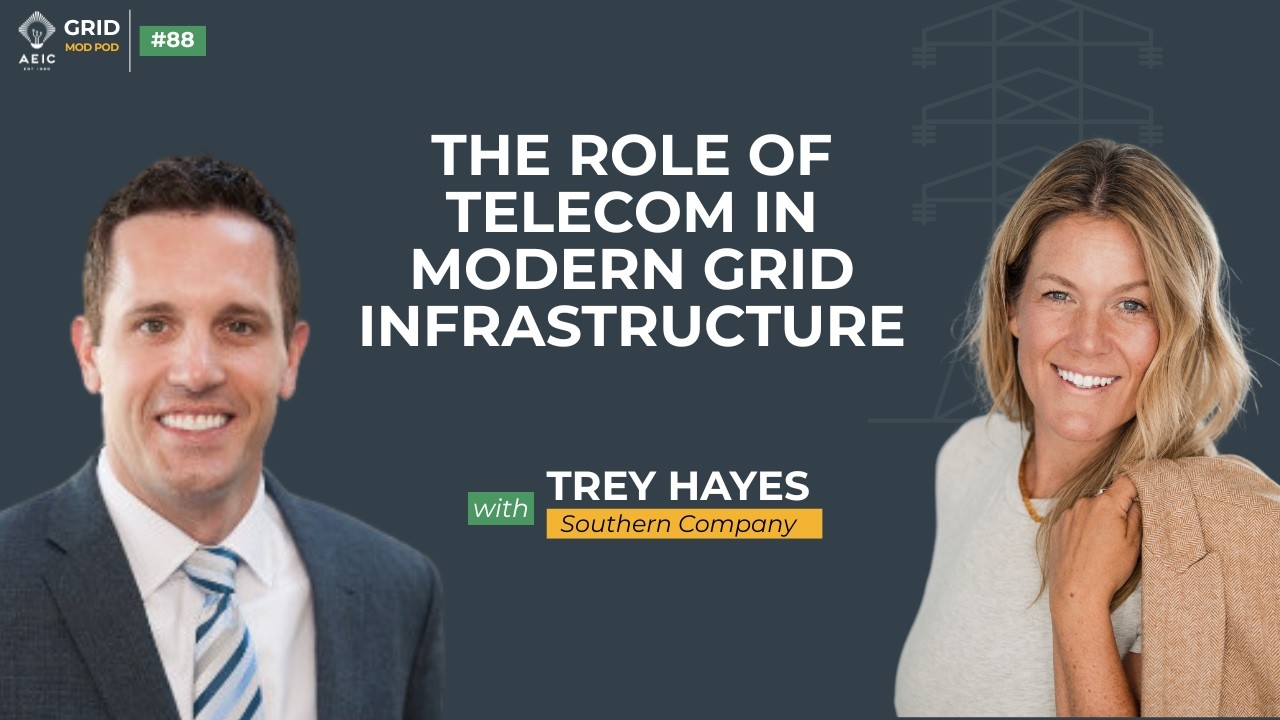
Utility-Owned Fiber Networks | Grid Mod Pod Ep. 88, Trey Hayes, Alabama Power (Southern Company)
Keywords
Summary
162 words
Critical Evaluation
Value of the Information & Strength of the Argument
The podcast provides valuable insights into the strategic rationale behind utility-owned fiber networks, particularly for grid modernization and data center connectivity. Hayes argues convincingly that building fiber is future-proof because only the end equipment needs upgrading, while the glass remains capable. He supports this with the example of Southern Company’s successful execution of a hyperscaler contract within a nine-month deadline, demonstrating the utility’s capability. The discussion on leasing excess capacity to address the digital divide and reduce rates is a compelling argument for the broader societal benefits. However, the argumentation is largely anecdotal and lacks quantitative data or comparative analysis with alternative approaches. The reliance on personal experience and industry collaboration, while credible, does not provide a rigorous technical or economic evaluation.
Scientific Rigor, Source Quality, Title Accuracy
The podcast maintains a high level of rigor in terms of the speaker’s expertise, as Trey Hayes has 18 years of experience at Southern Company and leads the telecommunications team. The content is consistent with industry trends and the AEIC’s mission of knowledge sharing. The title accurately reflects the content, focusing on utility-owned fiber networks. However, the episode does not cite specific external sources or studies, relying instead on the speaker’s professional experience. The description provides links to the AEIC website, LinkedIn, and Spotify, but these are organizational resources rather than direct references to the claims made. The discussion is more of an expert opinion than a scientifically rigorous analysis, but it is credible given the speaker’s position.
255 words
Title / Content Match
The title accurately reflects the content, focusing on utility-owned fiber networks and featuring Trey Hayes from Alabama Power.
Quality & Reliability
7/10
The podcast features an experienced utility executive discussing practical strategies and real-world examples. Claims are plausible and consistent with industry trends, but lack detailed technical data or independent verification. The discussion is largely anecdotal and promotional, with limited critical analysis.
Chapters
- The grid's nervous system
- Intro
- Meet Trey Hayes: 18 years at Southern Company
- Explaining telecom without the jargon
- 96,000 miles of distribution, 4,000 employees
- Standing up the AEIC Telecommunications Subcommittee
- Data consumption up 3,600%: build the network or buy it
- Spectrum, and what the subcommittee actually works on
- There are a lot of wires in the wireless business
- Labor strategy: in-house, contract, covered, non-covered
- A safe space for what did not work
- 1885: the letter that started AEIC
- Mutual assistance and storm response
- Data centers and large load: an infrastructure problem
- Long-haul fiber on transmission rights-of-way
- Utility-grade network, utility-grade outage response
- Leasing excess capacity and the digital divide
- How a utility joins the subcommittee
- Go fast alone, go far together
Cited Sources
- AEIC Official Website — The Association of Edison Illuminating Companies, which hosts the podcast and the Telecommunications Subcommittee.
- AEIC LinkedIn — LinkedIn page for AEIC, providing updates and networking opportunities.
- Grid Mod Pod on Spotify — The podcast series on Spotify, where this episode is available.
Concurring Sources
- Fiber-optic communication — General information on fiber optics, supporting the technical claims about speed and capacity.
- Smart grid — Discusses the integration of communication networks in grid operations, aligning with the podcast's theme.
Contribution & Novelties
The podcast offers a unique perspective on the strategic importance of utility-owned fiber networks, particularly for grid modernization and data center connectivity. It highlights the practical benefits of building rather than buying, such as future-proofing and control over reliability. The discussion on leasing excess capacity to address the digital divide is a novel angle that connects utility infrastructure to social good. The episode also emphasizes the collaborative nature of the AEIC subcommittee, which facilitates knowledge sharing across utilities.
Pour aller plus loin :
- Fiber-optic communication — Provides background on the technology and its advantages.
- Smart grid — Contextualizes the role of telecommunications in grid modernization.
- Data center — Explains the infrastructure needs of hyperscalers and the importance of connectivity.
119 words
Radar Profile
The radar profile shows a balanced performance across all dimensions, with slightly higher scores in quantity of information and reliability, reflecting the speaker's expertise and the breadth of topics covered. The lower score in technical level indicates that the content is accessible to a general audience, while still providing valuable insights for industry professionals.
💬 Sur les 0 commentaires analysés, aucune tendance n'a pu être dégagée.