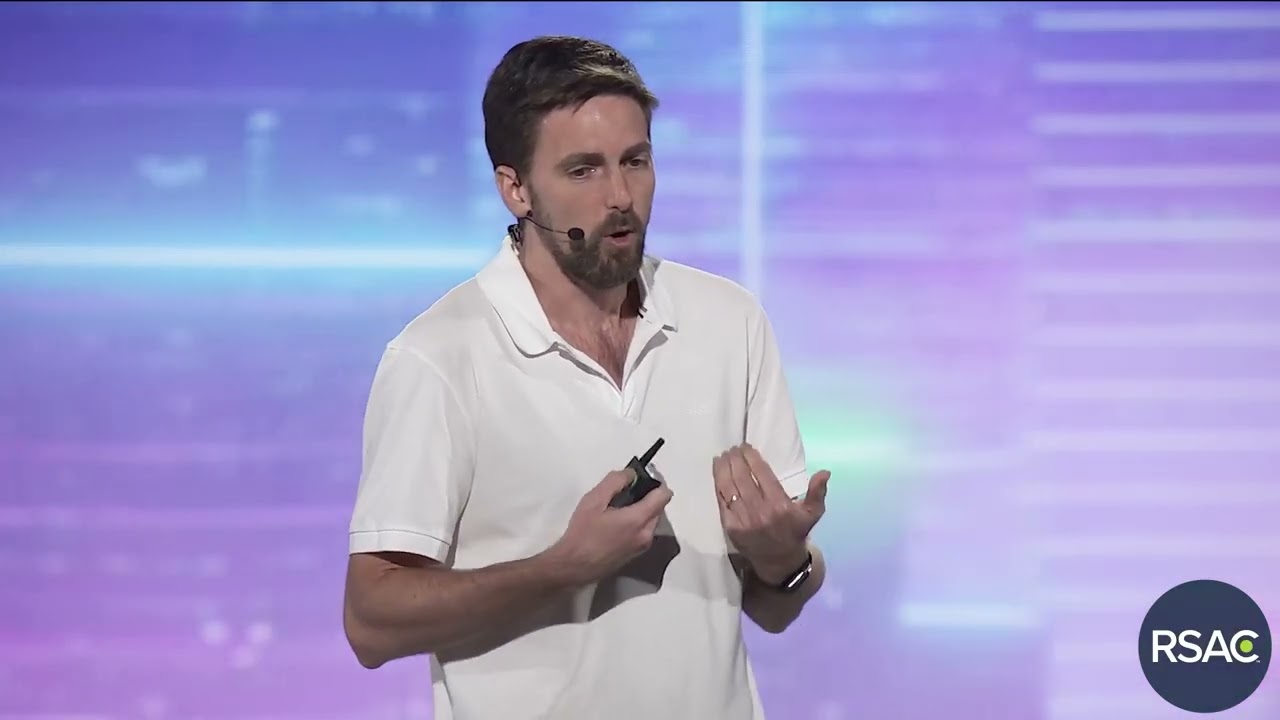
AI vs. AI: How to Reshape Defense Faster than Attackers Reshape Offense
Keywords
Summary
120 words
Critical Evaluation
Value of the Information & Strength of the Argument
The talk provides valuable insights into the emerging challenges of AI-driven attacks and the need for adaptive defense. Izrael’s argument is coherent and persuasive, drawing on industry trends and proprietary data. However, it lacks concrete evidence for some claims and relies heavily on anecdotal examples. The call for machine-speed defense is compelling, but the practical implementation remains vague.
Scientific Rigor, Source Quality, Title Accuracy
The speaker references Armis’s cyber warfare report and a monthly report on AI coding vulnerabilities, but these are not publicly accessible in detail. The talk is an expert opinion rather than a peer-reviewed study, so scientific rigor is moderate. The title accurately reflects the content, and the talk is well-structured.
123 words
Title / Content Match
The title accurately reflects the content, which focuses on the need for AI-driven defense to counter AI-powered attacks.
Quality & Reliability
7/10
The speaker is a CTO and co-founder of a cybersecurity company, providing expert opinion based on industry experience and proprietary reports. However, the talk is largely anecdotal and lacks peer-reviewed evidence, with some claims (e.g., human-to-agent ratio) not fully substantiated.
Key Moments
Markers derived by PSI from the transcript: the creator did not define chapters.
- Introduction to the talk and Armis's mission.
- Prediction of human-to-agent ratio in enterprises.
- Discussion of the expanding attack surface including AI agents and code.
- Examples of AI attacks: model poisoning, evasion, and autonomous blind spots.
- Armis's cyber warfare report and confidence vs. vulnerability gap.
- OpenClaw example and the creation of flat networks.
- Armis's monthly report on AI coding vulnerabilities.
- Need for machine-speed defense and moving from reactive to proactive.
- Conclusion: AI vs. AI and the need for adaptive defense.
Cited Sources
- Armis Cyber Warfare Report — Referenced as a source of data on AI-generated attacks and confidence vs. vulnerability.
- Armis Monthly Report on AI Coding Vulnerabilities — Referenced as a study on vulnerabilities in AI-generated code.
Concurring Sources
- OWASP Top 10 for LLM Applications — Supports the discussion of AI-specific vulnerabilities.
- NIST AI Risk Management Framework — Provides a framework for managing AI risks, aligning with the talk's call for proactive defense.
Dissenting Sources
- Critique of AI hype in cybersecurity — Some experts argue that AI threats are overstated and that traditional security measures remain effective.
Contribution & Novelties
The talk provides a forward-looking perspective on the necessity of AI-driven defense, emphasizing the shift from reactive to proactive security. It introduces the concept of ‘adaptive offense’ and the importance of machine-speed response. The speaker’s practical advice on influencing the choice of AI coding tools is actionable.
Pour aller plus loin :
- AI agent security — OWASP’s Top 10 for LLM applications, relevant to securing AI agents.
- Adversarial machine learning — Overview of attacks and defenses in ML.
- Zero trust architecture — A security model relevant to the talk’s emphasis on dynamic control.
93 words
Radar Profile
The radar profile shows moderate scores across all dimensions, with slightly higher scores in information quantity and quality, reflecting the talk's informative nature but limited technical depth and scientific rigor.
💬 Sur les 0 commentaires analysés, aucune tendance n'est disponible.