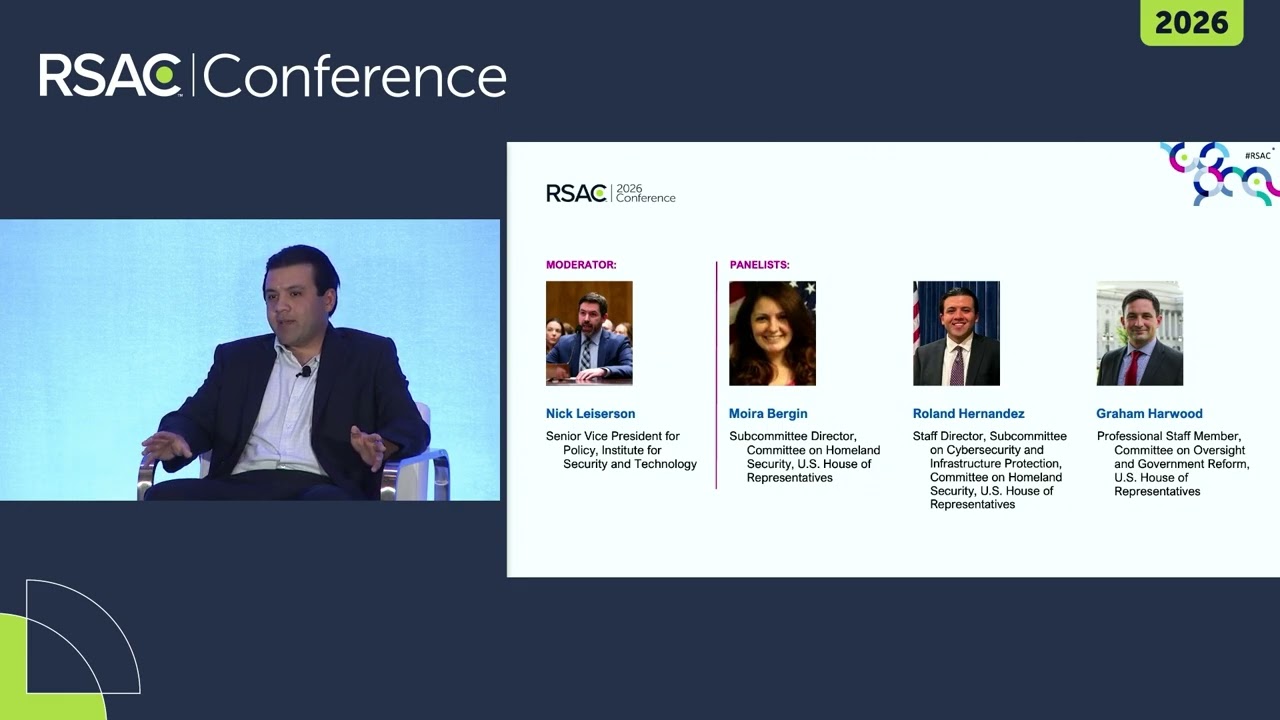
The Cyber House Rules: Perspectives on the 2026 Congressional Agenda
Keywords
Summary
138 words
Critical Evaluation
Value of the Information & Strength of the Argument
The value of the information is high for those interested in the legislative process and cybersecurity policy. The panelists provide insider perspectives on how Congress views and handles cyber issues, including the National Cyber Strategy and AI adoption. Their arguments are well-reasoned, based on their direct experience. For instance, Moira’s critique of the strategy’s lack of engagement with Democrats is a valid point, and Graham’s comparison of FedRAMP to a security necessity is compelling. However, the discussion is largely opinion and lacks concrete data or evidence, which limits its scientific rigor.
Scientific Rigor, Source Quality, Title Accuracy
The panelists are credible sources due to their positions, but they do not cite specific documents or studies. The discussion is based on their professional knowledge. The title accurately reflects the content, as it is indeed a discussion of the congressional agenda from the perspective of House staffers. The lack of citations and the partisan nature of some comments slightly reduce the scientific rigor, but the firsthand insights are valuable.
176 words
Title / Content Match
The title accurately reflects the content: a panel discussion on the 2026 congressional agenda from the perspective of House staffers.
Quality & Reliability
7/10
The panel consists of experienced congressional staffers with direct involvement in cybersecurity policy. Their insights are firsthand and credible, but the discussion is largely opinion and strategic analysis rather than peer-reviewed research. The lack of specific citations and the partisan perspectives (especially from Moira) slightly reduce the objective reliability.
Key Moments
Markers derived by PSI from the transcript: the creator did not define chapters.
Cited Sources
- National Cyber Strategy — Mentioned as recently released by the President.
- Executive Order on Cybercrime and Fraud — Mentioned as accompanying the strategy.
Concurring Sources
- CISA's Role in Critical Infrastructure — The panel discusses CISA's role and preparedness.
Dissenting Sources
- National Cyber Strategy — The panelists, particularly Moira, criticize the strategy for being too vague and lacking implementation details.
Contribution & Novelties
The video provides unique insights into the perspectives of congressional staffers on cybersecurity policy, which is rarely shared publicly. It highlights the importance of bipartisanship and the need for better executive-congressional engagement. The discussion on AI adoption and FedRAMP offers practical considerations for industry.
Pour aller plus loin :
- CISA — The Cybersecurity and Infrastructure Security Agency, central to the discussion.
- FedRAMP — The Federal Risk and Authorization Management Program, discussed in the context of AI adoption.
- National Cyber Strategy 2025 — The document critiqued by the panel.
88 words
Radar Profile
The radar profile shows high scores in quantity of information and technical level, reflecting the detailed insider knowledge shared. The quality and reliability scores are moderate, indicating that while the information is credible, it is largely opinion-based. The overall balance suggests a valuable but not rigorously scientific discussion.