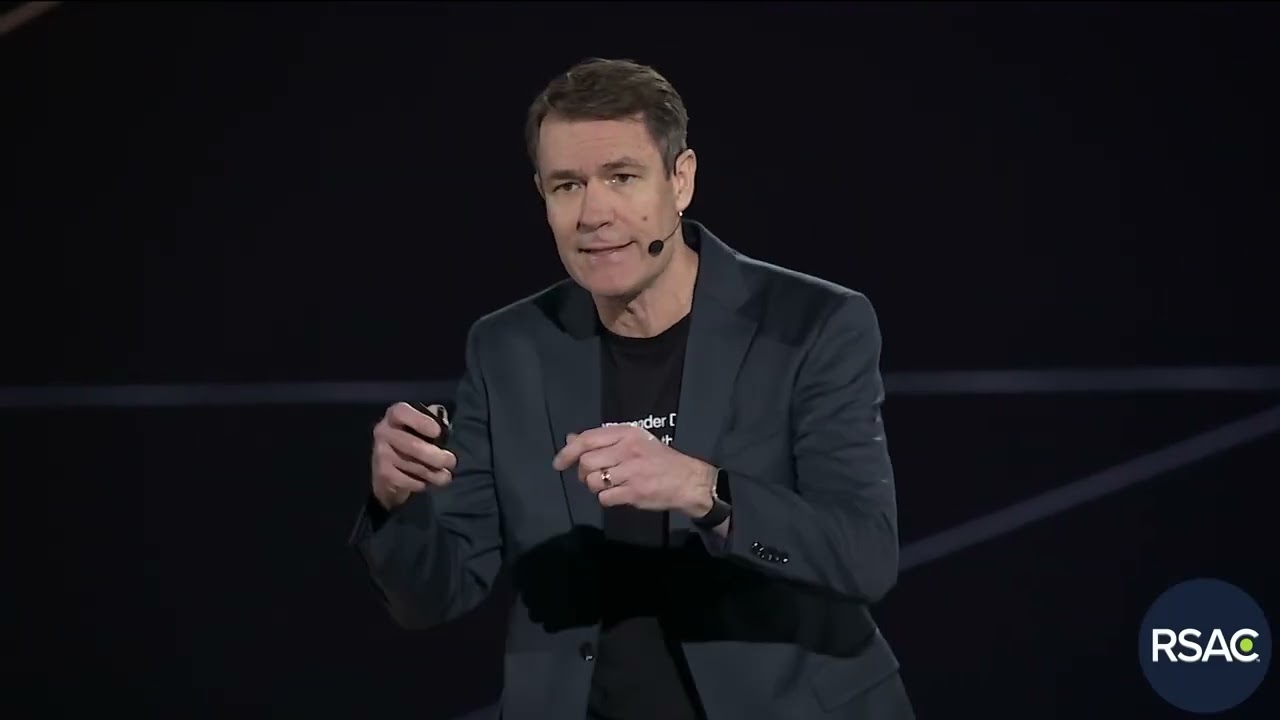
Lessons From the Agentic Frontier: How the SOC is Winning in the AI Era
Keywords
Summary
192 words
Critical Evaluation
Value of the Information & Strength of the Argument
The talk provides valuable insights into the practical application of agentic AI in security operations, with concrete examples that illustrate the potential benefits. The argumentation is persuasive, using analogies to nature and quantum computing to justify the embrace of non-determinism. However, the discussion remains at a high level, lacking deep technical detail or empirical evidence to support the claims. The speakers rely on their industry experience and anecdotal examples rather than rigorous data, which weakens the scientific rigor. The emphasis on the need for governance and trust models is well-argued, but the specifics of implementation are left vague.
Scientific Rigor, Source Quality, Title Accuracy
The talk does not cite specific academic or industry sources, but references general concepts like Zero Trust, GDPR, and OpenClaw. The speakers are senior executives at Splunk, which lends credibility but also introduces potential bias. The title accurately reflects the content, and the talk is well-structured, moving from conceptual rationalization to practical examples. However, the lack of citations and reliance on anecdotal evidence reduces the scientific rigor. The talk does not address potential counterarguments or limitations in depth, which could be seen as a weakness.
198 words
Title / Content Match
The title accurately reflects the content, focusing on lessons and strategies for implementing agentic AI in security operations centers.
Quality & Reliability
7/10
The talk provides a high-level overview of the agentic SOC concept, with practical examples and references to industry trends. However, it lacks detailed technical depth and empirical evidence, and the speakers are industry practitioners rather than independent researchers.
Key Moments
Markers derived by PSI from the transcript: the creator did not define chapters.
- Introduction to the agentic SOC concept and the problem of analyst burnout.
- Discussion on non-determinism in AI, with analogies to penicillin and quantum computing.
- Addressing the risks of AI agents and the need for trust and governance.
- Overview of the agentic SOC architecture, including data platform and collaboration.
- Key elements of the agentic security and governance stack, such as separation of duty and output validation.
- Practical example: junior analyst using agents to triage an impossible traveler alert.
- Second example: preventative agent blocking a data leak in a retail company.
- Three key takeaways: customized agents, building trust, and scaling with agents.
Cited Sources
- Splunk Security — Mentioned as the company of the speakers.
- OpenClaw — Referenced as an open-source project for building autonomous agents.
Concurring Sources
- Gartner Predicts Agentic AI — Aligns with the talk's emphasis on agentic AI as a major trend.
Dissenting Sources
- AI Risks and Non-Determinism — Some research highlights the dangers of non-deterministic AI, contrasting with the talk's optimistic view.
Contribution & Novelties
The talk contributes to the discourse on agentic AI in cybersecurity by framing non-determinism as a potential strength rather than a weakness, and by proposing a governance stack that includes separation of duty and output validation. It also emphasizes the importance of memory and learned behavior in agents, which is a novel perspective. However, the ideas are not entirely new and align with broader industry trends.
Pour aller plus loin :
- Agentic AI in Cybersecurity — Gartner’s perspective on agentic AI.
- Zero Trust Architecture — NIST SP 800-207 on Zero Trust.
- GDPR Right to Erasure — Article 17 of GDPR on the right to be forgotten.
106 words
Radar Profile
The radar profile shows a balanced but moderate performance across all dimensions, with slightly higher scores in information quantity and quality, reflecting the talk's comprehensive but not deeply technical nature. The lower technical depth score indicates that the content is accessible but lacks advanced detail.
💬 No comments were provided for analysis.