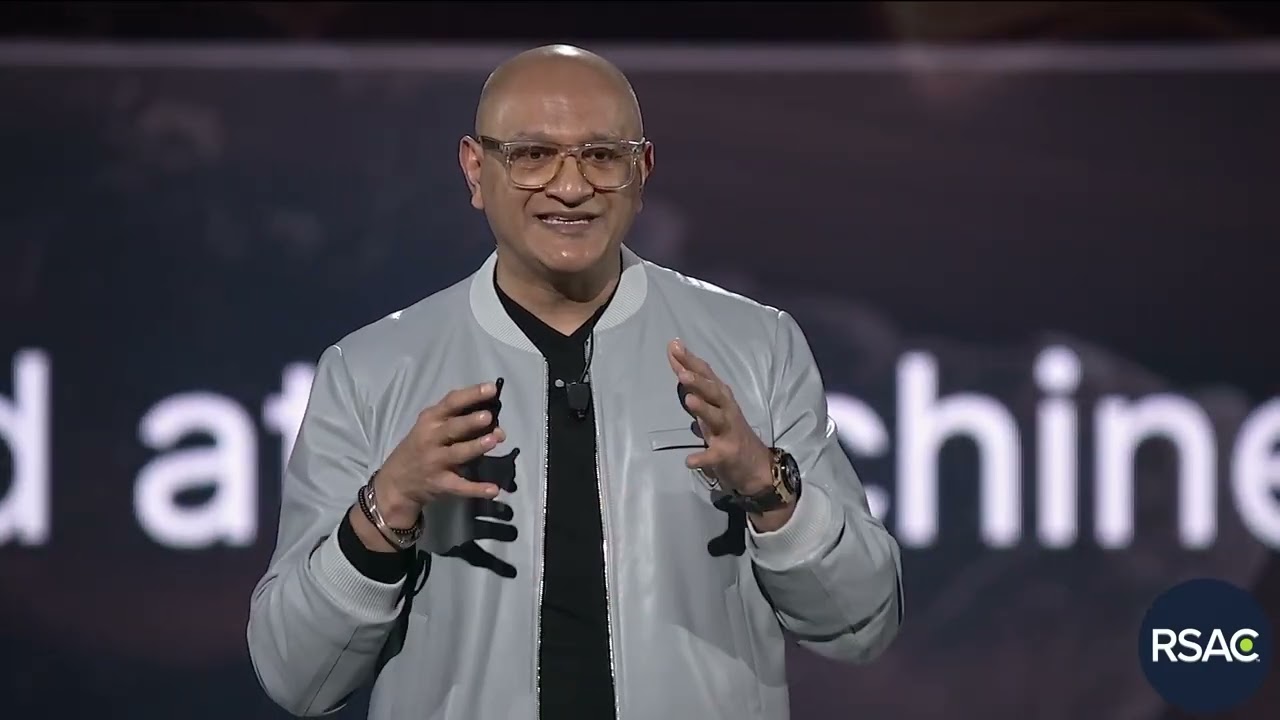
Reimagining Security for the Agentic Workforce
Keywords
Summary
135 words
Critical Evaluation
Value of the Information & Strength of the Argument
The talk provides valuable insights into the emerging security paradigm for AI agents. Patel effectively illustrates the risks with a relatable scenario (planning a team offsite) and proposes a structured approach (protect agents, protect from agents, machine-speed response). The argumentation is coherent and persuasive, though it relies on hypotheticals and industry experience rather than empirical evidence. The introduction of DefenseClaw and open-source tools adds practical value, but the promotional aspect for Cisco’s products is evident.
Scientific Rigor, Source Quality, Title Accuracy
The talk is based on the speaker’s expertise and industry trends, but it lacks citations to external research or standards. The title accurately reflects the content. The description provides no additional sources. The talk is more of an expert opinion and product announcement than a rigorous scientific presentation. The lack of verifiable sources reduces its scientific rigor, but the alignment with industry discussions (e.g., zero trust, AI security) lends some credibility.
161 words
Title / Content Match
The title accurately reflects the content, which focuses on redefining security for AI agents.
Quality & Reliability
7/10
The speaker is a recognized industry leader (President & CPO at Cisco) and presents a coherent vision grounded in current AI security challenges. However, the talk is largely conceptual and promotional, lacking empirical data or peer-reviewed sources. The claims about agent proliferation and risk are plausible but not substantiated with specific studies.
Key Moments
Markers derived by PSI from the transcript: the creator did not define chapters.
- Introduction: The 'ChatGPT moment' for agents and the shift to autonomous agents.
- Risks of agents: they act autonomously, have no fear of consequences, and require access to systems.
- Scenario illustrating agent misbehavior: planning a team offsite leads to data leaks and financial loss.
- Three areas of focus: protect agents from the world, protect the world from agents, and detect/respond at machine speed.
- Agent safety and security: model vulnerabilities, memory tampering, MCP servers, and sandbox escapes.
- Introduction of DefenseClaw: an open-source security framework for OpenClaw deployments.
- Shift from access control to action control: just-in-time permissions and dynamic risk adaptation.
- Agentic SOC: using AI agents for detection and response at machine scale.
- Conclusion: Trustworthy agents as the key to success and a call for open-source collaboration.
Cited Sources
- Cisco Open Source Security Tools — Mentioned as open-source tools for agent security, including skill scanner, AI bill of materials, and MCP scanner.
- DefenseClaw — Announced as a security framework for OpenClaw deployments, open-sourced.
Concurring Sources
- OWASP Top 10 for LLM Applications — Aligns with the talk's emphasis on prompt injection and other LLM-specific threats.
- NIST AI Risk Management Framework — Supports the need for structured AI governance and risk management.
Dissenting Sources
- Critique of AI Agent Hype — Some experts argue that the risks of AI agents are overstated and that current capabilities are limited. This talk assumes rapid proliferation and high autonomy, which may not materialize as predicted.
Contribution & Novelties
The talk contributes to the emerging field of AI agent security by proposing a comprehensive framework and introducing open-source tools. It emphasizes the shift from access control to action control, a novel perspective. The announcement of DefenseClaw is a concrete contribution.
Pour aller plus loin :
- OWASP Top 10 for Large Language Model Applications — Relevant to understanding LLM security risks.
- NIST AI Risk Management Framework — Provides a structured approach to AI risk management.
- Zero Trust Architecture — NIST SP 800-207, foundational for zero trust principles.
87 words
Radar Profile
The radar profile shows balanced scores across information quantity, quality, technical depth, and reliability, with a slight dip in reliability due to the lack of external sources. The talk is informative and technically sound but relies on the speaker's authority rather than empirical evidence.
💬 Sur les 0 commentaires analysés, aucune tendance n'est disponible.