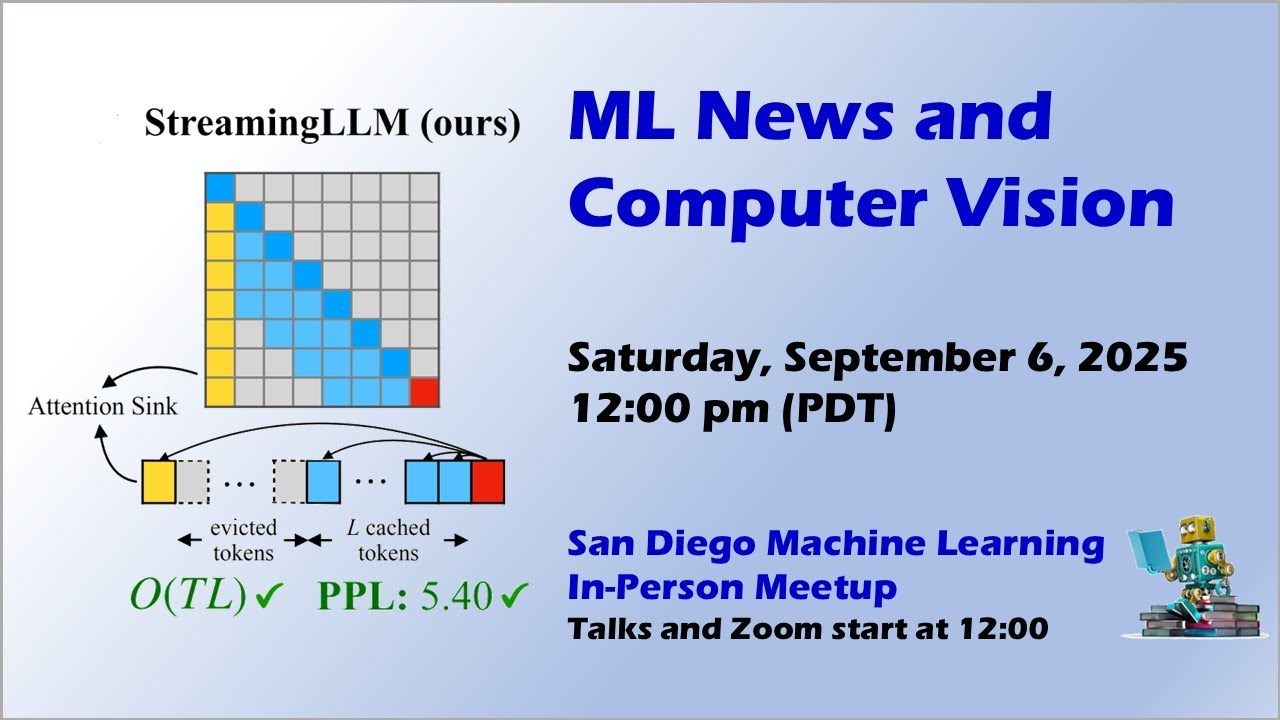
ARC AGI, ML News, and Computer Vision Workshop 4
Keywords
Summary
182 words
Critical Evaluation
Value of the Information & Strength of the Argument
The presentation provides valuable insights into the limitations of current LLMs in reasoning tasks, using the ARC-AGI benchmark as a concrete example. The argumentation is coherent: the speaker contrasts the impressive performance of LLMs on familiar tasks with their poor performance on novel tasks, illustrating the difference between skill and intelligence. The discussion of system 1 and system 2 thinking adds a cognitive science perspective. The description of the winning Kaggle solution is informative, showing an alternative approach to LLMs. However, the talk is largely based on the speaker’s own analysis and does not cite external sources, which limits its scientific rigor. The Q&A session enriches the discussion by addressing potential counterarguments, such as the role of training data and the possibility of domain-specific models.
Scientific Rigor, Source Quality, Title Accuracy
The talk does not cite specific papers or sources, but it references the ARC-AGI benchmark and its creator François Chollet. The description provides links to the meetup’s GitHub repository and Slack community, but these are not direct sources for the content. The title accurately reflects the content, as the main segment is about ARC-AGI, followed by ML news and a computer vision workshop. The speaker’s claims about LLM performance on ARC-AGI are consistent with known results, but without citations, the reliability is moderate. The discussion is technically sound but lacks formal references.
232 words
Title / Content Match
The title accurately reflects the content: the main segment is about ARC-AGI, followed by ML news and a computer vision workshop.
Quality & Reliability
7/10
The talk provides a clear explanation of the ARC-AGI benchmark, its motivation, and the limitations of LLMs on it. The speaker references the creator (François Chollet) and the Kaggle competition, but does not cite specific papers or sources. The discussion is informed and includes practical examples, but lacks formal citations and rigorous verification.
Key Moments
Markers derived by PSI from the transcript: the creator did not define chapters.
- Introduction and start of the presentation on ARC-AGI.
- Explanation of the ARC-AGI benchmark and its creation by François Chollet.
- Discussion on the difference between skill and intelligence, with examples of LLM failures on simple arithmetic.
- Introduction of Minsky and McCarthy schools of thought on intelligence.
- Explanation of system 1 and system 2 thinking and their relation to LLM performance.
- Example of an ARC-AGI puzzle and discussion on the core knowledge required.
- Q&A about the nature of the benchmark and potential multiple valid explanations.
- Discussion on the performance of LLMs on ARC-AGI from GPT-2 to GPT-4o.
- Explanation of the winning Kaggle solution by Ice Cuber using a DSL with 142 primitives.
- Further Q&A on the role of training data and domain-specific models.
Cited Sources
- San Diego Machine Learning talks repository — Mentioned in the description as a source for slides and notes from prior meetups.
- SDML Slack community — Mentioned in the description as a community for discussion.
Concurring Sources
- ARC-AGI official website — The benchmark is described as a measure of fluid intelligence, consistent with the talk's claims.
- Chollet's paper 'On the Measure of Intelligence' — Provides the theoretical foundation for ARC-AGI and the definition of intelligence as adaptation to novelty.
Dissenting Sources
- No direct discordant sources found — The talk does not present conflicting views, but some might argue that LLMs can be improved with more data, which the speaker acknowledges but counters with the novelty argument.
Contribution & Novelties
The talk provides a clear and accessible explanation of the ARC-AGI benchmark and why it is challenging for LLMs. It highlights the distinction between skill and intelligence, and discusses the limitations of scaling up models. The description of the winning Kaggle solution offers a concrete alternative approach. The Q&A session adds depth by addressing common questions about the benchmark.
Pour aller plus loin :
- ARC-AGI official website — Official site with details on the benchmark and competition.
- François Chollet’s paper on intelligence — ‘On the Measure of Intelligence’ discusses the ARC benchmark and definitions of intelligence.
- System 1 and System 2 thinking — Wikipedia article on Daniel Kahneman’s book, relevant to the cognitive science discussion.
115 words
Radar Profile
The radar profile shows moderate scores across all dimensions, with slightly higher scores in information quantity and quality, reflecting the informative but not deeply technical nature of the talk. The low technical level suggests it is accessible to a broad audience, while the moderate reliability indicates a lack of formal citations.