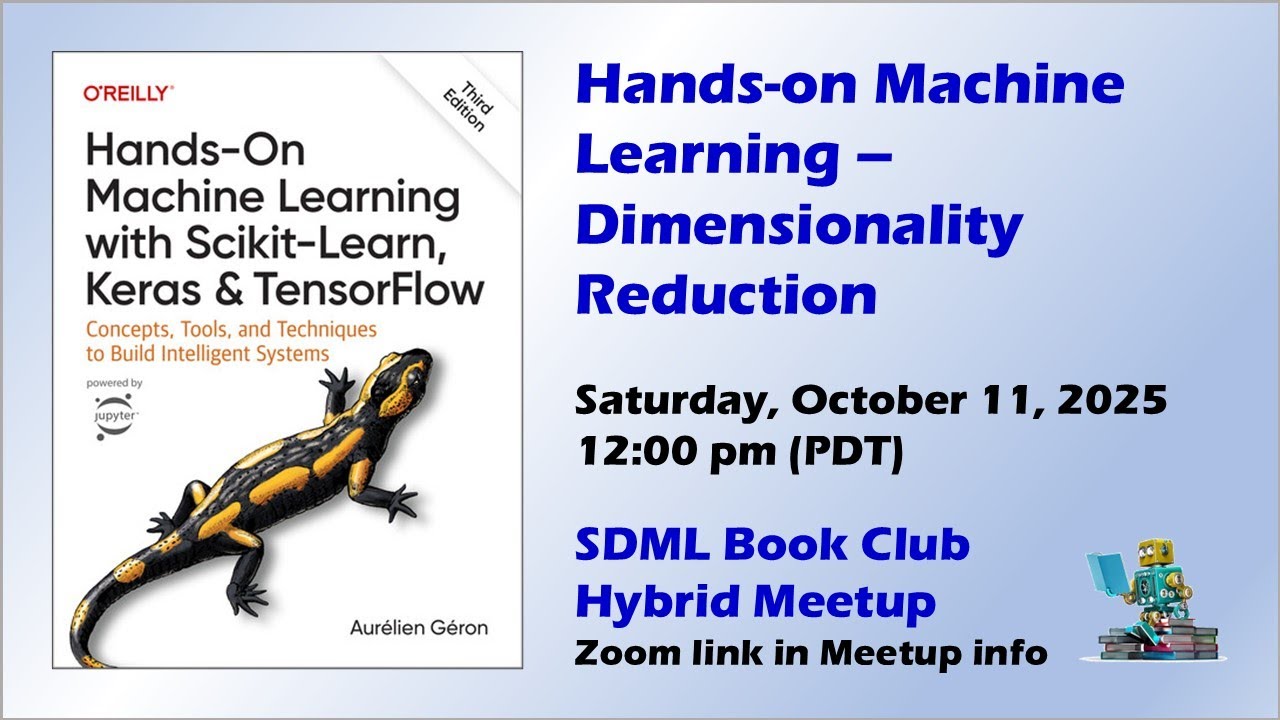
Hands-on Machine Learning -- Dimensionality Reduction
Keywords
Summary
164 words
Critical Evaluation
Value of the Information & Strength of the Argument
The video provides a clear and accessible explanation of dimensionality reduction concepts, grounded in the textbook. The presenter uses intuitive examples (e.g., plant measurements, Swiss roll) to illustrate abstract ideas like the curse of dimensionality and manifold learning. The argumentation is solid, as it builds from the motivation (curse of dimensionality) to specific techniques (projection, PCA, manifold learning) and includes practical caveats. The Q&A segments add value by addressing common misconceptions and clarifying nuances, such as the difference between extreme values and data sparsity. However, the discussion is informal and lacks rigorous mathematical depth, which might be insufficient for advanced learners.
Scientific Rigor, Source Quality, Title Accuracy
The content is based on a reputable textbook, which lends credibility. The presenter references the book and its concepts accurately. The title accurately reflects the content, as it is a hands-on session on dimensionality reduction. The video does not cite external sources beyond the book and the meetup’s GitHub repository, which is appropriate for a tutorial. The discussion is scientifically sound, though not exhaustive. The meetup format includes audience questions, which are handled competently. Overall, the scientific rigor is adequate for an introductory to intermediate audience.
202 words
Title / Content Match
The title accurately reflects the content: a hands-on session on dimensionality reduction from the book.
Quality & Reliability
7/10
The video is a book club discussion based on a well-regarded textbook (Hands-On ML by Aurélien Géron). The content is accurate and pedagogically sound, but it is a discussion rather than a formal lecture, with some informal tangents and Q&A. The information is reliable but not deeply rigorous.
Key Moments
Markers derived by PSI from the transcript: the creator did not define chapters.
- Introduction to the session and chapter 8 on dimensionality reduction.
- Explanation of the curse of dimensionality with examples.
- Discussion on why dimensionality reduction is needed.
- Introduction to projection as a dimensionality reduction technique.
- Explanation of manifold learning using the Swiss roll example.
- Q&A on practical implications and evaluation of dimensionality reduction.
Cited Sources
- Hands-On Machine Learning with Scikit-Learn, Keras, and TensorFlow (book) — The book being discussed, referenced for chapter 8.
- SDML Book Club Notes — Notes and slides for the session.
Concurring Sources
- Hands-On Machine Learning with Scikit-Learn, Keras, and TensorFlow — The primary source, consistent with the video's content.
Contribution & Novelties
The video provides a practical, discussion-based overview of dimensionality reduction, making it accessible to learners. It emphasizes the importance of understanding the curse of dimensionality and the trade-offs of different techniques. The Q&A format adds real-world perspectives and clarifies common misunderstandings.
Pour aller plus loin :
- Principal Component Analysis (PCA) — A fundamental technique for dimensionality reduction, discussed in the video.
- Manifold learning — The concept of learning lower-dimensional structures, illustrated with the Swiss roll.
- t-SNE — A popular manifold learning technique for visualization, often used in practice.
88 words
Radar Profile
The radar profile shows balanced scores across information quantity, quality, technical level, and reliability, with slightly higher quality and reliability. This indicates a well-rounded educational resource, though not extremely deep in technical detail.
💬 Sur les 0 commentaires analysés, aucune tendance n'est disponible.