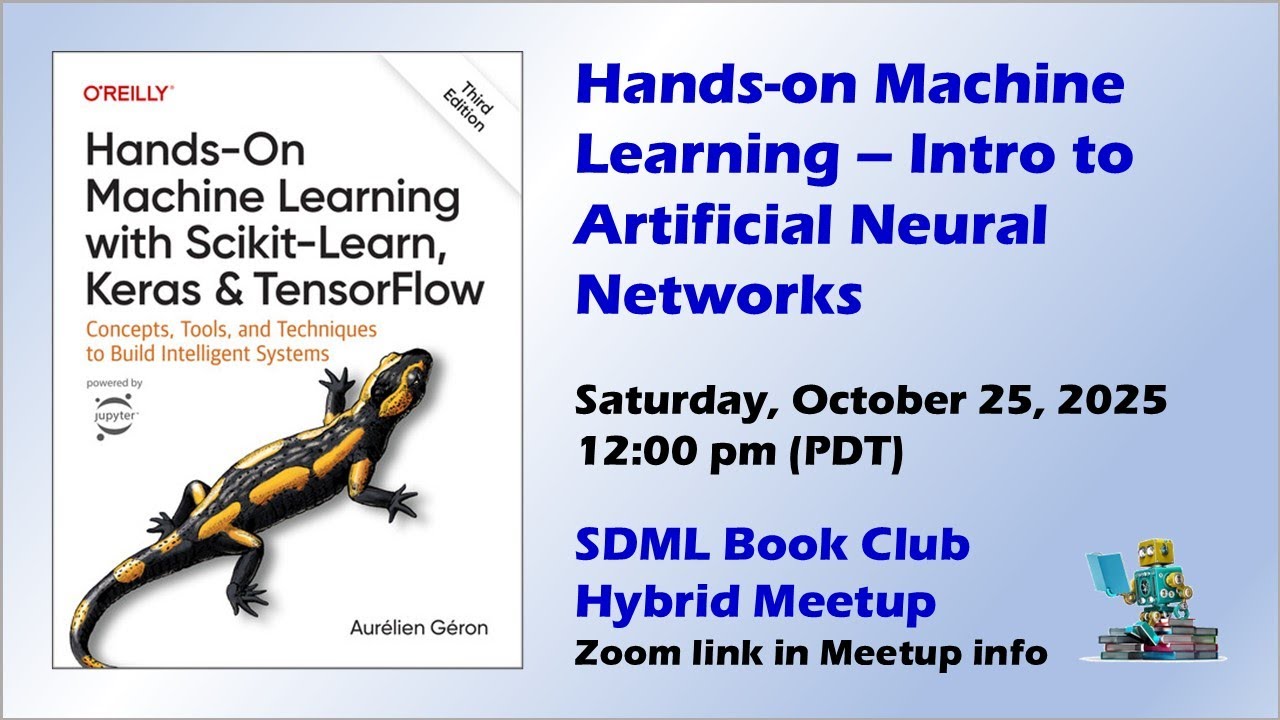
Hands-on Machine Learning -- Introduction to Artificial Neural Networks
Keywords
Summary
140 words
Critical Evaluation
Value of the Information & Strength of the Argument
The video provides a solid introduction to neural networks, explaining key concepts clearly and with practical examples. The argumentation is sound, based on the textbook and the presenters’ understanding. They effectively illustrate the limitations of single-layer perceptrons and the power of multi-layer networks. The discussion on activation functions and loss functions is particularly valuable for beginners. The presenters also address common misconceptions, such as the difference between historical perceptrons and modern neural networks. The use of a concrete code example (MLP regressor) helps ground the theory. However, the discussion is informal and lacks rigorous mathematical depth, which might be a limitation for advanced learners.
Scientific Rigor, Source Quality, Title Accuracy
The content is based on a reputable textbook by Aurélien Géron, which is widely recommended in the machine learning community. The presenters are part of a meetup group, and the discussion is collaborative, with participants correcting each other when needed. The title accurately reflects the content. The sources cited in the description include the GitHub repository for the book club and a Slack invitation, which are relevant for further engagement. The video does not cite external research papers, but the reliance on the textbook provides a solid foundation. The adequacy between title and content is high, as the video indeed provides a hands-on introduction to neural networks.
226 words
Title / Content Match
The title accurately reflects the content: a hands-on introduction to artificial neural networks, with practical examples and code.
Quality & Reliability
7/10
The content is a group discussion based on a well-known textbook (Hands-On Machine Learning by Aurélien Géron), providing accurate explanations of neural network concepts. The discussion is informal but technically sound, with occasional clarifications and corrections among participants. The source is a book club session, not peer-reviewed, but the material is reliable.
Key Moments
Markers derived by PSI from the transcript: the creator did not define chapters.
- Introduction to the book club and overview of topics: artificial neural networks, perceptrons, backpropagation, activation functions, MLP, Keras, TensorBoard, hyperparameter tuning.
- Historical background of neural networks, inspired by biological neurons, and the evolution away from spiking neural networks.
- Explanation of a single perceptron: inputs, weights, activation function, and its limitations (only linear decision boundaries).
- Introduction to multi-layer perceptrons (MLP) and how stacking layers allows representation of non-linear functions, using the XOR example.
- Discussion on activation functions: ReLU, sigmoid, tanh, and their derivatives. Importance of non-linearity and the role of derivatives in backpropagation.
- Q&A about feature interactions in hidden layers: how the network learns combinations of features automatically.
- Code example: MLP regressor in Scikit-Learn on California housing dataset, achieving RMSE 0.505.
- Discussion on choosing activation functions and loss functions for different tasks: regression (no activation), binary classification (sigmoid + binary cross-entropy), multiclass (softmax + categorical cross-entropy), multilabel (sigmoid).
- Comment on Keras abstraction and potential confusion with loss functions and data shapes.
Cited Sources
- SDML Book Club GitHub Repository — Repository containing notes and slides for the book club sessions.
- SDML Slack Community — Invitation to join the Slack community for discussions and questions.
Concurring Sources
- Hands-On Machine Learning with Scikit-Learn, Keras, and TensorFlow — The book referenced in the video, providing the theoretical foundation for the discussion.
Contribution & Novelties
This video provides a clear, accessible introduction to neural networks, emphasizing practical understanding over mathematical rigor. It clarifies common terminology confusions (e.g., perceptron vs. MLP) and offers a useful framework for selecting activation and loss functions. The discussion format allows for interactive Q&A, addressing typical beginner questions.
Pour aller plus loin :
- Hands-On Machine Learning with Scikit-Learn, Keras, and TensorFlow — The book this session is based on, providing comprehensive coverage of ML and deep learning.
- Neural network - Wikipedia — Overview of neural networks, including history and types.
- Activation function - Wikipedia — Detailed explanation of various activation functions and their properties.
- Backpropagation - Wikipedia — Explanation of the backpropagation algorithm for training neural networks.
116 words
Radar Profile
The radar profile shows balanced scores across all dimensions, with slightly lower technical depth and information quantity, reflecting the introductory nature of the session. The high reliability and quality scores indicate a trustworthy and well-structured presentation.