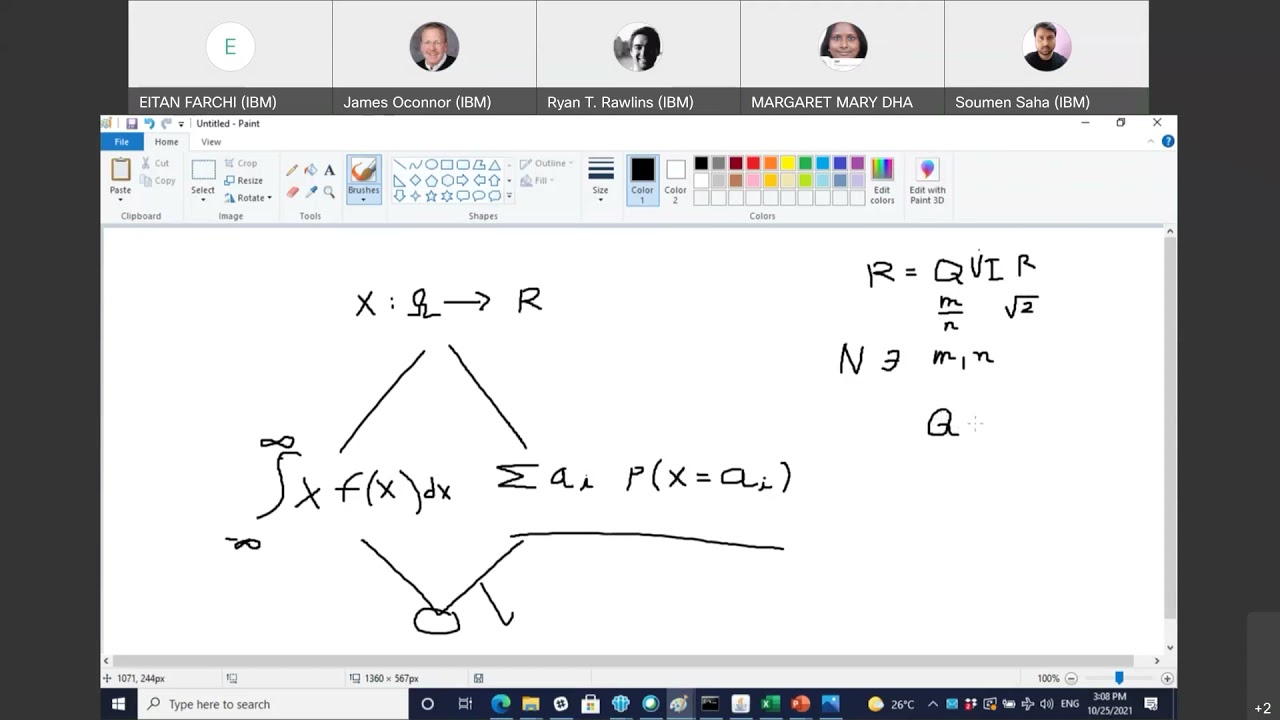
Why do we need the Lebesgue integral in probability?
Keywords
Summary
153 words
Critical Evaluation
Value of the Information & Strength of the Argument
The video provides a clear and intuitive explanation of the Lebesgue integral, effectively motivating its necessity in probability theory. The argumentation is solid: it starts with the limitations of the Riemann integral, uses a concrete example (the Dirichlet function) to illustrate the failure, and then shows how the Lebesgue approach resolves the issue by partitioning the range. The speaker also connects the Lebesgue integral to probability by treating probability as a measure, which unifies discrete and continuous cases. The value lies in its pedagogical clarity, making a complex topic accessible. However, the argumentation is not fully rigorous; it relies on intuition and omits formal proofs, which might be a drawback for advanced viewers.
Scientific Rigor, Source Quality, Title Accuracy
The scientific rigor is moderate: the mathematical content is correct, but the presentation is informal and lacks citations or references to literature. The title accurately reflects the content, which is a tutorial on the Lebesgue integral in probability. No sources are cited in the video or description, so the quality of sources cannot be assessed. The video does not include any advertising or sponsored content.
193 words
Title / Content Match
The title accurately reflects the content, which focuses on motivating the Lebesgue integral in the context of probability theory.
Quality & Reliability
7/10
The presentation is mathematically sound, clearly explains the motivation and construction of the Lebesgue integral, and correctly identifies the limitations of the Riemann integral. However, it lacks formal proofs and references, and the informal style may leave some gaps for a rigorous audience.
Key Moments
Markers derived by PSI from the transcript: the creator did not define chapters.
- Introduction and motivation for the Lebesgue integral in probability.
- Review of averages for discrete and continuous random variables.
- Discussion on the need for a unified concept for averages.
- Introduction to the Riemann integral and its limitations.
- Example of a function without a Riemann integral (Dirichlet function).
- Key idea: partition the range instead of the domain.
- Construction of the Lebesgue integral and its value for the example.
- Connection to probability theory and measures.
- Q&A session and suggestions for further study (Monte Carlo methods).
Contribution & Novelties
The video offers a clear pedagogical explanation of the Lebesgue integral, emphasizing its importance in probability theory. It effectively demonstrates the limitations of the Riemann integral with a concrete example and shows how the Lebesgue approach unifies discrete and continuous cases. The presentation is accessible, making it a valuable resource for students. However, it does not introduce new mathematical results, but rather provides an intuitive explanation of existing concepts.
Pour aller plus loin :
- Lebesgue integration — Provides a comprehensive overview of the theory.
- Measure (mathematics) — Essential for understanding the foundation of the Lebesgue integral.
- Probability theory — Contextualizes the use of the Lebesgue integral in probability.
- Monte Carlo method — Suggested by the speaker for practical applications.
119 words
Radar Profile
The radar profile shows a balanced performance across all dimensions, with slightly higher scores in quality and technical level, indicating a solid educational content with good depth and accuracy.