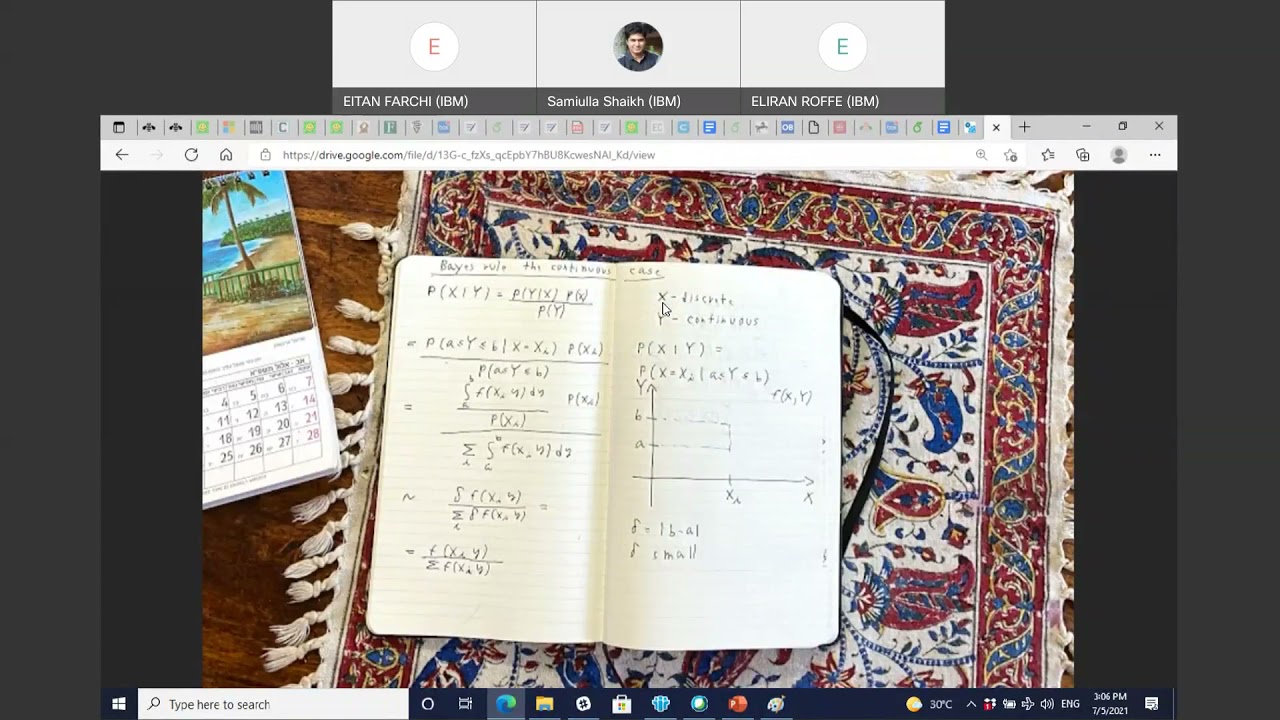
Continuous version of Bayes rule
Keywords
Summary
168 words
Critical Evaluation
Value of the Information & Strength of the Argument
The video provides a clear and intuitive explanation of a subtle topic: applying Bayes’ rule to continuous variables. The speaker carefully derives the formula, starting from the discrete case and then generalizing to continuous variables by considering intervals and densities. He emphasizes the approximation step, which is often glossed over in textbooks, and explains why it is valid. The argumentation is logical and well-structured, with a focus on building understanding rather than just presenting formulas. The value lies in its pedagogical approach, making a potentially confusing concept accessible. However, the video lacks concrete examples or applications, which would strengthen the argumentation and illustrate the practical use of the continuous Bayes rule.
Scientific Rigor, Source Quality, Title Accuracy
The scientific rigor is moderate. The mathematical derivations are correct and the explanation is sound, but the video does not cite any sources or references. The speaker’s affiliation with IBM adds some credibility, but the lack of citations means the viewer cannot verify the claims or explore further. The title accurately reflects the content, which is a tutorial on the continuous Bayes rule. There is no mention of any external sources in the description, so the video stands alone. The presentation is informal, which is suitable for a tutorial, but it could benefit from more formal rigor. Overall, the content is reliable but not extensively sourced.
232 words
Title / Content Match
The title accurately reflects the content, which focuses on extending Bayes' rule to continuous variables.
Quality & Reliability
7/10
The content is mathematically sound and clearly explained, but it lacks formal citations and references. The speaker is identified as an IBM researcher, adding credibility. The explanation is intuitive and correct, but the absence of sources and the informal presentation style limit the score.
Key Moments
Markers derived by PSI from the transcript: the creator did not define chapters.
- Introduction and overview of the video's purpose.
- Discussion of two interpretations of probability: frequentist and subjective.
- Contrast between Bayesian and classical machine learning: integrals vs. optimization.
- Definition of discrete and continuous random variables and their probability representations.
- Derivation of Bayes' rule for mixed discrete-continuous variables using intervals.
- Approximation of integrals for small intervals and simplification to densities.
- Explanation of the intuition behind using densities in Bayes' rule.
- Conclusion and preview of next session.
Contribution & Novelties
The video’s original contribution lies in its pedagogical approach to explaining the continuous Bayes rule, particularly the step-by-step derivation that clarifies why densities can be used in place of probabilities. It addresses a common source of confusion for students by explicitly showing the approximation from integrals to densities. The video also highlights the philosophical distinction between frequentist and subjective probability and its implications for machine learning paradigms.
Pour aller plus loin :
- Bayes’ theorem — Provides a comprehensive overview of Bayes’ theorem, including continuous formulations.
- Probability density function — Explains the concept of probability density and its properties.
- Bayesian inference — Discusses Bayesian inference and its applications in statistics and machine learning.
112 words
Radar Profile
The radar profile shows a balanced performance across all dimensions, with slightly higher scores in quality of information and technical level, indicating a solid educational content. The lower score in quantity of information suggests the video is concise and focused, which is appropriate for a tutorial.