A Unified Perspective on Adversarial and Out of Distribution Detection in the Open World
Keywords
Summary
156 words
Critical Evaluation
Value of the Information & Strength of the Argument
The video provides a clear and structured presentation of the research, with a logical flow from problem statement to methodology and results. The argumentation is solid, supported by quantitative comparisons across multiple datasets and attack types. The authors effectively demonstrate the limitations of existing methods in open-world settings and show that their proposed method achieves superior performance. However, the presentation is concise and lacks deep theoretical justification for why SV-random works, which could be a point of criticism. The use of visualizations (t-SNE, curves) helps in understanding the concepts.
Scientific Rigor, Source Quality, Title Accuracy
The video is based on original research, but no external sources are cited in the description or during the presentation. The methodology is described in sufficient detail, but the lack of references to prior work limits the ability to verify claims. The title accurately reflects the content, which is a unified perspective on adversarial and OOD detection. The presentation is scientifically rigorous in its experimental design, but the absence of source citations reduces its overall reliability.
180 words
Title / Content Match
The title accurately reflects the content, which unifies adversarial defense and OOD detection in an open-world setting.
Quality & Reliability
7/10
The video presents original research with a clear methodology and quantitative results, but lacks detailed derivations and external validation. The presentation is concise and technical, but the absence of references in the description limits verifiability.
Key Moments
Markers derived by PSI from the transcript: the creator did not define chapters.
- Introduction to the problem of adversarial and OOD detection in open world
- Explanation of adversarial attacks: FGSM, PGD, CW
- Overview of adversarial defense methods: adversarial training, input transformation, mixup
- Introduction to OOD detection methods: ODIN and generalized ODIN
- Motivation for open-world evaluation and t-SNE visualization of feature space
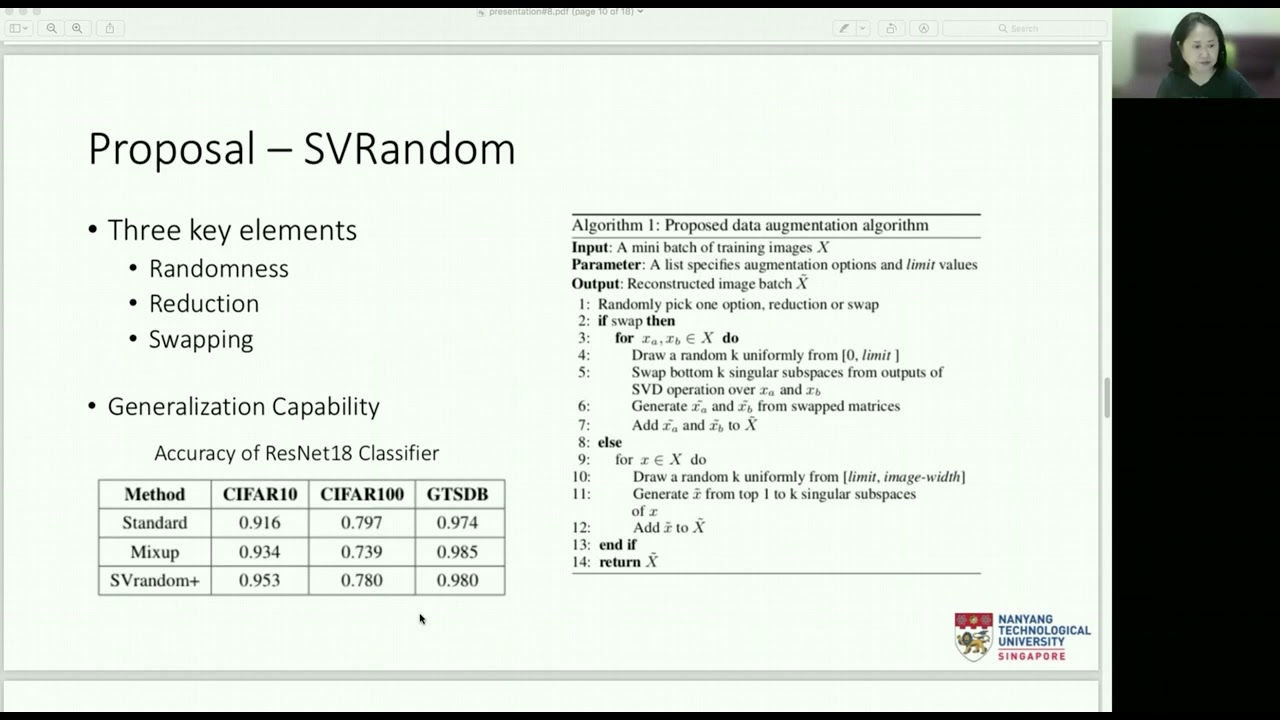
- Proposed method: SV-random data augmentation using SVD
- Multi-level semantics based OOD detection metric
- Experimental setup and comparison of training methods
- Results on adversarial defense and OOD detection performance
- Open-world evaluation and conclusion
Contribution & Novelties
The video presents a novel data augmentation method (SV-random) that leverages SVD to improve both adversarial robustness and OOD detection. The key innovation is the use of singular subspaces as latent space for generating augmented samples, which helps in reducing sensitivity to adversarial perturbations while maintaining or improving classification accuracy. The multi-level semantics based OOD detection metric is also a contribution, as it uses parent class information to improve detection in complex datasets like CIFAR-100. The open-world evaluation framework is a step forward from traditional lab settings.
Pour aller plus loin :
- Singular Value Decomposition (SVD) — Fundamental linear algebra concept used in the method.
- Adversarial Robustness: Mixup — Related data augmentation technique for robustness.
- ODIN: Out-of-Distribution Detector for Neural Networks — Baseline OOD detection method discussed.
127 words
Radar Profile
The radar profile shows high scores in technical level and information quality, indicating a technically dense presentation. The quantity of information is moderate, and reliability is slightly lower due to lack of external sources. Overall, the video is strong in content but could benefit from more references.