Detecting Concept Drift in the Presence of Sparsity A Case Study of Automated Change Risk
Keywords
Summary
188 words
Critical Evaluation
Value of the Information & Strength of the Argument
The value of the information is high: the authors identify a practical gap (concept drift detection in sparse data) and propose a systematic approach to imputation selection. They also challenge existing evaluation metrics, which is a valuable contribution. The argumentation is solid, supported by experiments on synthetic and real datasets. However, the presentation is somewhat informal and lacks detailed statistical analysis or formal proofs. The ensemble recommendation is well-motivated by the empirical results showing no single detector is best across all metrics.
Scientific Rigor, Source Quality, Title Accuracy
The scientific rigor is moderate: the methodology is clear, but the presentation lacks formal citations to the literature (e.g., for ADWIN, DDM, etc.) and does not provide references to the datasets used. The title accurately reflects the content. The authors do not provide external validation or peer-reviewed publication details, which limits the reliability. The use of real-world data (HAR) adds credibility, but the lack of detailed experimental setup (e.g., hyperparameters, statistical significance) reduces rigor.
171 words
Title / Content Match
The title accurately reflects the content: the presentation focuses on detecting concept drift in sparse data, applied to an automated change risk assessment system.
Quality & Reliability
7/10
The presentation is based on original research with a clear methodology, but lacks peer-reviewed publication details and external validation. The authors are from industry (Walmart Global Tech), which adds practical relevance but may introduce bias. The content is technical and appears rigorous, but the lack of formal citations and the informal presentation style reduce the overall reliability score.
Key Moments
Markers derived by PSI from the transcript: the creator did not define chapters.
- Introduction and overview of the work by Anirban Chatterjee.
- Discussion on sparsity, its causes, and the need for imputation.
- Types of sparsity: MCAR, MAR, MNAR.
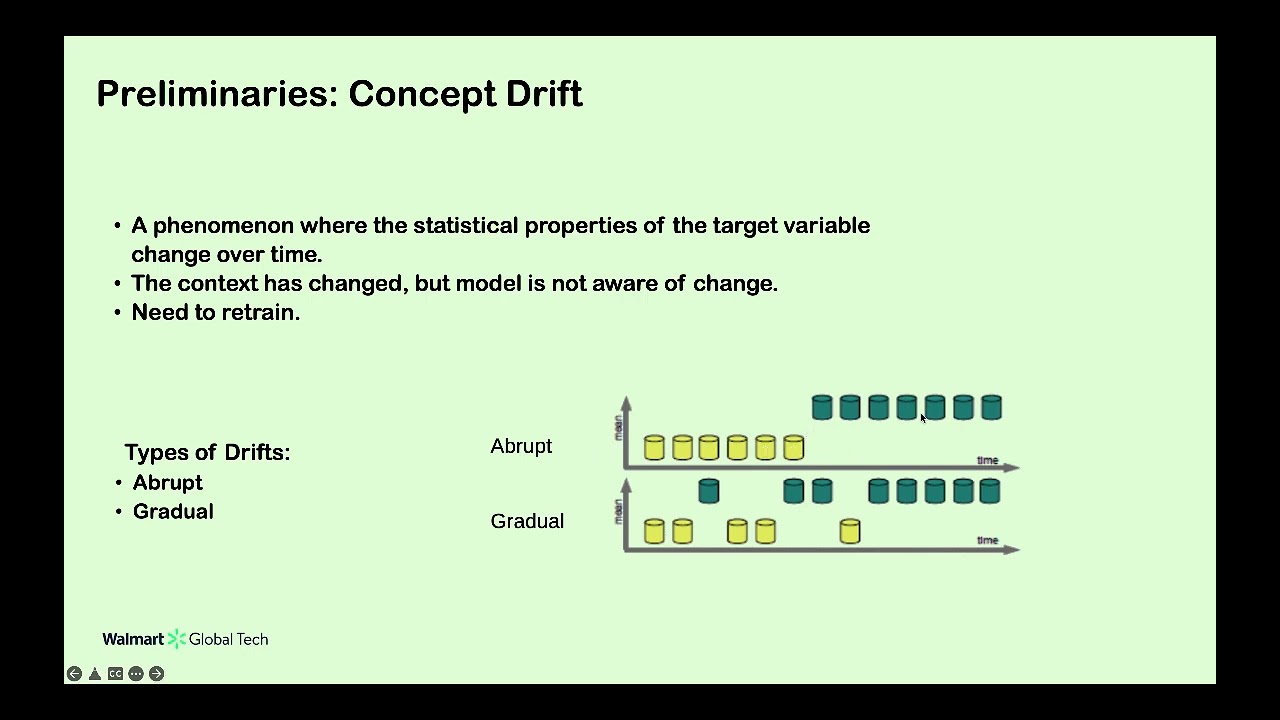
- Introduction to concept drift and its types (abrupt, gradual).
- Review of existing drift detection methods (ADWIN, DDM, EDDM, HDDM, KSWIN, Page-Hinkley).
- Critique of traditional evaluation metrics and proposal of new metrics.
- Proposed methodology: using complete-case data to select imputation technique.
- Experiments on synthetic data: imputation technique selection based on RMSE.
- Experiments on HAR database with advanced imputation methods.
- Results showing imputation improves drift detection; ensemble recommendation.
Cited Sources
- ADWIN: Adaptive Windowing — Mentioned as a concept drift detection method.
- DDM: Drift Detection Method — Mentioned as a concept drift detection method.
- EDDM: Early Drift Detection Method — Mentioned as a concept drift detection method.
- HDDM: Hoeffding's Inequality based Drift Detection Method — Mentioned as a concept drift detection method.
- KSWIN: Kolmogorov-Smirnov Windowing — Mentioned as a concept drift detection method.
- Page-Hinkley test — Mentioned as a concept drift detection method.
Concurring Sources
- A Survey on Concept Drift Adaptation — Provides background on concept drift detection methods.
Dissenting Sources
- None — No discordant sources were mentioned in the presentation.
Contribution & Novelties
The main novelty is the empirical study of how data imputation affects concept drift detection, providing guidelines for choosing imputation methods based on data distribution and sparsity pattern. The proposal of new evaluation metrics (detection delay, true positive rate, true positives per drift, drift count) addresses the misleading nature of traditional metrics. The majority-voting ensemble of drift detectors is a practical contribution that improves robustness across different drift types.
Pour aller plus loin :
- Concept drift — Overview of concept drift and its challenges.
- Missing data imputation — General information on imputation techniques.
- ADWIN algorithm — Original ADWIN paper and implementation.
- Drift Detection Method (DDM) — Original DDM paper and implementation.
111 words
Radar Profile
The radar profile shows high scores in quantity of information and technical level, indicating a dense and technical presentation. The quality of information is also high, but the reliability is slightly lower due to lack of formal citations. The overall balance suggests a valuable technical talk for an audience familiar with machine learning concepts.
💬 No comments were provided for analysis.