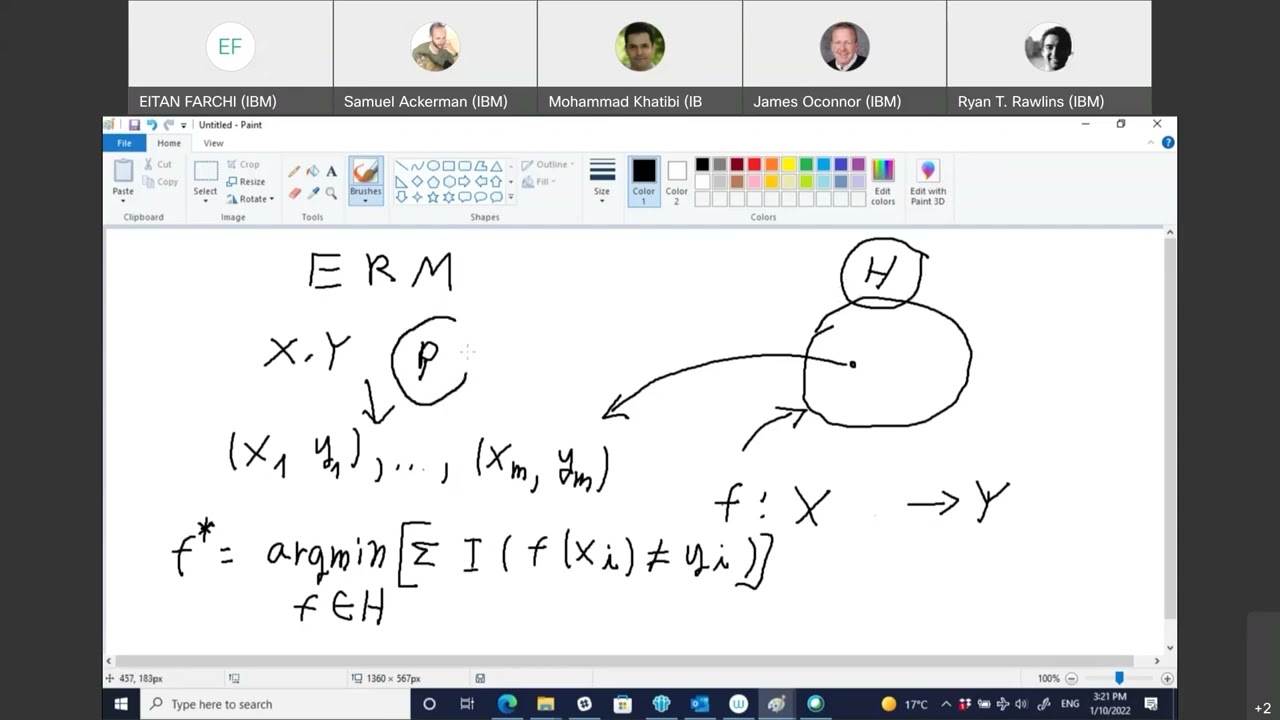
How can ERM be fooled?
Keywords
Summary
146 words
Critical Evaluation
Value of the Information & Strength of the Argument
The video provides a clear and rigorous demonstration of a fundamental limitation of ERM. The argument is logically structured: it defines ERM, introduces the concept of density functions, and then constructs a counterexample where the training data is uninformative. The reasoning is mathematically sound and accessible to an audience with basic knowledge of probability. The value lies in highlighting a subtle but important issue in machine learning, which is often overlooked in practical applications. The argumentation is solid, though it could be strengthened by discussing real-world implications or connections to broader learning theory.
Scientific Rigor, Source Quality, Title Accuracy
The video is a lecture without citations or references, so the scientific rigor relies on the internal consistency of the argument. The mathematical reasoning is correct, and the example is well-constructed. The title accurately reflects the content. No external sources are provided, which limits the ability to verify claims or explore further. The presentation is informal but clear, and the lack of references is a minor weakness.
175 words
Title / Content Match
The title accurately reflects the content: the video demonstrates a specific scenario where ERM can be fooled by an adversary.
Quality & Reliability
7/10
The video presents a formal argument about the limitations of Empirical Risk Minimization (ERM) using a clear mathematical example. The reasoning is sound and based on well-established probability theory. However, it is a short lecture without citations or references, and the presentation is informal, which limits its depth and verifiability.
Key Moments
Markers derived by PSI from the transcript: the creator did not define chapters.
- Introduction: question about ERM approximation
- Definition of ERM and hypothesis space
- Example of ERM with classifiers and neural networks
- Introduction of density functions and probability of points
- Construction of adversarial example with finite support function
- Explanation that training data will be all zeros, fooling ERM
- Conclusion: ERM is sensitive to distribution assumptions
Contribution & Novelties
The video provides a clear and concise demonstration of a known theoretical limitation of ERM, but it does not introduce new research. Its contribution is pedagogical, making the concept accessible.
Pour aller plus loin :
- Empirical risk minimization - Wikipedia — Overview of ERM and its theoretical foundations.
- Probably approximately correct learning - Wikipedia — Related learning framework that addresses some limitations of ERM.
- No free lunch theorem - Wikipedia — Related result about the impossibility of universal learning algorithms.
80 words
Radar Profile
The radar profile shows high scores in quality of information and technical level, but lower in quantity of information and global reliability due to lack of sources. This indicates a focused, expert-level explanation with limited breadth.