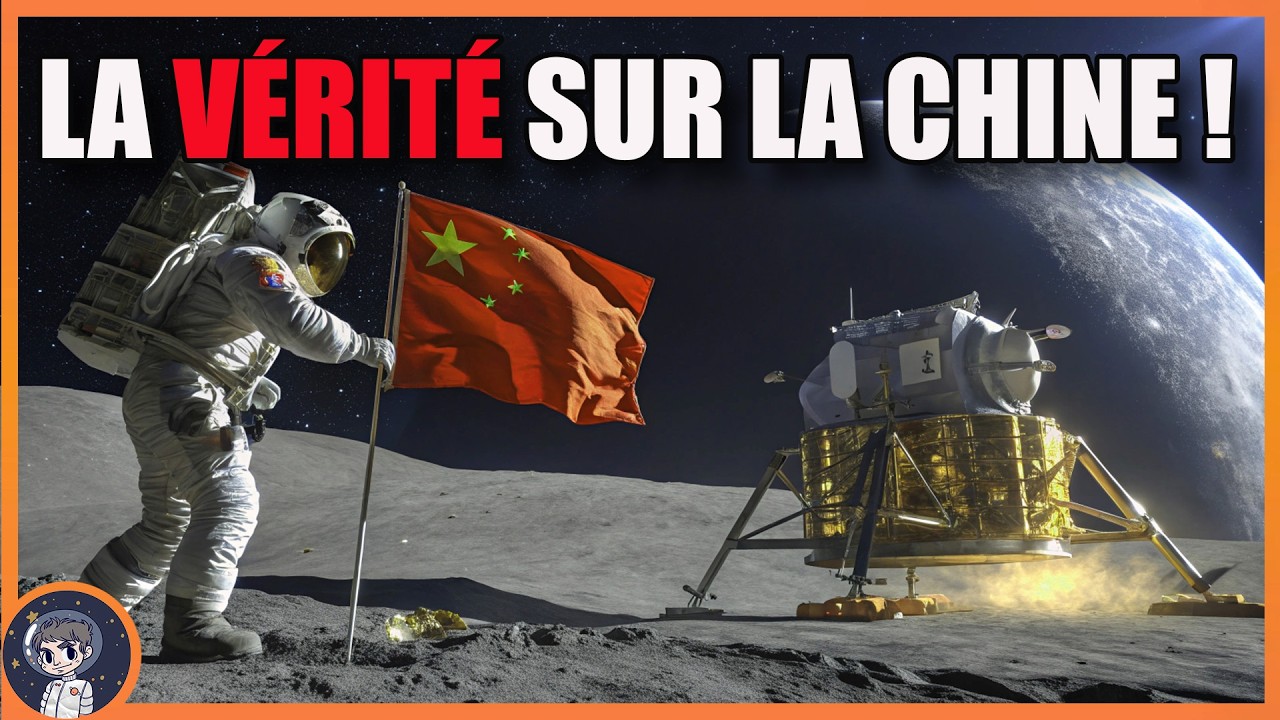
SPATIAL : LA CHINE va t-elle prendre le POUVOIR ? - Le Saviez Vous #2 - Le JDE
Keywords
Summary
139 words
Critical Evaluation
Value of the Information & Strength of the Argument
The video provides a comprehensive and informative overview of China’s space program, with a clear narrative and logical progression. It effectively argues that China’s political stability and sustained investment are key advantages. The argumentation is solid, though it occasionally oversimplifies complex technical and political aspects. The use of comparisons (e.g., Long March 9 vs. SLS) helps contextualize the information, but some analogies (like comparing thrust to Rafale jets) may be less precise.
Scientific Rigor, Source Quality, Title Accuracy
The video does not explicitly cite specific sources during the narration, but the description lists general sources such as NASA, ESA, and the forum-conquete-spatiale. The title accurately reflects the content. The video is well-produced and appears to be based on reliable general knowledge, though it lacks direct references to primary documents. The comments indicate some viewers perceived the narration as AI-generated, which may affect perceived authenticity.
153 words
Title / Content Match
The title accurately reflects the content, which focuses on China's space program and its potential to lead in lunar exploration.
Quality & Reliability
7/10
The video provides a well-structured overview of China's space program, citing specific missions and technical details. However, it lacks direct citations to primary sources and relies on general knowledge, with some potential inaccuracies (e.g., SLS first flight date). The presentation is engaging but not deeply sourced.
Key Moments
Markers derived by PSI from the transcript: the creator did not define chapters.
- Introduction to China's space program and its ambitions.
- Discussion on political stability and budget.
- Presentation of the Long March 9 rocket and its capabilities.
- Overview of the Tiangong space station and its role.
- Details on the Chang'e lunar missions and achievements.
- Technological advancements in materials, life support, and propulsion.
- Planned crewed lunar mission architecture and comparison with Artemis.
- Training of taikonauts and international partnerships.
- Conclusion on China's prospects and the new space race.
Cited Sources
- Creative Commons Attribution 4.0 — License for music used in the video.
- CreatorChords — Music source for the video.
- Sound Lapse — Music source.
- Utho Riley — Music source.
- Fifty Sounds — Music source.
- Forum de la conquête spatiale — General source for space news and discussions.
- Jamendo - Inspire Galactic — Music track used in the video.
- Journal de l'Espace — Official blog of the channel.
- LinkedIn - Quentin Leicht — LinkedIn profile of the channel's host.
- Scott Buckley — Music source.
- Bensound - Evolution — Music track used in the video.
- City Walk - Sound Lapse — Music track used in the video.
Concurring Sources
- NASA - Artemis — Official NASA page on the Artemis program, which the video compares to China's lunar plans.
- CNSA - China National Space Administration — Official CNSA website providing details on China's space missions.
Dissenting Sources
- SpaceNews - SLS first flight — The video states SLS first flight was on September 2, 2020, but it actually occurred on November 16, 2022. This is a factual error.
Contribution & Novelties
The video offers a concise and accessible synthesis of China’s space program, highlighting its strategic advantages and technical milestones. It provides a useful comparison with the US Artemis program, emphasizing China’s more direct mission architecture. The video also underscores the role of political stability and military oversight in accelerating progress.
Pour aller plus loin :
- China National Space Administration — Official CNSA website for primary information.
- Chang’e 5 mission overview — Detailed mission details and achievements.
- Long March 9 rocket — Technical specifications and development status.
- Tiangong space station — Overview of the station’s modules and operations.
- Artemis program — NASA’s official Artemis program page for comparison.
107 words
Radar Profile
The radar profile shows high scores in information quantity and technical level, indicating a content-rich video with moderate technical depth. The quality and reliability scores are slightly lower, reflecting the lack of direct citations and minor inaccuracies. Overall, the video is informative but not deeply rigorous.
💬 Positive. Sur les 30 commentaires analysés, la majorité exprime un intérêt et une appréciation pour le contenu, avec quelques critiques sur la narration perçue comme artificielle et des débats sur la légitimité du programme spatial chinois.