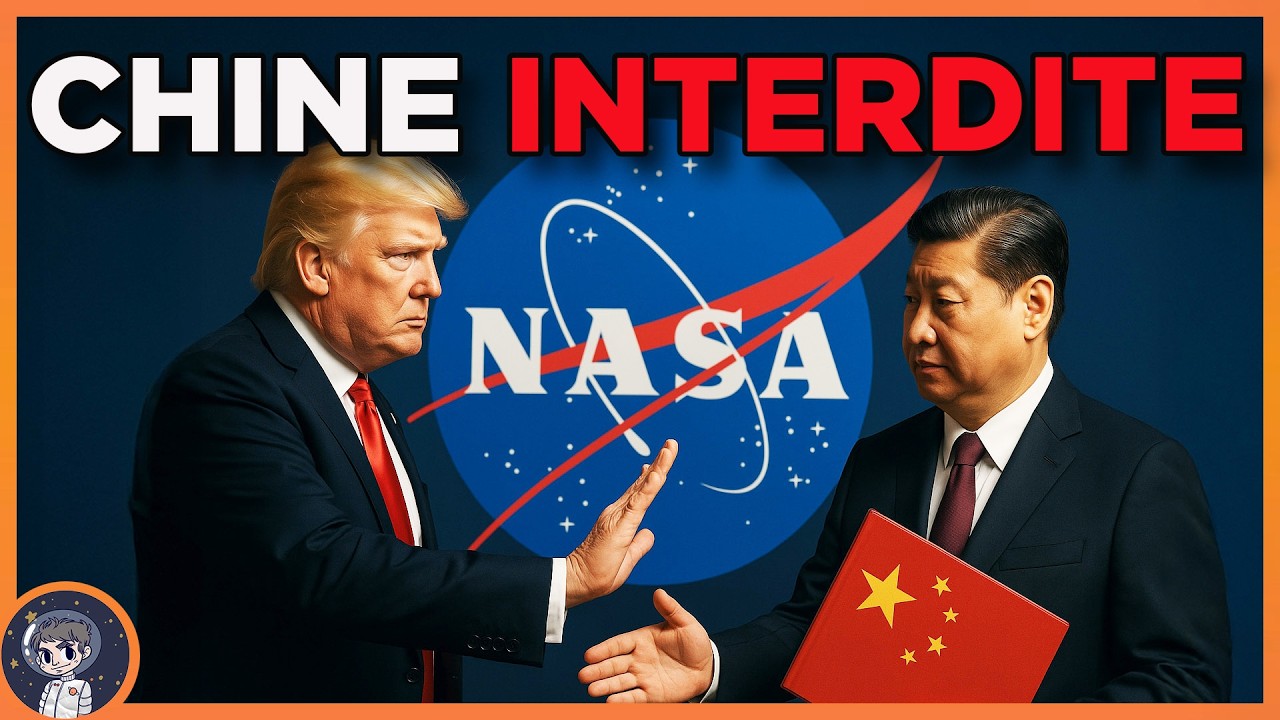
La NASA vient de BLOQUER tous ses ACCÈS aux CHINOIS ! - Le Journal de l'Espace #308 - Actu spatiale
Keywords
Summary
145 words
Critical Evaluation
Value of the Information & Strength of the Argument
The video provides a comprehensive and informative overview of current space news, with each segment offering clear explanations of the technical and strategic aspects. The argumentation is generally solid, presenting facts and context without excessive speculation. For instance, the NASA-China story is framed within the broader context of US-China competition, and the SpaceX launch increase is supported by environmental review details. The Venus exploration segment explains the technological challenges and the potential of new materials and sensors. The European space policy segment argues for the need to integrate startups for strategic independence, supported by references to the war in Ukraine. The Boeing solar panel segment highlights the benefits of 3D printing in terms of production speed and cost. The M51.4 segment provides a technical explanation of ballistic missile flight and its strategic role. Overall, the information is valuable and well-presented, though some claims could benefit from more direct sourcing.
Scientific Rigor, Source Quality, Title Accuracy
The video demonstrates a reasonable level of scientific rigor, with references to official agencies like NASA, FAA, and ESA, and mentions of specific programs and technologies. However, the sources are not always explicitly cited within the video, and the reliance on general knowledge may limit the depth of verification. The title accurately reflects the main story, but the video covers multiple topics, so the title is somewhat narrower than the content. The description includes links to the channel’s blog and social media, but no direct links to the specific news sources. The video’s production quality is high, with clear visuals and narration, but the lack of detailed citations for each claim is a minor weakness.
279 words
Title / Content Match
The title accurately reflects the main story about NASA blocking Chinese access, but the video covers multiple other space news items, making the title somewhat narrower than the content.
Quality & Reliability
7/10
The video presents a balanced overview of recent space news, with clear explanations and references to official sources (NASA, FAA, ESA). However, some claims lack direct citations, and the presentation is aimed at a general audience, which may simplify complex technical details.
Chapters
- Intro et Sponso INCOGNI
- La NASA vient de BLOQUER tous ses ACCÈS aux CHINOIS !
- SpaceX accélère la cadence à CAP CANAVERAL
- Deux innovations pour EXPLORER Vénus
- L'Europe ouvre l'accès au New Space pour gagner en indépendance spatiale
- Boeing innove fort dans les panneaux solaires spatiaux
- La France franchit un cap dans la dissuasion nucléaire avec un nouveau missile
Cited Sources
- Incogni — Sponsor of the video, offering data privacy services.
- Creative Commons Attribution 4.0 International — License for the music used in the video.
- CreatorChords — Source of the music track 'Superepic' by Alexander Nakarada.
- Forum de la conquête spatiale — General source for space news and discussions.
- Journal de l'Espace Blog — The channel's blog with additional articles and news.
- Quentin Leicht LinkedIn — Profile of the host, Quentin Leicht.
- Scott Buckley Music — Source of music used in the video.
- Utho Riley — Source of music used in the video.
- Sound Lapse - City Walk — Source of the music track 'City Walk'.
- Bensound - Evolution — Source of the music track 'Evolution'.
- Jamendo - Inspire Galactic — Source of the music track 'Inspire Galactic' by Carvine.
Concurring Sources
- NASA — Official NASA website, which would have press releases about the policy change regarding Chinese nationals.
- Federal Aviation Administration (FAA) — Official FAA website, relevant to the SpaceX launch authorization.
- European Space Agency (ESA) — Official ESA website, relevant to European space policy and New Space initiatives.
Dissenting Sources
- No direct discordant sources found — The video does not present conflicting viewpoints, but the topic of NASA-China relations is complex and may have differing perspectives not covered.
External References
Contribution & Novelties
The video provides a concise and accessible summary of recent space news, highlighting key developments in space policy, technology, and exploration. Its originality lies in the synthesis of multiple stories into a single episode, offering viewers a broad perspective on the current state of space activities. The segment on Venus exploration innovations, particularly the high-temperature alloy and sensor, adds value by explaining potential breakthroughs that could enable longer missions. The discussion on European space policy and the integration of New Space startups is timely and relevant.
Pour aller plus loin :
- NASA’s Artemis Program — Official NASA page on the Artemis program, which is central to US lunar exploration and the context of the NASA-China tensions.
- Falcon 9 — Wikipedia article on SpaceX’s Falcon 9 rocket, providing technical details and launch history.
- Venera program — Wikipedia article on the Soviet Venera missions to Venus, relevant to the discussion on Venus exploration challenges.
- European Space Agency (ESA) — Official website of ESA, useful for understanding European space initiatives and policies.
- M51 (missile) — Wikipedia article on the M51 missile, providing details on its development and capabilities.
185 words
Radar Profile
The radar profile shows high scores in quantity of information and technical level, indicating a content-rich video with moderate technical depth. The quality of information and reliability are slightly lower, suggesting that while the information is generally accurate, it may lack detailed sourcing. The overall balance suggests a well-rounded news review suitable for a general audience interested in space.
💬 Positif. Sur les 30 commentaires analysés, la majorité exprime des remerciements et des appréciations pour la qualité des informations, avec quelques remarques constructives sur des détails techniques et des suggestions de sujets.