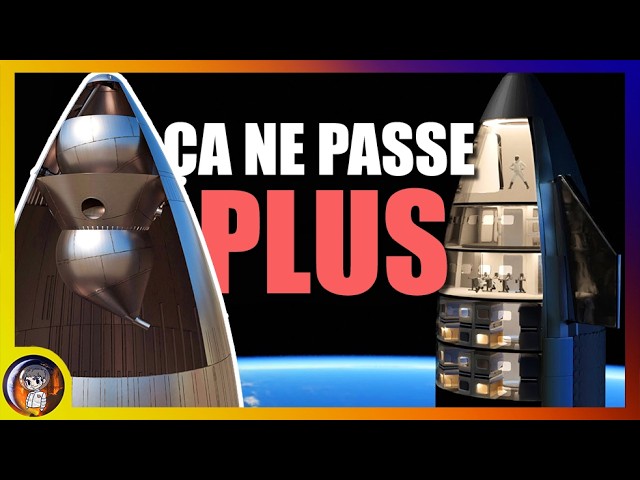
Le STARSHIP habité est-il devenu IRRÉALISTE ? - Le Journal de la Starbase #195 - Le JDE
Keywords
Summary
155 words
Critical Evaluation
Value of the Information & Strength of the Argument
The video offers valuable insights into the ongoing development of the Starship, particularly the technical rationale behind the header tank relocation. The argumentation is solid, as it explains the trade-offs between stability, propellant feed, and cargo volume, using concrete figures (e.g., 7.3 tonnes of methane, 23 tonnes of oxygen, 200 m³ for propellant transfer). The host also contextualizes the changes within SpaceX’s iterative design philosophy. However, some claims, such as the similarity between the new launch pad and the one at Massey’s, are presented as speculation, though they are clearly labeled as such.
Scientific Rigor, Source Quality, Title Accuracy
The video relies on a variety of sources, including images from independent observers (e.g., John Randolf, Fabien Ramirez) and footage from NASA Spaceflight. These are credited on screen and in the description. The host also references SpaceX’s official plans for Starship V2 and V3. The title accurately reflects the content, as the main question is indeed about the feasibility of a crewed Starship. The video does not overstate its claims and clearly distinguishes between confirmed facts and hypotheses. The absence of direct primary sources (e.g., official SpaceX statements) is a minor weakness, but the information is consistent with publicly available data.
209 words
Title / Content Match
The title accurately reflects the main question addressed in the video, which is the feasibility of a crewed Starship given the new header tank configuration.
Quality & Reliability
7/10
The video provides a detailed update on SpaceX Starbase activities, based on direct observation and community sources. It clearly distinguishes facts from speculation, and the technical explanations are coherent. However, the lack of primary sources and the reliance on unofficial imagery limit the overall reliability.
Key Moments
Markers derived by PSI from the transcript: the creator did not define chapters.
- Introduction and overview of the episode's topics.
- Aerial views of Starbase and discussion of the second launch pad construction.
- Update on the second orbital launch tower and its equipment.
- Discussion of the Star Factory facade modification and new employee entrance.
- Update on the S31 prototype at Massey's site and upcoming static fire.
- Introduction of the viewer question about crewed Starship feasibility.
- Explanation of the header tank evolution and new placement in the nose.
- Analysis of the impact on cargo volume and comparison with ISS.
- Conclusion and call to action.
Cited Sources
- NASA Spaceflight YouTube channel — Footage of the S31 prototype and Starbase activities.
- LabPadre YouTube channel — Live streams and images of Starbase construction.
- Starship Gazer YouTube channel — Images and videos of Starbase and Starship prototypes.
- RGV Aerial Photography YouTube channel — Aerial footage of Starbase.
- Forum de la conquête spatiale — Discussion forum for space enthusiasts, used as a source of information.
Concurring Sources
- NASA Spaceflight — Independent coverage of SpaceX activities, consistent with the video's observations.
- LabPadre — Live streams and images of Starbase, corroborating the construction progress.
External References
Contribution & Novelties
The video provides a detailed and up-to-date overview of the latest developments at Starbase, including the new header tank configuration and its implications for crewed missions. It offers a clear explanation of the engineering trade-offs, which is valuable for understanding SpaceX’s design choices. The comparison of the available volume with the ISS helps contextualize the feasibility of crewed flights.
Pour aller plus loin :
- Starship (Wikipedia) — Overview of the Starship vehicle and its development.
- Header tanks in spacecraft — General information on header tanks.
- SpaceX Starbase (Wikipedia) — Details on the Starbase facility.
94 words
Radar Profile
The radar profile shows high scores in quantity of information and technical level, reflecting the video's detailed and specialized content. The quality and reliability scores are slightly lower, indicating that while the information is generally accurate, it relies on unofficial sources and some speculation. Overall, the video is a solid source for enthusiasts but not for formal scientific reference.
💬 Très positif. Sur les 30 commentaires analysés, la grande majorité exprime des remerciements et des éloges pour la qualité et la régularité des vidéos, avec quelques remarques constructives sur la prononciation anglaise.