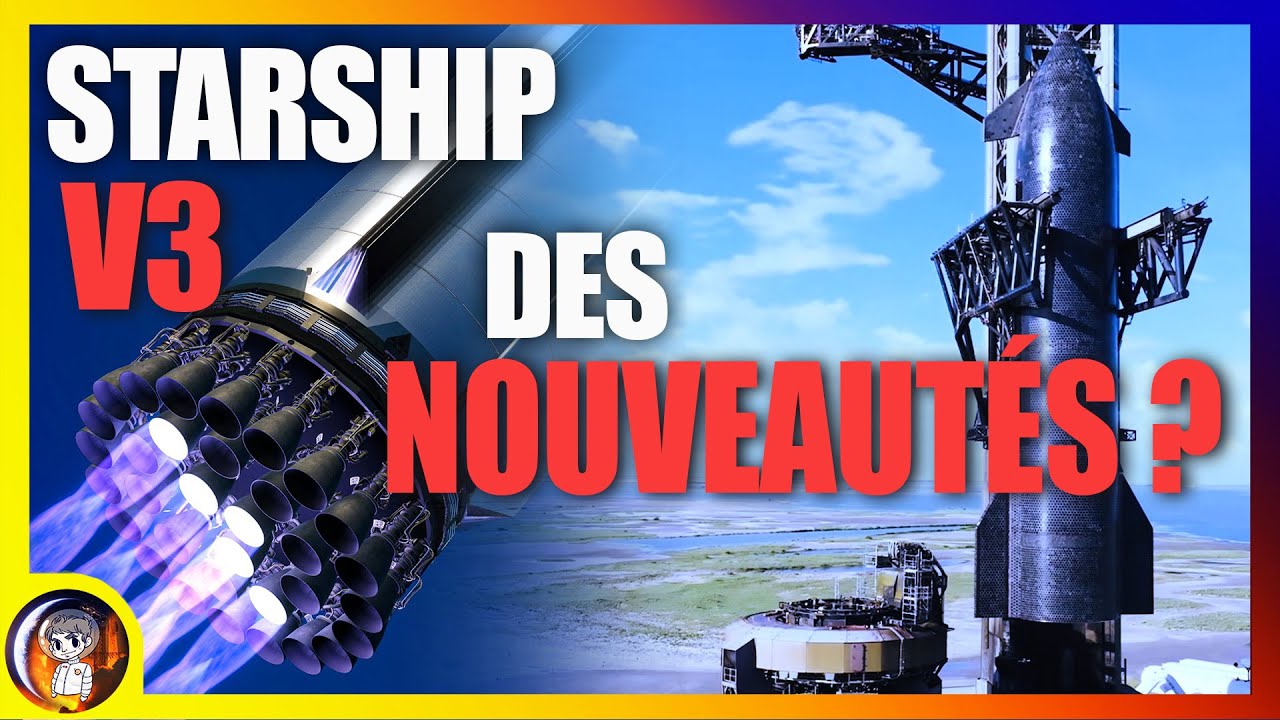
STARSHIP V3 : Anatomie d’un MONSTRE ! - Le Journal de la Starbase #302 - Le JDE
Keywords
Summary
208 words
Critical Evaluation
Value of the Information & Strength of the Argument
The video provides valuable, in-depth technical analysis of the Starship V3 booster’s aft section, a topic with limited official information. It synthesizes observations from various sources, particularly Space_Crab, and explains the function of components like common manifolds and autogenous pressurization systems. The argumentation is logical and well-structured, moving from specific components to a broader assessment of the V3’s changes. The presenter is careful to distinguish between confirmed facts and hypotheses, which strengthens the credibility of the analysis. However, the video does not critically evaluate the sources or consider alternative interpretations, and the lack of official confirmation for many details is a limitation.
Scientific Rigor, Source Quality, Title Accuracy
The video relies on a mix of official SpaceX communications (e.g., the launch date announcement) and unofficial observations from space enthusiasts (e.g., Space_Crab, LabPadre). The presenter clearly attributes information to these sources and acknowledges when details are speculative. The title accurately reflects the content, which is a detailed examination of the V3 booster’s anatomy. The video does not cite peer-reviewed scientific literature, but it is a news/analysis format where such citations are not expected. The overall rigor is adequate for the genre, but the reliance on unverified hypotheses prevents a higher score.
209 words
Title / Content Match
The title accurately reflects the content, which focuses on the anatomy of the Starship V3 booster, particularly its aft section.
Quality & Reliability
7/10
The video provides a detailed technical analysis of the Starship V3 booster's aft section, based on observations and hypotheses from space enthusiasts (Space_Crab) and official SpaceX communications. The information is presented with appropriate caveats about uncertainty, but the lack of official confirmation for many details limits the overall reliability.
Key Moments
Markers derived by PSI from the transcript: the creator did not define chapters.
- Introduction and overview of the episode's topics.
- Report on the 11th flight launch date and mission overview.
- Details on the booster B15.2's engine re-ignition sequence.
- Details on the ship S38's mission, including intentional heat shield tile removal.
- Introduction to the analysis of the V3 booster's aft section.
- Explanation of the common manifolds for methane and oxygen.
- Discussion of the rectangular boxes and potential data/power conduits.
- Comparison of V3 aft section with previous versions and summary of key changes.
Cited Sources
- Space_Crab (@Space_Crab_08) on X — Source of the detailed analysis of the V3 aft section, including the common manifolds and other components.
- Listing of subscriber questions and answers (JDE PDF) — Referenced as a recap table of subscriber questions for the Starbase Journal.
- LabPadre on X — Source of images and videos of the Starbase, including the V3 booster's integration.
- Marcus House on YouTube — Source of an animation showing the integration of a new tank into the B18 booster.
- SpaceX official website — Referenced for the mission overview and launch date announcement for the 11th flight.
Concurring Sources
- LabPadre on X — Provides visual evidence of the V3 booster's integration and the new tank, consistent with the video's analysis.
- SpaceX official website — Confirms the launch date and mission objectives for the 11th flight, aligning with the video's report.
Dissenting Sources
- No discordant sources identified — The video's analysis is based on hypotheses and observations, and no conflicting information was presented.
External References
Contribution & Novelties
The video provides a detailed, up-to-date analysis of the Starship V3 booster’s aft section, synthesizing recent observations and hypotheses. It explains the function of common manifolds, autogenous pressurization, and other components, offering a clear technical breakdown that is not widely available in mainstream media. The comparison with previous versions highlights the evolutionary nature of the V3 design, focusing on reusability and maintenance improvements.
Pour aller plus loin :
- Starship (spacecraft) - Wikipedia — Provides general background on the Starship vehicle and its development.
- Autogenous pressurization - Wikipedia — Explains the concept of autogenous pressurization used in the booster’s propulsion system.
- Raptor (rocket engine) - Wikipedia — Details on the Raptor engines used in the Starship system.
- Hot staging - Wikipedia — Explains the hot staging separation technique used in the Starship design.
132 words
Radar Profile
The radar profile shows high scores in information quantity, technical level, and moderate scores in information quality and reliability. This indicates a technically dense and informative video, but with some limitations in source verification and overall reliability due to the speculative nature of the analysis.
💬 Sur les 0 commentaires analysés, aucune tendance n'a pu être dégagée.