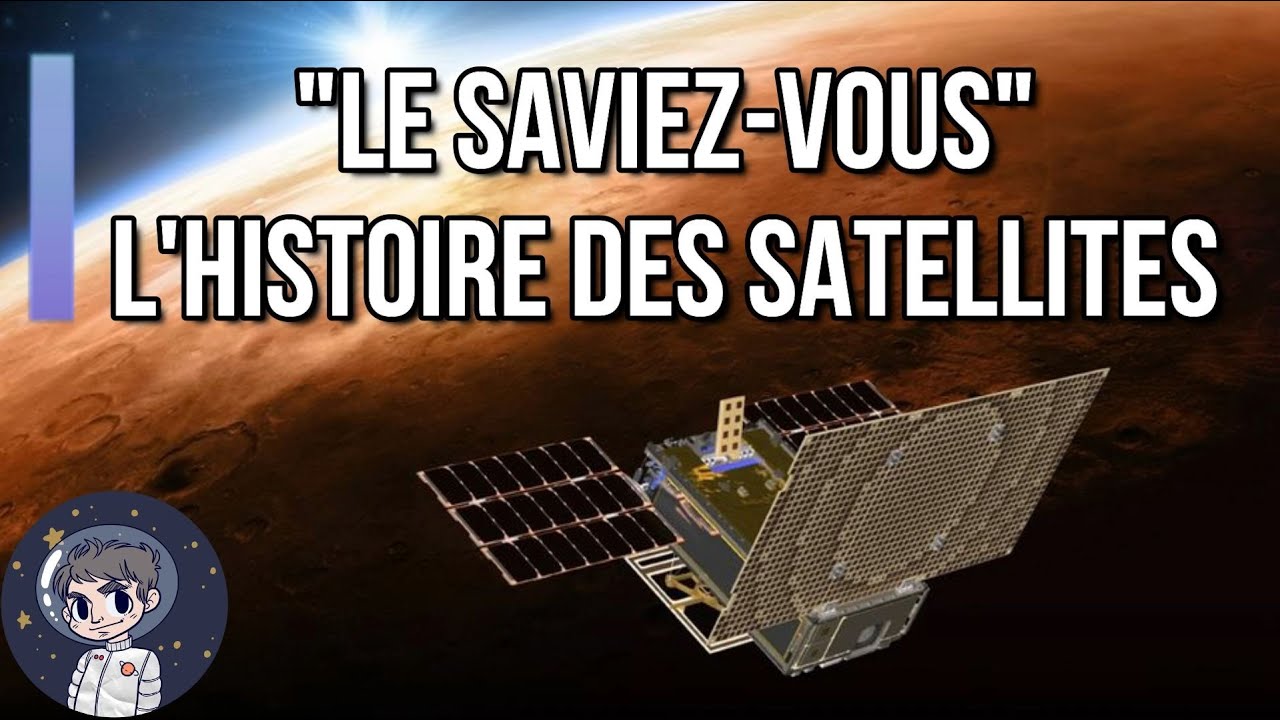
"Le Saviez Vous": L'Histoire des Satellites - Le Journal de l'Espace LSV#3 - Culture Spatiale
Keywords
Summary
157 words
Critical Evaluation
Value of the Information & Strength of the Argument
The video provides a solid, informative overview of satellite history and technology. It effectively explains complex concepts like orbital mechanics in an accessible manner, using clear examples and visuals. The argumentation is coherent, tracing the evolution from military to civilian applications. The inclusion of specific historical events and technological milestones adds depth. However, the video does not delve into potential downsides or controversies, such as space debris or the militarization of space, which could have provided a more balanced perspective.
Scientific Rigor, Source Quality, Title Accuracy
The video demonstrates a good level of scientific rigor, with accurate explanations of orbital physics and satellite functions. It references reputable organizations like NASA, ESA, and CNES, and uses archival footage and 3D simulations. However, specific claims are not individually cited, and the video relies on general knowledge rather than detailed sources. The title accurately reflects the content, which is a historical and educational overview of satellites. The video’s structure is clear, with chapters indicated in the description, aiding navigation.
175 words
Title / Content Match
The title accurately reflects the content, which is a historical and educational overview of satellites.
Quality & Reliability
7/10
The video provides a well-structured historical overview of satellites, with accurate technical explanations of orbital mechanics and satellite types. It references credible sources (NASA, ESA, CNES) and uses archival footage. However, it lacks explicit citations for specific claims and does not discuss potential controversies or failures in detail.
Key Moments
Markers derived by PSI from the transcript: the creator did not define chapters.
- Definition of a satellite and types of orbits
- Explanation of why satellites don't fall back to Earth
- Historical context: Cold War and the race for rockets
- Launch of Sputnik 1 and its impact
- Scientific satellites and their uses
- Earth observation satellites and their applications
- Telecommunication satellites and their role in globalization
- Miniaturization of satellites: CubeSats and future trends
Cited Sources
- Forum de la conquête spatiale — Mentioned as a source for space exploration discussions.
- Scott Buckley Music — Music used in the video.
- Utho Riley Music — Music used in the video.
- Sound Lapse - City Walk — Music used in the video.
- Jamendo - Inspire Galactic — Music used in the video.
- Bensound - Evolution — Music used in the video.
- Sound Lapse - City Walk (YouTube) — Music used in the video.
Concurring Sources
- NASA History - Sputnik — NASA's official history page on Sputnik, corroborating the video's account.
- ESA - Copernicus — ESA's page on the Copernicus program, mentioned in the video for Earth observation.
External References
Contribution & Novelties
The video provides a concise and engaging synthesis of satellite history, making it accessible to a broad audience. It effectively connects historical events to modern applications, highlighting the evolution of satellite technology. The use of archival footage and clear explanations adds educational value.
Pour aller plus loin :
- Sputnik 1 - Wikipedia — For more details on the first artificial satellite.
- Orbital mechanics - Wikipedia — To understand the physics behind satellite orbits.
- CubeSat - Wikipedia — For information on miniaturized satellites.
82 words
Radar Profile
The radar profile shows high scores in information quantity and quality, indicating a content-rich video with reliable information. The technical level is moderate, suitable for a general audience. The overall reliability is good, but could be improved with more explicit citations.
💬 Très positif. Sur les 30 commentaires analysés, les spectateurs expriment un enthousiasme marqué pour le format et la qualité pédagogique, avec des demandes de sujets similaires.