Teo dia2 parte 2
Keywords
Summary
205 words
Critical Evaluation
Value of the Information & Strength of the Argument
The video provides valuable insights into handling heteroscedasticity in ANOVA, a common issue in ecological data. The instructor uses a real case study, making the content practical and relatable. The argumentation is solid, clearly explaining the statistical concepts and the rationale for modeling variance instead of transforming data. The biological interpretation of variance is emphasized, which adds depth to the statistical discussion. The presentation is well-structured, building from basic ANOVA assumptions to advanced variance modeling techniques.
Scientific Rigor, Source Quality, Title Accuracy
The scientific rigor is high for a lecture: the instructor demonstrates a deep understanding of statistical methods and their application. However, no formal sources are cited in the video or description, relying instead on the instructor’s expertise and the case study. The title is vague and does not convey the specific topic, but it is part of a series. The content is consistent with standard statistical practices, and the instructor acknowledges limitations and assumptions, showing critical thinking.
168 words
Title / Content Match
The title is generic and does not reflect the specific content about modeling variance in an ecological study, but it is part of a series.
Quality & Reliability
8/10
The video is an academic lecture from a university course, presenting a real case study with clear methodological explanations. The instructor demonstrates expertise in statistics and ecology, and the content is consistent with standard statistical practices. However, it is not peer-reviewed and lacks formal citations.
Key Moments
Markers derived by PSI from the transcript: the creator did not define chapters.
- Introduction to the lecture on modeling variance.
- Presentation of the case study: rats as bioindicators of lead contamination in Buenos Aires.
- Description of the four environments and the dataset of 143 rats.
- Discussion of observational study design and independence assumptions.
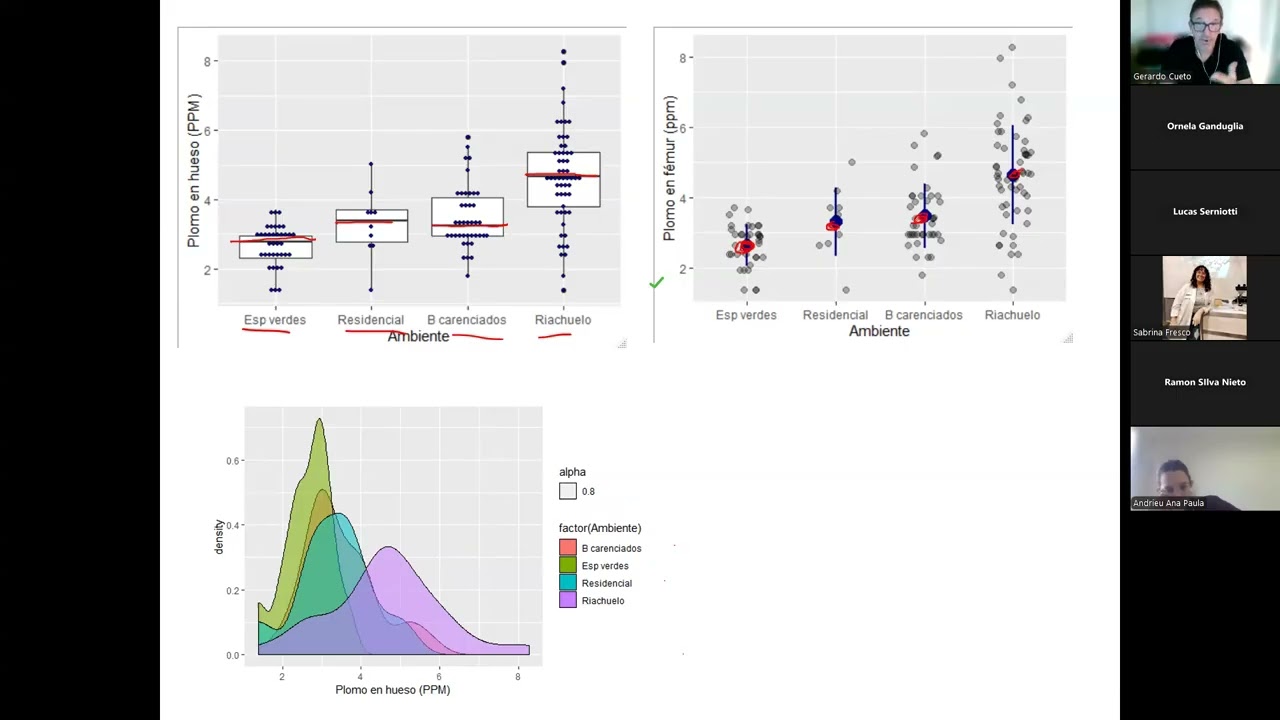
- Exploratory data analysis: boxplots and density plots showing heteroscedasticity.
- Introduction to ANOVA and its assumptions.
- Diagnostic plots: residuals vs fitted, Levene's test, Shapiro test.
- Discussion of traditional data transformation and its drawbacks.
- Introduction to modeling variance: variance functions.
- Detailed explanation of varIdent, varExp, and varPower functions.
Contribution & Novelties
The video offers a clear pedagogical approach to modeling heteroscedasticity in ANOVA, using a real ecological dataset. It contrasts traditional data transformation with modern variance modeling, emphasizing the biological interpretability of variance. The lecture is particularly valuable for students and researchers in ecology and biology who encounter heteroscedastic data.
Pour aller plus loin :
- Generalized least squares — Provides background on the estimation method used for modeling variance.
- Levene’s test — The test mentioned for checking homogeneity of variances.
- Shapiro–Wilk test — The normality test referenced in the lecture.
- nlme package in R — The R package commonly used for fitting such variance models.
104 words
Radar Profile
The radar profile shows high scores in quantity and quality of information, with a moderate technical level. This indicates a well-structured lecture that provides substantial content and reliable explanations, though it may require some statistical background to fully appreciate.