TP dia 3 DBA y DMR
Keywords
Summary
127 words
Critical Evaluation
Value of the Information & Strength of the Argument
The video provides valuable insights into the application of mixed models in biological research. The instructors clearly explain the rationale behind using random effects and demonstrate their implementation in R. The argumentation is solid, as they systematically address model assumptions, hypothesis testing, and interpretation of results. They also engage with student questions, clarifying potential misunderstandings. The practical coding examples enhance the learning experience, making the content highly applicable for students.
Scientific Rigor, Source Quality, Title Accuracy
The scientific rigor is high, as the instructors follow standard statistical procedures and emphasize the importance of checking assumptions. The sources are primarily the course materials and R packages, which are appropriate for the educational context. The title accurately reflects the content, focusing on the practical session on mixed models. The video does not cite external literature, but it is consistent with established statistical methods.
150 words
Title / Content Match
The title is concise and accurately reflects the content: a practical session on mixed models (DBA and DMR) in biostatistics.
Quality & Reliability
8/10
The video is a university tutorial on mixed models in biostatistics, presented by instructors with clear expertise. It provides step-by-step code demonstrations and explanations of statistical concepts. The content is consistent with standard statistical methodology, though it is not peer-reviewed and is intended for educational purposes.
Key Moments
Markers derived by PSI from the transcript: the creator did not define chapters.
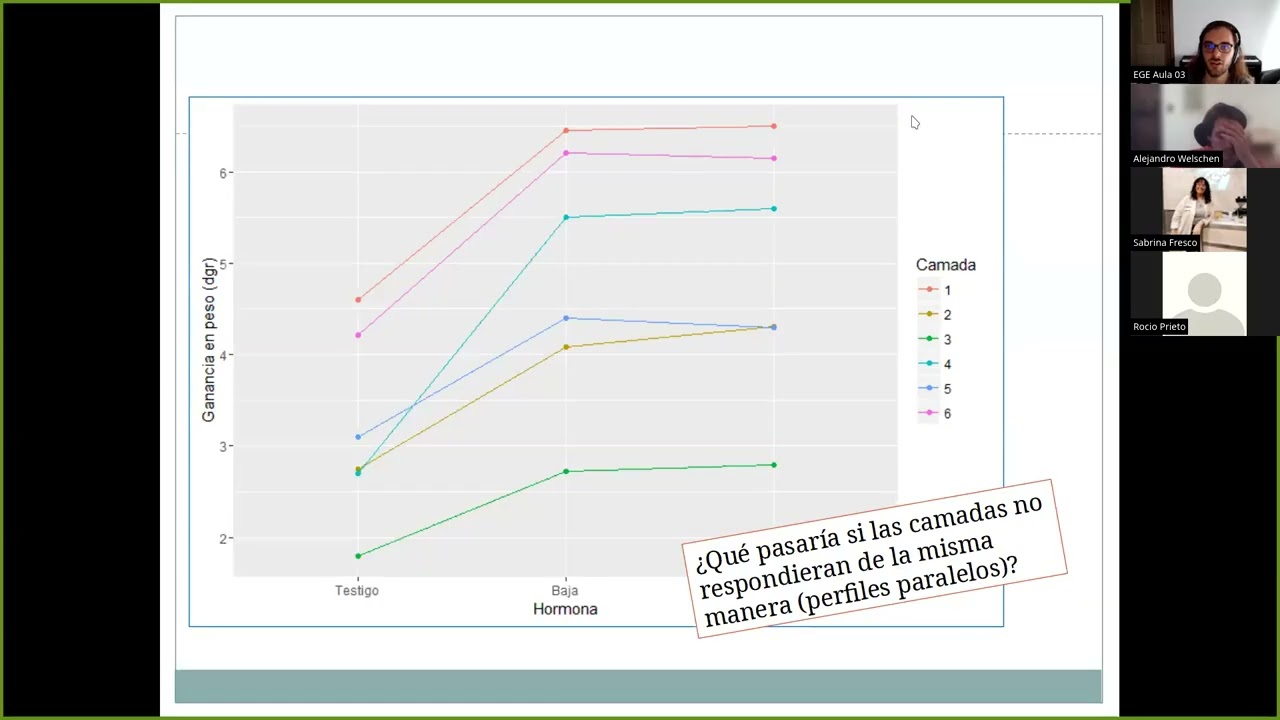
- Introduction and overview of the problem on growth hormone in rats.
- Discussion of experimental design: experimental vs observational, unit, response variable.
- Explanation of fixed and random effects, and the concept of blocking by litter.
- Model formulation in regression format and assumptions for random effects.
- Running code in R: loading data, descriptive analysis, and checking assumptions.
- Troubleshooting common R issues, such as function conflicts and package installation.
- Testing fixed effects using likelihood ratio test and obtaining p-values.
- Post-hoc comparisons to determine which treatment levels differ.
- Analysis of variance components and calculation of intraclass correlation coefficient.
- Discussion of the importance of random effects and implications for the experiment.
Cited Sources
- Course materials and R scripts — The instructors refer to course materials and R scripts provided to students, which are not publicly available.
Concurring Sources
- Mixed model - Wikipedia — Provides general information on mixed models, consistent with the video's content.
- Intraclass correlation - Wikipedia — Explains the concept of ICC, which is discussed in the video.
Contribution & Novelties
The video offers a practical, hands-on approach to teaching mixed models, which is often challenging for students. It bridges the gap between theory and application by providing detailed R code and real-time troubleshooting. The emphasis on variance components and ICC provides a deeper understanding of random effects.
Pour aller plus loin :
- Mixed model — Overview of mixed models, including fixed and random effects.
- Intraclass correlation coefficient — Explanation of ICC and its role in mixed models.
- R lme4 package — Official documentation for the lme4 package used in the video.
91 words
Radar Profile
The radar profile shows high scores in information quantity, quality, and reliability, with a slightly lower technical level, indicating a well-balanced educational resource that is both informative and accessible.
💬 No comments were provided for analysis.